Short Communication - (2025) Volume 15, Issue 6
Received: 02-Dec-2025, Manuscript No. jeat-26-188660;
Editor assigned: 04-Dec-2025, Pre QC No. P-188660;
Reviewed: 18-Dec-2025, QC No. Q-188660;
Revised: 23-Dec-2025, Manuscript No. R-188660;
Published:
30-Dec-2025
, DOI: 10.37421/2161-0525.2025.15.880
Citation: Youssef, Hassan Ben. ”Advances In Environmental
Chemical Exposure Analysis.” J Environ Anal Toxicol 15 (2025):880.
Copyright: © 2025 Youssef B. Hassan This is an open-access article distributed under the terms of the Creative Commons Attribution License, which permits unrestricted use,
distribution and reproduction in any medium, provided the original author and source are credited.
The assessment of human exposure to environmental chemicals is a critical undertaking for safeguarding public health and the environment. Analytical methodologies have undergone significant evolution, transitioning from traditional biomonitoring techniques to sophisticated omics technologies that offer deeper insights into dose-response relationships and the identification of susceptible populations. These advanced approaches are indispensable for understanding the intricate pathways of chemical exposure and their biological consequences. The measurement of external and internal exposure, across diverse matrices such as air, water, food, and biological samples, necessitates integrated strategies for a comprehensive risk evaluation [1].
In the realm of water quality, the precise determination of chemical contaminants is paramount. A novel approach for the simultaneous quantification of multiple per- and polyfluoroalkyl substances (PFAS) in drinking water has been developed, employing liquid chromatography coupled with tandem mass spectrometry (LC-MS/MS). This method's high sensitivity and selectivity are crucial for accurately identifying both legacy and emerging PFAS, thereby enabling a more robust assessment of public health risks associated with contaminated water sources [2].
Indoor air quality poses unique challenges for exposure assessment due to the variety of volatile organic compounds (VOCs) present. An advanced analytical strategy utilizing thermal desorption-gas chromatography-mass spectrometry (TD-GC-MS) has been introduced for the identification and quantification of these indoor air pollutants. This technique is vital for understanding residential exposure levels and the associated health impacts of common VOCs [3].
The emergence of previously unrecognized environmental chemicals necessitates advanced analytical tools for their detection. High-resolution mass spectrometry (HRMS) has proven to be exceptionally powerful for non-target screening of these emerging contaminants in various environmental matrices. HRMS offers significant advantages in identifying unknown pollutants and characterizing complex mixtures, thereby enhancing the capacity for risk assessment of novel environmental agents [4].
Assessing long-term exposure to airborne pollutants requires reliable sampling methods. The application of passive sampling devices for the evaluation of long-term exposure to polycyclic aromatic hydrocarbons (PAHs) in urban air has been investigated. These devices provide time-weighted average concentrations, offering a more representative measure of exposure compared to conventional active sampling techniques, which can be limited by temporal variability [5].
Biomonitoring of environmental chemical exposure is being revolutionized by omics technologies, particularly metabolomics. Changes in metabolic profiles can serve as sensitive indicators of exposure and early biological effects. This approach provides invaluable insights into the underlying mechanisms of toxicity, allowing for a more nuanced understanding of how environmental chemicals impact biological systems [6].
The presence of microplastics in food represents a growing concern for human health. The development and validation of analytical methods for identifying and quantifying microplastics in food samples are crucial. Fourier-transform infrared (FTIR) spectroscopy has emerged as a key technique for this purpose, enabling the assessment of human exposure through dietary intake [7].
Real-time monitoring of environmental contaminants is essential for rapid risk assessment and response. Biosensor technology holds significant promise in this area, offering the potential for rapid, sensitive, and cost-effective detection of pollutants. This facilitates immediate environmental monitoring and enables quicker interventions when contamination events occur [8].
Ensuring food safety from pesticide residues is a global priority. A review of recent advancements in analytical techniques for pesticide residue analysis in food highlights the ongoing challenges and future directions. The development of sensitive and selective methods is crucial for protecting consumer health from pesticide exposure and maintaining the integrity of the food supply chain [9].
Endocrine-disrupting chemicals (EDCs) pose a significant threat to environmental and public health. The development of comprehensive analytical methods for their detection in complex environmental matrices is vital. Liquid chromatography coupled with high-resolution mass spectrometry (LC-HRMS) has enabled the detection of a wide range of EDCs at low concentrations, which is critical for effective environmental risk assessment and public health protection [10].
The scientific community is increasingly focused on developing sophisticated analytical methodologies for evaluating human exposure to environmental chemicals. A significant advancement lies in the evolution from traditional biomonitoring to the utilization of advanced omics technologies. These technologies play a pivotal role in understanding dose-response relationships and identifying populations that may be particularly susceptible to chemical insults. The comprehensive evaluation of exposure requires techniques capable of measuring both external and internal exposure levels across various environmental and biological matrices. This holistic approach is fundamental for accurate risk assessment [1].
Within the context of water safety, the accurate and simultaneous determination of multiple chemical contaminants is of utmost importance. A novel method has been presented for the simultaneous quantification of per- and polyfluoroalkyl substances (PFAS) in drinking water, leveraging the power of liquid chromatography coupled with tandem mass spectrometry (LC-MS/MS). This technique's inherent sensitivity and selectivity are critical for the precise assessment of both legacy and emerging PFAS, thereby informing public health strategies related to contaminated water resources [2].
Investigating the composition of indoor air is essential for understanding potential health risks associated with residential environments. An advanced analytical strategy has been introduced for the identification and quantification of volatile organic compounds (VOCs) in indoor air. This approach employs a combination of thermal desorption-gas chromatography-mass spectrometry (TD-GC-MS), a method vital for characterizing indoor air quality and assessing the health implications of exposure to common VOC pollutants found in homes [3].
The identification and quantification of emerging contaminants, particularly those previously unknown, present a significant analytical challenge. High-resolution mass spectrometry (HRMS) offers a powerful solution for non-target screening of these substances in environmental samples. The advantages of HRMS in identifying unknown pollutants and providing detailed characterization of complex mixtures are indispensable for expanding our understanding of risks posed by novel environmental chemicals [4].
For substances like polycyclic aromatic hydrocarbons (PAHs), understanding long-term exposure patterns is crucial. Passive sampling devices have demonstrated their utility in assessing chronic exposure to PAHs in urban air. By providing time-weighted average concentrations, these devices offer a more representative measure of exposure over extended periods compared to traditional active sampling methods, which may capture only transient peaks [5].
Biomonitoring strategies are being enhanced through the integration of omics technologies, specifically metabolomics. By analyzing changes in metabolic profiles, researchers can identify sensitive biomarkers of exposure and early biological effects. This allows for a deeper understanding of the mechanisms of toxicity induced by environmental chemicals, offering a more refined approach to health risk assessment [6].
The presence of microplastics in food products is a growing concern for human health. The development and validation of robust analytical methods for the identification and quantification of microplastics in food are therefore critical. Fourier-transform infrared (FTIR) spectroscopy has emerged as a key technique, enabling the assessment of human exposure to microplastics through dietary consumption [7].
Real-time monitoring of environmental contaminants is crucial for immediate risk assessment and timely response. Biosensor technology is a promising avenue for achieving this goal. Its potential to provide rapid, sensitive, and cost-effective detection of pollutants can significantly improve environmental monitoring capabilities and facilitate prompt mitigation efforts [8].
Ensuring food safety involves rigorous analysis for pesticide residues. A review of recent advancements in analytical techniques for pesticide residue analysis in food highlights the continuous efforts to develop highly sensitive and selective methods. These advancements are vital for protecting consumer health and maintaining the safety of the global food supply [9].
Endocrine-disrupting chemicals (EDCs) represent a significant environmental and public health threat. The development of effective analytical methods for their detection in complex environmental water samples is essential. Liquid chromatography coupled with high-resolution mass spectrometry (LC-HRMS) offers the capability to detect a broad spectrum of EDCs at low concentrations, which is imperative for informed environmental risk assessment and public health protection [10].
This collection of research highlights advancements in analytical techniques for assessing environmental chemical exposure. Studies cover sophisticated methods for measuring chemicals in air, water, and food, including omics technologies, LC-MS/MS, TD-GC-MS, HRMS, passive sampling, FTIR spectroscopy, biosensors, and methods for pesticide and endocrine-disrupting chemical analysis. These advancements are crucial for understanding dose-response relationships, identifying susceptible populations, and informing public health and environmental risk assessments.
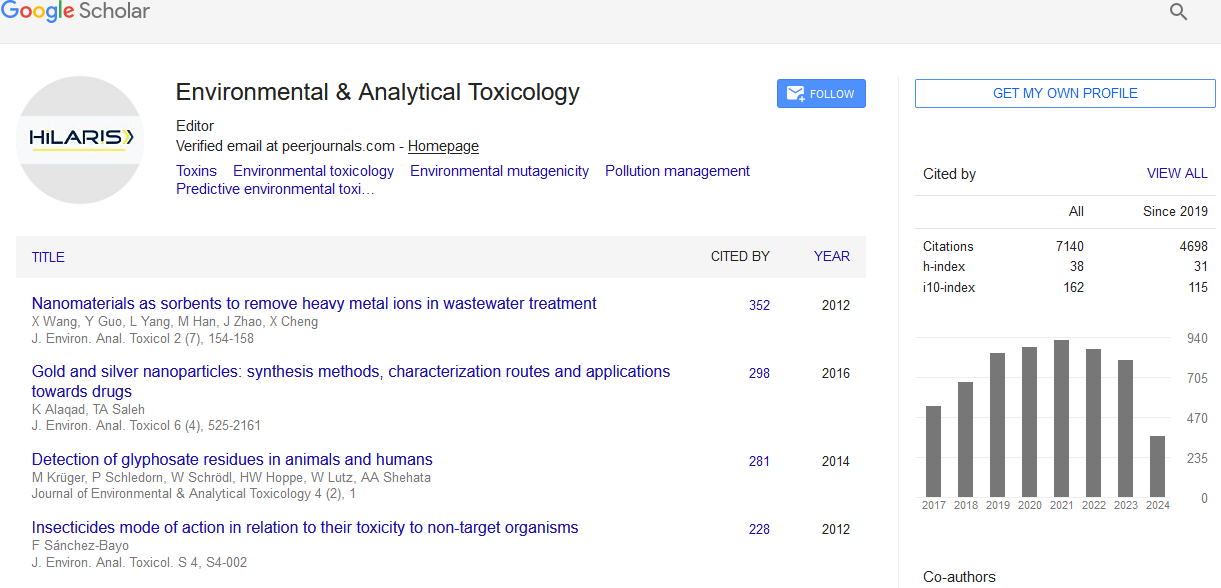
Environmental & Analytical Toxicology received 6818 citations as per Google Scholar report