Opinion - (2025) Volume 14, Issue 3
Received: 01-Jun-2025, Manuscript No. jme-26-185207;
Editor assigned: 03-Jun-2025, Pre QC No. P-185207;
Reviewed: 17-Jun-2025, QC No. Q-185207;
Revised: 23-Jun-2025, Manuscript No. R-185207;
Published:
30-Jun-2025
, DOI: 10.37421/2169-0022.2025.14.725
Citation: Rahman, Khalid. ”Advancements In Thermoelectric
Materials For Energy Conversion.” J Material Sci Eng 14 (2025):725.
Copyright: © 2025 Rahman K. This is an open-access article distributed under the terms of the Creative Commons Attribution License, which permits unrestricted use,
distribution and reproduction in any medium, provided the original author and source are credited.
The field of thermoelectric materials is experiencing significant advancements, driven by the critical need for efficient solid-state energy conversion and cooling technologies. Recent research has focused on optimizing various material classes to enhance their thermoelectric performance. This includes in-depth studies on oxides, skutterudites, and chalcogenides, exploring their unique properties and the sophisticated strategies employed to boost their thermoelectric figure of merit (ZT). Techniques such as nanostructuring and doping are crucial for simultaneously improving the power factor and reducing thermal conductivity, thereby achieving higher ZT values, which is essential for practical energy harvesting and cooling applications [1].
The exploration of novel inorganic thermoelectric materials continues to be a vital area of research, with a systematic investigation into new compound classes designed for improved efficiency. A key aspect of this research is understanding the intricate interplay between microstructure and thermoelectric properties, demonstrating how controlled synthesis directly influences the ZT value. Optimizing carrier concentration and understanding scattering mechanisms are paramount for enhancing electrical conductivity and the Seebeck coefficient. Simultaneously, strategies for reducing lattice thermal conductivity through alloying and defect engineering are being pursued to develop cost-effective, high-performance thermoelectric generators [2].
Significant progress has been made in bismuth telluride-based thermoelectric materials, which are foundational for near-room-temperature applications. Research efforts are concentrated on enhancing their thermoelectric performance through advanced nanostructuring and alloying techniques. A primary focus is the effective reduction of thermal conductivity without compromising electrical properties. Analyzing the impact of various processing techniques on material microstructure and its correlation with the ZT is providing valuable insights into optimizing these materials for efficient waste heat recovery and solid-state cooling devices [3].
The development of efficient thermoelectric modules for waste heat recovery is a critical objective, encompassing a wide range of material systems. This includes oxides, intermetallics, and organic semiconductors, with a detailed examination of the key parameters governing their thermoelectric efficiency, particularly the figure of merit (ZT). Strategies for optimizing these materials at both atomic and microstructural levels, such as doping, alloying, and nanostructuring, are being explored to enhance power factor and reduce thermal conductivity. The challenges related to scalability, cost, and long-term stability for practical applications remain important considerations [4].
As the demand for sustainable energy solutions grows, the development of lead-free thermoelectric materials is gaining considerable attention. These materials offer environmentally friendly alternatives for energy conversion. Investigations focus on specific compound classes, analyzing the correlation between crystal structure, electronic band structure, and thermoelectric transport properties. Compositional tuning and defect engineering are demonstrated as effective methods to improve the power factor and reduce lattice thermal conductivity, leading to higher ZT values, which is crucial for developing green thermoelectric devices that can harness waste heat [5].
Oxide thermoelectric materials are attracting significant interest due to their superior stability at high temperatures compared to traditional telluride compounds. Research in this area centers on enhancing their thermoelectric performance through targeted doping, carrier control, and microstructural engineering. The focus is on optimizing the Seebeck coefficient and electrical conductivity while simultaneously reducing thermal conductivity through effective phonon scattering mechanisms. These advancements are vital for thermoelectric power generation applications that operate under demanding high-temperature conditions [6].
Skutterudite compounds are recognized as highly promising thermoelectric materials owing to their tunable electronic properties and inherently low lattice thermal conductivity. Research efforts are directed towards exploring various filling strategies and alloying compositions to optimize their thermoelectric figure of merit (ZT). Detailed studies are investigating the relationship between nanoscale disorder, phonon scattering, and thermoelectric transport. These investigations are contributing to the development of efficient thermoelectric generators suitable for mid-range temperature applications [7].
The advancement of organic thermoelectric materials is crucial for the development of flexible and wearable energy harvesting devices. Research in this domain involves diverse molecular designs and processing techniques aimed at enhancing the power factor and reducing the thermal conductivity of these materials. Emphasis is placed on understanding charge transport mechanisms and phonon scattering phenomena to achieve high thermoelectric performance. Overcoming challenges related to stability and scalability is essential for their widespread practical application [8].
Nanostructuring strategies are being extensively explored to improve the thermoelectric performance of a broad range of materials, primarily by reducing thermal conductivity. A key focus is on the impact of grain boundaries, interfaces, and point defects on phonon transport and their subsequent influence on the thermoelectric figure of merit (ZT). The research presents examples of how various nanomaterials and processing techniques can effectively scatter phonons without significantly degrading electrical transport properties, thereby paving the way for more efficient energy conversion devices [9].
Band structure engineering represents a powerful approach for optimizing thermoelectric materials. Researchers are demonstrating how manipulating the electronic band structure, through techniques such as alloying and strain engineering, can lead to an enhanced Seebeck coefficient and power factor without compromising electrical conductivity. Both theoretical and experimental evidence confirms the effectiveness of these approaches in improving the overall thermoelectric figure of merit (ZT) for diverse material systems, contributing to the design of more efficient thermoelectric generators and coolers [10].
The scientific community is actively pursuing advancements in thermoelectric materials, with a particular emphasis on enhancing efficiency for energy conversion and cooling applications. Key material classes such as oxides, skutterudites, and chalcogenides are under intense scrutiny. Researchers are employing sophisticated methods, including nanostructuring and doping, to optimize the power factor and minimize thermal conductivity. The ultimate goal is to achieve higher figures of merit (ZT), which are critical for the practical implementation of thermoelectric devices in energy harvesting and solid-state cooling [1].
The development of novel inorganic thermoelectric materials is a central theme in current research, focusing on systematic investigations of new compound families designed for superior efficiency. A significant aspect involves understanding the complex relationship between the material's microstructure and its thermoelectric characteristics, showcasing how controlled synthesis can lead to substantial improvements in ZT values. The optimization of carrier concentration and the detailed study of scattering mechanisms are crucial for enhancing electrical conductivity and the Seebeck coefficient. Concurrently, strategies such as alloying and defect engineering are being utilized to reduce lattice thermal conductivity, driving the development of cost-effective and high-performance thermoelectric generators [2].
Substantial progress has been achieved in the field of bismuth telluride-based thermoelectric materials, which are essential for applications operating near room temperature. Current research efforts are dedicated to improving their thermoelectric performance through advanced nanostructuring and alloying techniques. A primary objective is the effective reduction of thermal conductivity while ensuring that electrical properties are not adversely affected. Through detailed analysis of how various processing methods influence material microstructure and its subsequent impact on the thermoelectric figure of merit (ZT), valuable insights are being gained for the optimization of these materials for efficient waste heat recovery and solid-state cooling applications [3].
The creation of efficient thermoelectric modules for waste heat recovery is a key objective, addressing a variety of material systems, including oxides, intermetallics, and organic semiconductors. The research critically examines the fundamental parameters that govern the thermoelectric efficiency of these materials, with a strong focus on the figure of merit (ZT). Strategies for optimizing these materials at both the atomic and microstructural levels are being explored. These include doping, alloying, and nanostructuring, aimed at boosting the power factor and reducing thermal conductivity. Despite these advancements, challenges related to scalability, cost-effectiveness, and long-term material stability for practical deployment remain important areas of investigation [4].
In response to the growing demand for sustainable energy technologies, the development of lead-free thermoelectric materials is becoming increasingly important. These materials present a more environmentally friendly alternative for energy conversion applications. The research focuses on specific classes of compounds, analyzing the intricate correlations between their crystal structure, electronic band structure, and thermoelectric transport behavior. Compositional modification and defect engineering are demonstrated as powerful tools for significantly improving the power factor and reducing lattice thermal conductivity, thereby achieving higher ZT values. This work is vital for the advancement of eco-friendly thermoelectric devices capable of efficiently capturing waste heat [5].
Oxide thermoelectric materials are gaining attention due to their inherent advantage of superior stability at elevated temperatures when compared to conventional telluride materials. The current research endeavors are focused on enhancing their thermoelectric performance through strategic doping, precise carrier control, and advanced microstructural engineering. The primary aim is to optimize both the Seebeck coefficient and electrical conductivity, while simultaneously reducing thermal conductivity by employing effective phonon scattering mechanisms. The findings derived from these studies are crucial for the development and application of thermoelectric power generation systems that are required to operate under demanding high-temperature conditions [6].
Skutterudite compounds are recognized as highly promising materials for thermoelectric applications, primarily due to their electronically tunable characteristics and intrinsically low lattice thermal conductivity. Research in this area involves exploring a variety of filling strategies and alloying compositions with the objective of optimizing their thermoelectric figure of merit (ZT). The studies provide detailed investigations into the relationship between nanoscale structural disorder, phonon scattering phenomena, and thermoelectric transport properties. These contributions are essential for the development of efficient thermoelectric generators that are well-suited for mid-range temperature applications [7].
The field of organic thermoelectric materials is witnessing significant advancements, particularly for their application in flexible and wearable energy harvesting devices. The research encompasses a diverse range of molecular designs and processing techniques that are employed to enhance the power factor and reduce the thermal conductivity of these materials. A critical aspect of this research involves understanding the fundamental charge transport mechanisms and phonon scattering processes that are key to achieving high thermoelectric performance. Nevertheless, overcoming challenges related to material stability and manufacturing scalability is paramount for their successful integration into practical applications [8].
Nanostructuring techniques are being extensively investigated as a means to enhance the thermoelectric performance of a wide array of materials, mainly through the reduction of thermal conductivity. A significant focus is placed on understanding the influence of structural features such as grain boundaries, interfaces, and point defects on phonon transport. This understanding is then used to ascertain their subsequent effect on the thermoelectric figure of merit (ZT). The research provides concrete examples of how different types of nanomaterials and various processing techniques can effectively scatter phonons without causing a substantial degradation of the electrical transport properties, thereby enabling the development of more efficient energy conversion devices [9].
Band structure engineering has emerged as a pivotal strategy for optimizing thermoelectric materials. Researchers are effectively demonstrating how the deliberate manipulation of the electronic band structure, utilizing techniques like alloying and strain engineering, can lead to a significant enhancement of the Seebeck coefficient and power factor. Crucially, these improvements are achieved without compromising the electrical conductivity of the material. The presentation of both theoretical and experimental evidence underscores the efficacy of these approaches in elevating the overall thermoelectric figure of merit (ZT) across various material systems, thereby contributing to the design and development of more efficient thermoelectric generators and coolers [10].
This collection of research highlights significant advancements in thermoelectric materials for energy conversion and cooling. Studies focus on optimizing various material classes, including oxides, skutterudites, chalcogenides, bismuth tellurides, and organic semiconductors, through techniques like nanostructuring, doping, alloying, and band structure engineering. The primary objective is to enhance the thermoelectric figure of merit (ZT) by increasing the power factor and reducing thermal conductivity. Research also addresses the development of lead-free and inorganic materials for sustainable applications and explores challenges related to scalability, cost, and stability for practical device implementation.
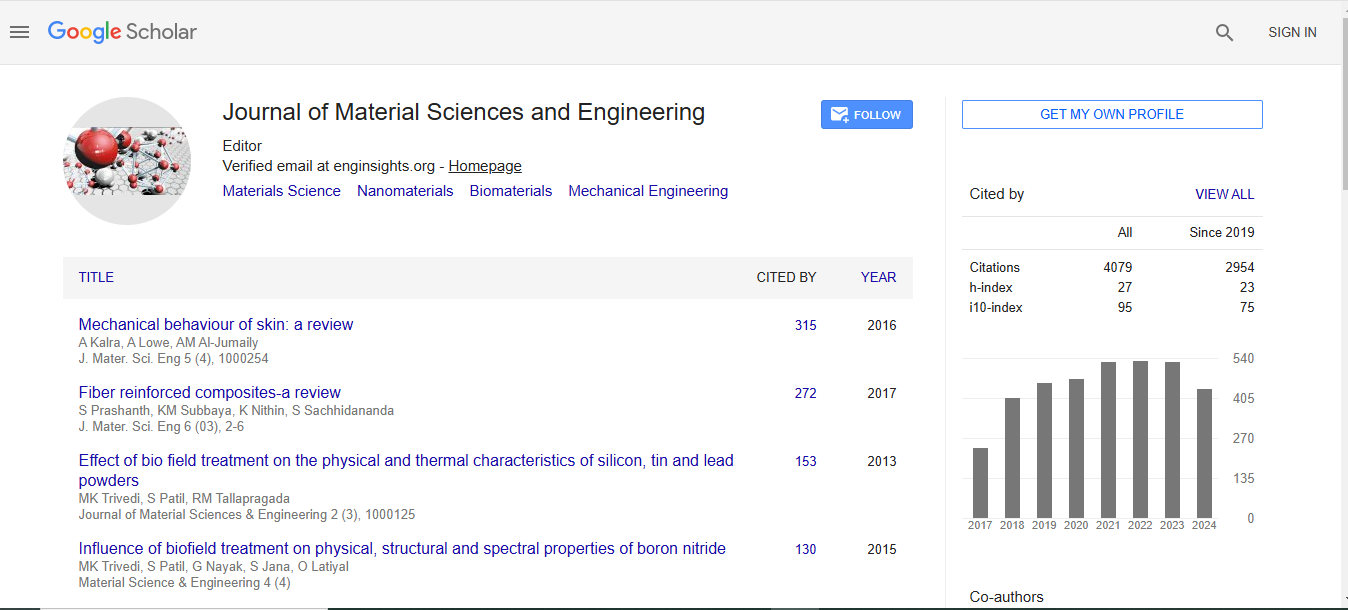
Journal of Material Sciences & Engineering received 3677 citations as per Google Scholar report