Brief Report - (2025) Volume 11, Issue 5
Received: 01-Sep-2025, Manuscript No. aso-25-184658;
Editor assigned: 03-Sep-2025, Pre QC No. P-184658;
Reviewed: 17-Sep-2025, QC No. Q-184658;
Revised: 22-Sep-2025, Manuscript No. R-184658;
Published:
29-Sep-2025
, DOI: 10.37421/2471-2671.2025.11.187
Citation: Matthews, John. ”Advancements in Surgical Oncology:
Precision, Minimally Invasive, and Personalized Care.” Arch Surg Oncol 11
(2025):187.
Copyright: © 2025 Matthews J. This is an open-access article distributed under the terms of the Creative Commons Attribution License, which permits unrestricted use,
distribution and reproduction in any medium, provided the original author and source are credited.
The field of surgical oncology is undergoing a profound transformation, driven by innovative techniques and a deeper understanding of cancer biology. Minimally invasive approaches, notably robotic surgery, are increasingly adopted for their precision and patient benefits [1].
These advancements are complemented by Enhanced Recovery After Surgery (ERAS) protocols, which streamline patient care pathways for optimal recovery [1].
The integration of molecular profiling into treatment strategies signifies a paradigm shift, moving towards personalized medicine where therapies are tailored to the specific biological characteristics of a patient's tumor [1].
This biologically informed approach aims to surpass the limitations of traditional anatomical resection and improve oncologic outcomes [1].
Multidisciplinary tumor boards play a pivotal role in this evolving landscape, ensuring comprehensive and collaborative patient management to optimize care [1].
The ongoing pursuit of improved oncologic outcomes remains a primary objective, with a concurrent focus on enhancing the patient's quality of life throughout their treatment journey [1].
The introduction of neoadjuvant therapies, including immunotherapy and targeted agents, is revolutionizing the management of numerous solid tumors, aiming to improve survival rates [2].
Optimizing the timing and combination of these systemic treatments with surgical intervention is a key area of research to maximize disease-free and overall survival [2].
However, challenges persist in accurately predicting treatment responses and managing potential toxicities in the perioperative setting [2].
Robotic-assisted surgery has firmly established itself as a cornerstone for complex oncologic procedures, offering unparalleled precision and visualization [3].
Procedures such as radical prostatectomy, colectomy, and pancreatectomy benefit significantly from robotic approaches, leading to reduced blood loss and faster recovery [3].
Precision medicine in surgical oncology hinges on sophisticated molecular diagnostics to guide therapeutic decisions effectively [4].
Genomic sequencing and liquid biopsies are instrumental in identifying optimal surgical candidates and predicting treatment responses [4].
The effective translation of these advanced diagnostics into routine clinical practice is crucial for accurate patient stratification and improved outcomes [4].
ERAS protocols are evidence-based multidisciplinary care plans designed to accelerate patient recovery and mitigate surgical stress [5].
Their implementation in major oncologic resections has demonstrated significant improvements in patient outcomes, including reduced complications and shorter hospital stays [5].
The synergistic potential of immunotherapy with surgical resection is a rapidly expanding area of investigation, particularly for advanced or metastatic disease [6].
Combining immune checkpoint inhibitors with surgical intervention offers promise for enhanced systemic control [6].
Careful management of immune-related adverse events in the perioperative period is essential for patient safety and treatment efficacy [6].
Advancements in minimally invasive surgical techniques, such as laparoscopic and endoscopic approaches, continue to refine cancer surgeries [7].
These techniques contribute to improved patient recovery, reduced postoperative pain, and minimized scarring [7].
Furthermore, innovations in surgical instrumentation and imaging are enhancing the safety and effectiveness of these procedures in complex oncological cases [7].
Multidisciplinary tumor boards are indispensable for comprehensive cancer care, fostering collaborative decision-making among a diverse group of specialists [8].
Evidence supports the effectiveness of these boards in refining diagnostic accuracy and treatment planning, ultimately improving patient outcomes [8].
Optimizing the function of tumor boards and integrating patient-specific factors are critical for maximizing their impact [8].
The application of artificial intelligence (AI) and machine learning (ML) in surgical oncology represents a burgeoning frontier with the potential to revolutionize patient care [9].
AI/ML tools can assist in preoperative diagnosis, provide intraoperative guidance, and predict postoperative outcomes with increasing accuracy [9].
These technologies hold promise for personalizing treatment strategies and enhancing surgical efficiency, alongside critical ethical considerations and data security measures [9].
The attainment of clear surgical margins is a paramount factor influencing oncologic outcomes, directly impacting local control and patient prognosis [10].
Intraoperative margin assessment techniques, including frozen section analysis and advanced imaging, are crucial for minimizing positive margins and avoiding the need for re-excision [10].
The practice of modern surgical oncology is characterized by significant advancements, particularly in the realm of minimally invasive techniques such as robotic surgery. These techniques, alongside Enhanced Recovery After Surgery (ERAS) protocols, are reshaping patient care by improving outcomes and facilitating faster recoveries [1].
A key development is the increasing integration of molecular profiling and personalized treatment strategies, which allow for a more biologically informed approach to cancer management beyond traditional anatomical considerations [1].
The crucial role of multidisciplinary tumor boards in optimizing patient care pathways and achieving better oncologic outcomes and quality of life is also highlighted [1].
The therapeutic landscape for solid tumors is being transformed by neoadjuvant therapies, specifically immunotherapy and targeted agents. Optimizing the timing and combination of these systemic treatments with surgical intervention is a primary focus for improving disease-free and overall survival rates [2].
Addressing the complexities of predicting treatment response and managing treatment-related toxicities in the perioperative setting remains a significant challenge [2].
Robotic-assisted surgery has become a fundamental component of complex oncologic procedures, owing to its ability to enhance precision, visualization, and surgical dexterity [3].
The benefits observed in procedures like radical prostatectomy, colectomy, and pancreatectomy include reduced blood loss, shorter hospital stays, and accelerated recovery compared to traditional surgical methods [3].
Precision medicine in surgical oncology is heavily reliant on molecular diagnostics to guide treatment decisions. The application of genomic sequencing, liquid biopsies, and biomarker analysis is vital for selecting appropriate surgical candidates, predicting adjuvant therapy responses, and monitoring for recurrence [4].
Translating these advanced diagnostic capabilities into standard clinical practice is essential for improving patient stratification and overall outcomes [4].
Enhanced Recovery After Surgery (ERAS) protocols represent systematic multidisciplinary pathways designed to optimize patient recovery and minimize surgical stress. Their implementation in major oncologic resections has been shown to yield substantial improvements in patient outcomes, including reduced complication rates and shorter hospital stays [5].
The synergistic relationship between immunotherapy and surgical management of cancer is a rapidly evolving area. This synergy, particularly when combining immune checkpoint inhibitors with surgical resection, holds promise for improved systemic control, especially in advanced or metastatic disease [6].
Careful management of immune-related adverse events in the perioperative period is critical for successful outcomes and patient well-being [6].
Minimally invasive surgical techniques, including laparoscopic and endoscopic approaches, continue to advance and are being applied to a wider range of oncologic procedures. These methods offer advantages such as improved patient recovery, reduced postoperative pain, and diminished scarring [7].
Ongoing advancements in instrumentation and imaging are further enhancing the safety and effectiveness of these minimally invasive procedures in complex cancer surgeries [7].
Multidisciplinary tumor boards (MTBs) are integral to providing comprehensive cancer care by facilitating collaborative decision-making among specialists. Research supports the effectiveness of MTBs in enhancing diagnostic accuracy, optimizing treatment planning, and ultimately improving patient outcomes in surgical oncology [8].
Efforts to optimize MTB functionality and ensure the integration of patient-specific factors into discussions are crucial [8].
The application of artificial intelligence (AI) and machine learning (ML) in surgical oncology is a rapidly developing field with the potential to transform various aspects of care. AI/ML tools can aid in preoperative diagnosis, intraoperative guidance, and the prediction of postoperative outcomes, contributing to personalized treatment strategies and improved surgical efficiency [9].
Addressing ethical considerations and ensuring data security are paramount as these technologies become more integrated [9].
Achieving clear surgical margins is a critical factor that significantly influences oncologic outcomes. Intraoperative margin assessment techniques, such as frozen section analysis and novel imaging modalities, are employed to minimize positive margins and reduce the necessity for re-excision, thereby enhancing local control and patient prognosis [10].
This collection of research highlights significant advancements in surgical oncology, emphasizing the growing importance of minimally invasive techniques like robotic surgery and comprehensive recovery protocols such as ERAS. The integration of molecular profiling and personalized medicine is transforming treatment strategies, moving towards a biologically informed approach. Multidisciplinary tumor boards are crucial for collaborative decision-making and optimizing patient care pathways. Neoadjuvant therapies, including immunotherapy and targeted agents, are revolutionizing solid tumor management by improving survival rates when combined with surgery. Robotic surgery offers enhanced precision and faster recovery for complex procedures. Precision medicine relies heavily on molecular diagnostics like genomic sequencing to guide treatments. ERAS protocols have demonstrated significant improvements in patient outcomes. The synergy between immunotherapy and surgery is a promising area for advanced cancer. Advancements in minimally invasive surgery continue to benefit patient recovery and reduce complications. AI and machine learning are emerging tools for diagnosis, guidance, and outcome prediction. Intraoperative margin assessment is critical for local control and patient prognosis.
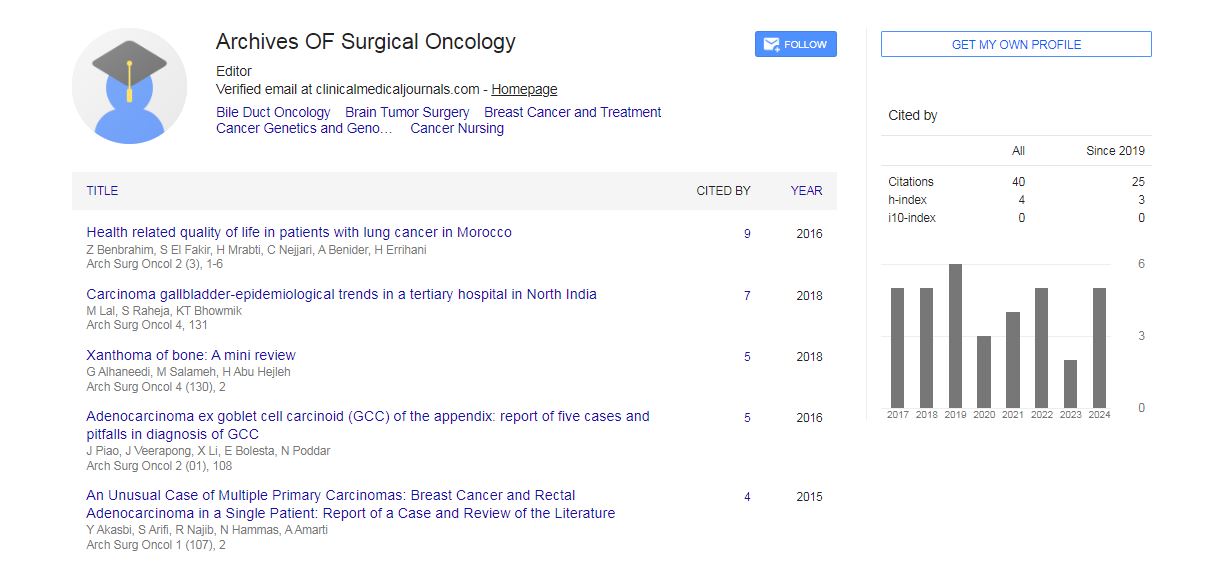
Archives of Surgical Oncology received 37 citations as per Google Scholar report