Perspective - (2025) Volume 11, Issue 2
Received: 01-Apr-2025, Manuscript No. jctt-26-188392;
Editor assigned: 03-Apr-2025, Pre QC No. P-188392;
Reviewed: 17-Apr-2025, QC No. Q-188392;
Revised: 22-Apr-2025, Manuscript No. R-188392;
Published:
29-Apr-2025
, DOI: 10.37421/2471-9323.2024.10.316
Citation: Schneider, Lukas. ”Advancements in Hair Science and Care.” J Cosmo Tricho 11 (2025):316.
Copyright: © 2025 Schneider L. This is an open-access article distributed under the terms of the Creative Commons Attribution License, which permits unrestricted use, distribution and reproduction in any medium, provided the original author and source are credited.
This exploration delves into the intricate relationship between hair's physical and chemical properties and its aesthetic presentation, highlighting how advancements in cosmetic science and trichology are refining beauty practices. It emphasizes the understanding of hair structure and the development of innovative treatments and products that enhance both health and appearance [1].
The role of microbiome diversity on scalp health and its downstream effects on hair growth and quality is examined. Research indicates that a balanced scalp microbiome is crucial for preventing hair loss and promoting robust hair shafts, leading to new therapeutic strategies targeting microbial communities [2].
This article investigates the impact of environmental stressors, such as pollution and UV radiation, on hair integrity and appearance. It explores the mechanisms of damage and introduces innovative protective formulations and treatments designed to mitigate these adverse effects and preserve hair vitality [3].
The article provides an in-depth look at the molecular mechanisms underlying hair pigmentation and graying. It discusses recent discoveries in melanogenesis and the factors contributing to age-related pigment loss, paving the way for potential cosmetic interventions to manage hair color [4].
This research highlights the application of advanced imaging techniques and computational modeling in analyzing hair shaft structure and defects. These tools offer unprecedented insights into hair morphology, enabling more precise diagnosis and targeted treatment of various trichological conditions [5].
The study explores the potential of regenerative medicine and stem cell therapies in addressing hair loss disorders. It reviews the current landscape of research and clinical trials focused on stimulating hair follicle regeneration and improving hair growth cycles [6].
This paper critically assesses the efficacy and safety of various chemical treatments for hair, including coloring, straightening, and perming. It provides a scientific basis for understanding the chemical interactions with hair keratin and the long-term consequences of repeated treatments [7].
The article investigates the role of nutrition and dietary supplements in promoting hair health and strength. It summarizes the current scientific evidence linking specific vitamins, minerals, and amino acids to optimal hair growth and structure [8].
This review focuses on the development and application of novel cosmetic ingredients derived from biotechnology, such as peptides and growth factors, for hair care. It discusses their mechanisms of action and potential to enhance hair regeneration and scalp health [9].
The article examines the psychosocial impact of hair loss and the evolving landscape of cosmetic and medical solutions. It underscores the importance of a holistic approach to hair disorders, integrating psychological support with scientific interventions [10].
The foundational understanding of hair's physical and chemical properties is paramount for advancing cosmetic science and trichology. Innovations in these fields are continually refining beauty practices by focusing on hair structure and developing treatments that bolster both health and appearance, as demonstrated by research into cosmetic science and trichology [1].
Significant attention is now being directed towards the scalp microbiome, recognizing its crucial role in hair health. The diversity of microbial communities on the scalp directly influences hair growth and quality, and research is uncovering how balancing this ecosystem can prevent hair loss and foster stronger hair shafts, leading to novel therapeutic approaches [2].
Environmental factors, including pollution and UV radiation, pose considerable threats to hair integrity and its visual appeal. Understanding the specific damage pathways induced by these stressors is essential for developing effective protective formulations and treatments that can preserve hair vitality and resilience against such assaults [3].
The intricate science of hair pigmentation, particularly the mechanisms of melanin synthesis and the process of graying, is a subject of ongoing investigation. Recent discoveries are shedding light on the molecular basis of age-related pigment loss, opening avenues for cosmetic interventions aimed at managing or restoring natural hair color [4].
Cutting-edge technological advancements, such as advanced imaging and computational modeling, are revolutionizing the analysis of hair shaft structure and identifying subtle defects. These sophisticated tools provide unparalleled insights into hair morphology, thereby facilitating more accurate diagnoses and the development of precisely targeted treatments for a range of trichological issues [5].
Regenerative medicine and stem cell therapies represent a frontier in the treatment of hair loss disorders. Current research and ongoing clinical trials are intensely focused on harnessing these approaches to stimulate the regeneration of hair follicles and optimize the hair growth cycle, offering new hope for those experiencing hair thinning or loss [6].
Chemical treatments commonly applied to hair, such as coloring, straightening, and perming, are subject to rigorous scientific evaluation. Comprehensive assessments of their efficacy and safety profiles are vital, grounded in a deep understanding of their chemical interactions with hair keratin and their potential long-term effects on hair structure [7].
Nutrition plays a critical role in maintaining hair health and strength, and the scientific community is actively investigating the impact of dietary choices and supplements. Evidence is accumulating that specific vitamins, minerals, and amino acids are essential for optimal hair growth and structural integrity, guiding recommendations for dietary interventions [8].
Biotechnology is emerging as a powerful tool in the development of advanced hair care ingredients. Novel compounds like peptides and growth factors derived from biotechnological processes are being explored for their potential to enhance hair regeneration, support scalp health, and improve overall hair condition through targeted mechanisms of action [9].
The psychosocial implications of hair loss are profound, and the field is evolving to address these aspects alongside physical treatments. Acknowledging the emotional and mental toll of hair disorders necessitates a holistic management strategy that integrates psychological support with evidence-based scientific and medical interventions [10].
This collection of research highlights advancements across various domains of hair science and care. It explores the interplay between hair structure and cosmetic treatments, the critical role of the scalp microbiome in hair health, and the impact of environmental stressors on hair integrity. Further studies delve into the science of hair pigmentation and graying, the application of advanced imaging techniques for morphological analysis, and the potential of regenerative medicine and stem cell therapies for hair loss. The efficacy and safety of chemical hair treatments are assessed, alongside the influence of nutrition and dietary supplements on hair health. Emerging biotechnological ingredients and the psychosocial dimensions of hair loss are also examined, emphasizing a holistic approach to hair disorders. Collectively, these findings underscore a multifaceted approach to understanding and improving hair health and appearance through scientific innovation.
None
None
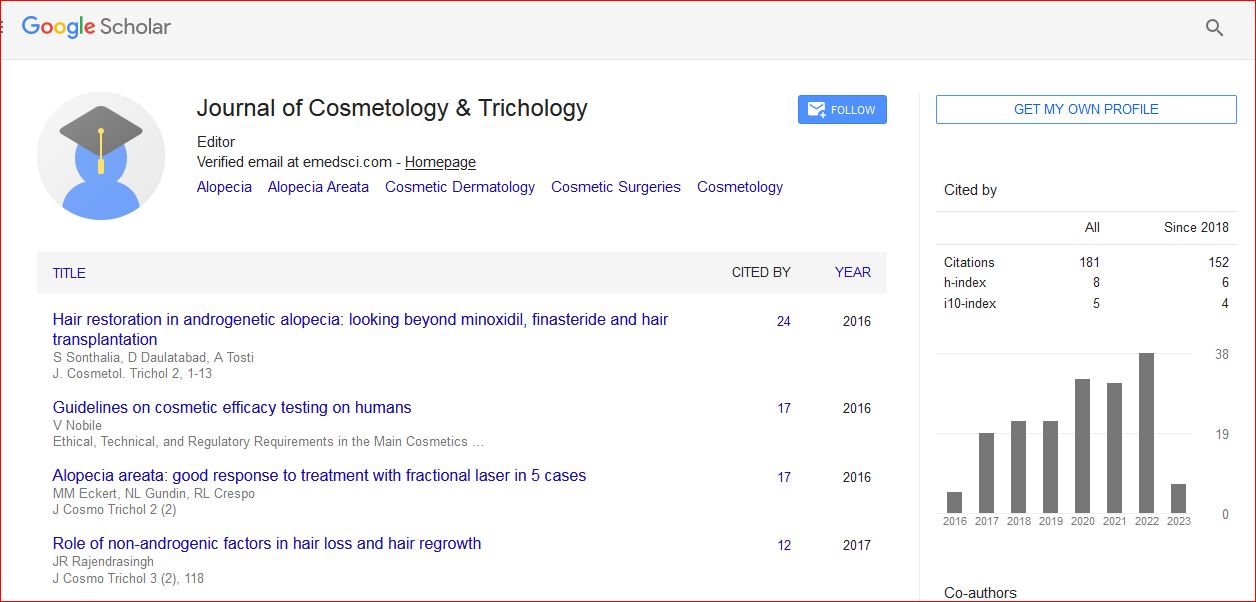
Journal of Cosmetology & Trichology received 180 citations as per Google Scholar report