Perspective - (2025) Volume 15, Issue 5
Received: 02-Oct-2025, Manuscript No. jeat-26-188647;
Editor assigned: 06-Oct-2025, Pre QC No. P-188647;
Reviewed: 20-Oct-2025, QC No. Q-188647;
Revised: 23-Oct-2025, Manuscript No. R-188647;
Published:
30-Oct-2025
, DOI: 10.37421/2161-0525.2025.15.867
Citation: Popescu, Andrei. ”Advancements in Environmental
Contaminant Analysis and Detection.” J Environ Anal Toxicol 15 (2025):867.
Copyright: © 2025 Popescu A. This is an open-access article distributed under the terms of the Creative Commons Attribution License, which permits unrestricted use,
distribution and reproduction in any medium, provided the original author and source are credited.
The environmental landscape is increasingly threatened by the pervasive presence of toxic chemical contaminants, necessitating robust analytical methodologies for their detection and quantification across diverse matrices. Advancements in analytical techniques are crucial for understanding the extent of pollution and mitigating its harmful effects. For instance, sophisticated chromatographic and spectroscopic methods are pivotal in identifying emerging contaminants and assessing ecological risks associated with toxic chemical exposure [1].
The urban environment, a hub of human activity and industrial operations, often accumulates significant levels of pollutants. Studies focusing on the presence of heavy metals in urban soils, employing precise quantification techniques like inductively coupled plasma-mass spectrometry (ICP-MS), are essential for identifying contamination sources and assessing potential risks to human health and ecosystems [2].
Water bodies, vital for both human consumption and ecological balance, are susceptible to contamination from various sources, including agricultural runoff and industrial discharge. The development and validation of sensitive methods, such as gas chromatography-mass spectrometry (GC-MS), are critical for detecting trace levels of harmful compounds like pesticides in drinking water, thereby supporting environmental monitoring programs [3].
Aquatic ecosystems face unique challenges from persistent pollutants. The bioaccumulation of microplastics and their associated chemical contaminants within aquatic organisms, analyzed using advanced techniques like pyrolysis-GC-MS, reveals significant levels of potentially harmful substances, raising ecological and health concerns [4].
Indoor environments, where humans spend a substantial amount of time, are not immune to chemical contamination. The investigation of volatile organic compounds (VOCs) in indoor air, utilizing high-performance liquid chromatography coupled with mass spectrometry (LC-MS), helps identify common sources and understand their implications for indoor air quality and human health [5].
Wastewater treatment processes are critical for removing pollutants before discharge into the environment. Analytical challenges arise in detecting endocrine-disrupting chemicals (EDCs) in complex matrices such as wastewater, where sensitive and robust methods like liquid chromatography-tandem mass spectrometry (LC-MS/MS) are required for effective risk assessment [6].
The persistence and widespread distribution of per- and polyfluoroalkyl substances (PFAS) in various environmental compartments pose significant global challenges. Advanced analytical techniques, including liquid chromatography-high-resolution mass spectrometry (LC-HRMS), are vital for their comprehensive characterization and understanding their environmental fate and transport [7].
Atmospheric pollution is another significant concern, particularly the presence of hazardous compounds like polycyclic aromatic hydrocarbons (PAHs). Gas chromatography-mass spectrometry (GC-MS) is instrumental in analyzing PAH profiles in atmospheric particulate matter, identifying their sources, and assessing their carcinogenic risks to public health [8].
Industrial activities often generate wastewater laden with toxic metals, necessitating effective remediation strategies. The evaluation of biosorbents for removing these metals, supported by analytical techniques like atomic absorption spectrometry (AAS), demonstrates the potential of sustainable and cost-effective remediation technologies [9].
Pharmaceutical residues are increasingly recognized as emerging contaminants in aquatic environments. Analytical investigations using techniques such as ultra-high-performance liquid chromatography-tandem mass spectrometry (UHPLC-MS/MS) are crucial for identifying and quantifying these compounds, addressing the growing concern of pharmaceutical pollution in surface water [10].
The identification and quantification of toxic chemical exposure in environmental matrices are foundational to effective environmental management and public health protection. Pioneering work in this domain highlights the evolution of analytical methodologies, with a specific emphasis on chromatographic and spectroscopic techniques that have been instrumental in detecting emerging contaminants and evaluating ecological risks associated with persistent organic pollutants [1].
Urban soils represent a critical environmental compartment, often serving as a sink for a variety of pollutants originating from industrial activities and anthropogenic sources. Research employing sophisticated analytical tools such as inductively coupled plasma-mass spectrometry (ICP-MS) has provided precise quantification of heavy metals, thereby enabling the identification of contamination pathways and a thorough assessment of associated human health and ecosystem risks [2].
Ensuring the safety of drinking water is paramount, and this necessitates rigorous monitoring for harmful substances. The development and rigorous validation of highly sensitive analytical methods, exemplified by gas chromatography-mass spectrometry (GC-MS), are indispensable for detecting pesticide residues in water samples, thus supporting comprehensive environmental monitoring initiatives [3].
Aquatic organisms play a crucial role in the food web, and their exposure to microplastics and associated chemical contaminants can have cascading effects. Advanced analytical techniques, including pyrolysis-GC-MS, have been employed to identify and quantify these pollutants within fish tissues, revealing significant levels of plastic additives and raising concerns about bioaccumulation and potential health impacts [4].
Indoor air quality is a significant determinant of human health, and it can be compromised by a range of volatile organic compounds (VOCs). Studies utilizing high-performance liquid chromatography coupled with mass spectrometry (LC-MS) have been effective in characterizing these compounds, identifying their sources within residential buildings, and discussing their implications for occupant well-being [5].
Endocrine-disrupting chemicals (EDCs) present a unique challenge due to their potent biological effects even at low concentrations. Analyzing these complex compounds in matrices like wastewater requires highly sensitive and specific techniques, with liquid chromatography-tandem mass spectrometry (LC-MS/MS) emerging as a powerful tool for their identification and quantification, essential for environmental risk assessment [6].
Per- and polyfluoroalkyl substances (PFAS), often referred to as 'forever chemicals,' are ubiquitous in the environment and exhibit remarkable persistence. Comprehensive characterization of these substances across different environmental compartments is achieved through advanced analytical methods, such as liquid chromatography-high-resolution mass spectrometry (LC-HRMS), which are critical for understanding their distribution and environmental fate [7].
Atmospheric particulate matter can host a variety of harmful organic compounds, including polycyclic aromatic hydrocarbons (PAHs). Gas chromatography-mass spectrometry (GC-MS) has been extensively used to analyze PAH profiles, enabling the apportionment of sources, such as vehicular emissions and industrial processes, and informing public health strategies concerning these carcinogenic compounds [8].
Industrial wastewater often contains elevated levels of toxic metals, necessitating effective treatment and remediation solutions. The study of biosorbents derived from agricultural waste highlights a sustainable approach to metal removal, with analytical techniques like atomic absorption spectrometry (AAS) serving as critical tools for monitoring treatment efficacy and metal concentrations [9].
Pharmaceuticals, when released into the environment, can exert unintended biological effects on non-target organisms. Analytical investigations into pharmaceutical residues in surface waters, employing advanced techniques like ultra-high-performance liquid chromatography-tandem mass spectrometry (UHPLC-MS/MS), are vital for understanding the extent of this pollution and its implications for aquatic ecosystems [10].
This collection of research highlights advancements in analytical techniques for detecting and quantifying toxic chemical contaminants in various environmental matrices. Studies cover persistent organic pollutants in environmental samples, heavy metals in urban soils, pesticides in drinking water, microplastics and associated chemicals in aquatic organisms, volatile organic compounds in indoor air, endocrine-disrupting chemicals in wastewater, per- and polyfluoroalkyl substances in the environment, polycyclic aromatic hydrocarbons in atmospheric particulate matter, toxic metals in industrial wastewater, and pharmaceutical residues in surface water. The research emphasizes the importance of sensitive, selective, and validated analytical methods for environmental monitoring, risk assessment, and public health protection, often employing techniques such as chromatography and mass spectrometry.
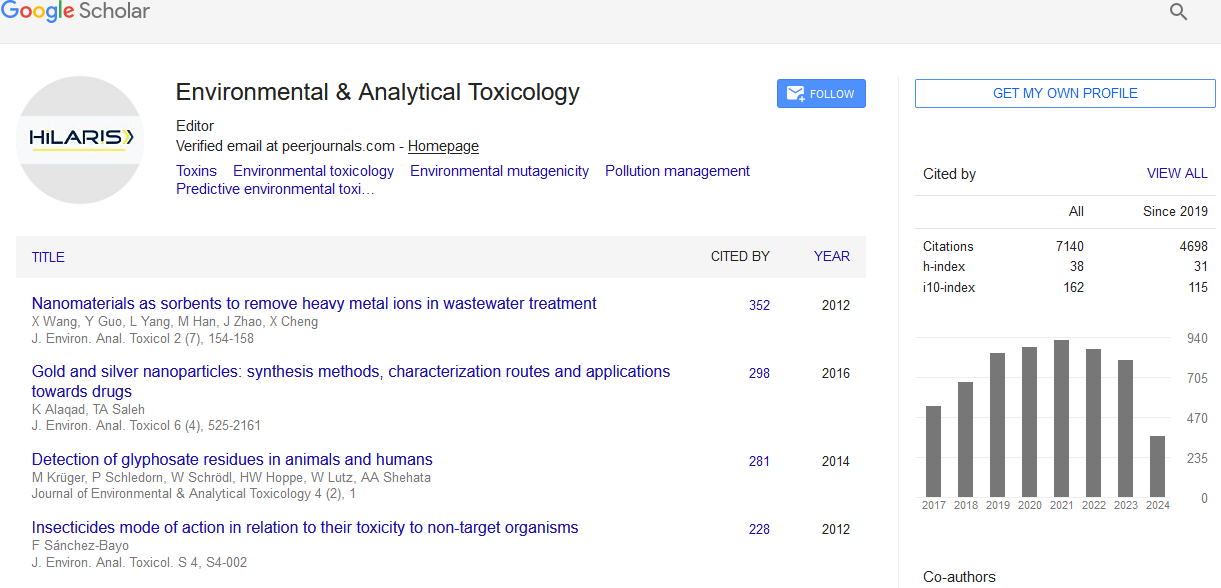
Environmental & Analytical Toxicology received 6818 citations as per Google Scholar report