Perspective - (2025) Volume 11, Issue 6
Received: 01-Dec-2025, Manuscript No. jctt-26-188438;
Editor assigned: 02-Dec-2025, Pre QC No. P-188438;
Reviewed: 17-Dec-2025, QC No. Q-188438;
Revised: 22-Dec-2025, Manuscript No. R-188438;
Published:
29-Dec-2025
, DOI: 10.37421/2471-9323.2024.10.356
Citation: Park, Ji-hoon. ”Advancements in Dermatology and Trichology: Novel Treatments.” J Cosmo Tricho 11 (2025):356.
Copyright: © 2025 Park J. This is an open-access article distributed under the terms of the Creative Commons Attribution License, which permits unrestricted use, distribution and reproduction in any medium, provided the original author and source are credited.
The field of dermatology and trichology is undergoing a significant transformation, driven by a deeper understanding of underlying biological mechanisms and the development of innovative therapeutic strategies. This evolution encompasses a broad spectrum of concerns, from the aesthetic enhancement of skin to the complex treatment of hair loss disorders. Recent advancements in cosmetic dermatology are offering sophisticated solutions for skin rejuvenation, utilizing novel energy-based devices, advanced injectable fillers, and targeted topical treatments that evaluate efficacy and safety profiles for potential combination therapies. The integration of evidence-based approaches and a focus on patient outcomes are paramount in this dynamic landscape [1].
Concurrently, the intricate relationship between environmental factors and scalp health is becoming increasingly apparent. Research is identifying specific pollutants, dietary deficiencies, and stress-related mechanisms that contribute to hair thinning and scalp disorders, paving the way for preventative measures and targeted treatments. Understanding these external influences is crucial for comprehensive hair care and the management of scalp conditions [2].
Beyond external influences, the genetic architecture of common hair loss conditions, such as androgenetic alopecia, is being systematically unraveled. Recent discoveries in gene expression, signaling pathways, and the identification of molecular targets are laying the groundwork for the development of highly specific therapeutic interventions. This genetic insight promises a more personalized approach to treating hair loss [4].
The skin microbiome, a complex ecosystem of microorganisms residing on the skin's surface, is emerging as a critical factor in dermatological health and disease. Studies are illuminating the impact of microbial diversity and dysbiosis on conditions like acne and eczema, suggesting the potential for probiotic and prebiotic interventions to restore balance and promote skin health [5].
Scalp psoriasis, a chronic inflammatory condition, continues to be a focus of clinical research. Current therapeutic approaches, ranging from topical treatments and phototherapy to systemic medications and emerging biologics, are being continuously refined to enhance symptom management and improve patients' quality of life [6].
The potential of regenerative medicine, particularly stem cell therapy, is a burgeoning area of research for both skin and hair regeneration. Investigations into various stem cell types, their applications in treating hair loss and skin aging, and the associated challenges and future prospects highlight this rapidly advancing field [7].
As the landscape of aesthetic treatments expands, the safety and efficacy of cosmetic procedures are under increasing scrutiny, especially when performed by non-dermatologists. Addressing common complications, regulatory considerations, and emphasizing patient safety through qualified practitioners and robust protocols are essential [8].
Inflammation plays a pivotal role in various skin aging processes, including the development of wrinkles, loss of elasticity, and hyperpigmentation. Understanding the intricate inflammatory pathways involved is leading to the exploration of therapeutic interventions aimed at modulating inflammation for anti-aging benefits [9].
Alopecia areata, an autoimmune form of hair loss, is benefiting from the evaluation of novel topical agents. This research is examining the mechanisms of action of new drug candidates, including immunomodulators and growth factors, and reporting on their clinical efficacy and safety profiles [10].
Overall, the convergence of advances in dermatology, trichology, and regenerative medicine, coupled with a deeper understanding of genetic, environmental, and molecular factors, is ushering in a new era of personalized and effective treatments for a wide array of skin and hair concerns.
The evolving landscape of hair restoration is characterized by a shift from traditional techniques to regenerative medicine, focusing on novel formulations, diagnostic tools, and therapeutic strategies for hair and skin conditions. This approach emphasizes evidence-based practices and improved patient outcomes in cosmetic dermatology and trichology [1].
Environmental factors and lifestyle choices significantly impact scalp health and hair quality. Research is actively identifying specific pollutants, dietary deficiencies, and stress-related mechanisms that contribute to hair thinning and scalp disorders, providing insights for preventative strategies and targeted treatments [2].
Innovations in aesthetic dermatology are leading to advanced skin rejuvenation techniques, including new energy-based devices, injectable fillers, and topical treatments. These advancements are continuously evaluated for their efficacy, safety, and potential for combination therapies to achieve optimal aesthetic results [3].
The genetic underpinnings of common hair loss conditions, such as androgenetic alopecia, are being systematically explored. Recent discoveries in gene expression and signaling pathways are crucial for developing targeted therapies that address the molecular mechanisms of disease [4].
The skin microbiome's role in dermatological health and disease, particularly in conditions like acne and eczema, is a significant area of investigation. Findings on microbial diversity and the impact of dysbiosis are guiding potential probiotic and prebiotic interventions [5].
Current therapeutic approaches for scalp psoriasis are advancing, encompassing topical treatments, phototherapy, systemic medications, and emerging biologics. These treatments aim to effectively manage symptoms and enhance patients' quality of life [6].
Stem cell therapy holds considerable promise for regenerative dermatology and hair growth. Research is examining different stem cell types, their applications in treating hair loss and skin aging, and the challenges and future prospects of this rapidly developing field [7].
The safety and efficacy of cosmetic procedures performed by non-dermatologists are being reviewed. This assessment involves addressing common complications, regulatory considerations, and recommendations for patient safety, highlighting the importance of qualified practitioners [8].
Inflammation is a key driver of skin aging processes, including wrinkles, loss of elasticity, and hyperpigmentation. Understanding these inflammatory pathways is leading to the development of therapeutic targets aimed at mitigating these age-related changes [9].
Novel topical agents are being developed and evaluated for the treatment of alopecia areata, an autoimmune hair loss condition. Research focuses on immunomodulators and growth factors to assess their clinical efficacy and safety [10].
This collection of research highlights significant advancements across dermatology and trichology. Key areas of focus include the integration of cosmetic dermatology with trichology, exploring novel treatments for hair and skin conditions, and the impact of environmental and lifestyle factors on scalp health. Genetic research is unraveling the molecular basis of hair loss for targeted therapies. The skin microbiome's role in dermatological health is being explored for potential interventions. Progress is being made in managing scalp psoriasis with new therapeutic agents and in regenerative medicine through stem cell therapy for skin and hair. Safety and efficacy of cosmetic procedures are under review, while inflammation's role in skin aging is being targeted for anti-aging effects. Finally, emerging topical therapies for alopecia areata show promise.
None
None
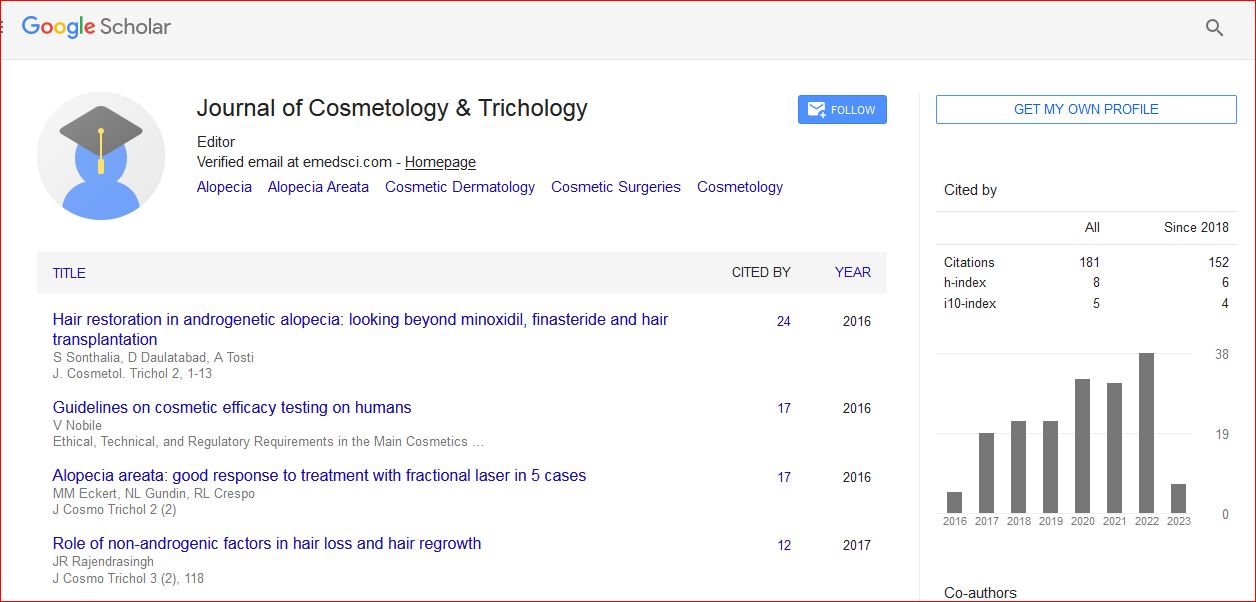
Journal of Cosmetology & Trichology received 180 citations as per Google Scholar report