Brief Report - (2025) Volume 16, Issue 3
Received: 02-Jun-2025, Manuscript No. jbsbe-26-183295;
Editor assigned: 04-Jun-2025, Pre QC No. P-183295;
Reviewed: 18-Jun-2025, QC No. Q-183295;
Revised: 23-Jun-2025, Manuscript No. R-183295;
Published:
30-Jun-2025
, DOI: 10.37421/2165-6210.2025.16.501
Citation: Al-Fayed, Noor. ”Advancements in Biosensor Technology Across Applications.” J Biosens Bioelectron 16 (2025):501.
Copyright: © 2025 Al-Fayed N. This is an open-access article distributed under the terms of the Creative Commons Attribution License, which permits unrestricted use, distribution and reproduction in any medium, provided the original author and source are credited.
The field of biosensing has witnessed remarkable advancements, driven by the escalating need for precise and accessible diagnostic tools across various physiological monitoring applications. Electrochemical biosensors, in particular, have emerged as a cornerstone of this progress, offering high sensitivity, rapid response times, and the potential for miniaturization. One significant area of development involves the creation of ultrasensitive electrochemical biosensors for glucose detection, utilizing novel nanomaterial-modified electrodes. These innovations are crucial for effective diabetes management, enhancing electron transfer and enzyme immobilization for accurate readings [1].
Beyond glucose monitoring, the development of wearable biosensor systems has opened new avenues for real-time physiological tracking. Research exploring these systems for lactate monitoring in athletes, leveraging flexible electrodes and microfluidics to analyze sweat, provides a non-invasive method to assess metabolic stress and fatigue. Such designs prioritize user comfort and signal stability during rigorous physical activity [2].
The non-invasive detection of critical biomarkers is another frontier in biosensor technology. Studies focusing on optical biosensors for detecting ketone bodies in breath, a vital marker for diabetic ketoacidosis, demonstrate the potential of colorimetric approaches with advanced polymers. These sensors offer a fast, reagent-free alternative for at-home monitoring, improving patient care accessibility [3].
The integration of microfluidic devices with biosensors represents a sophisticated approach to simultaneous monitoring of multiple analytes. This strategy, which mimics the body's metabolic pathways, allows for a more comprehensive understanding of physiological status. The miniaturization of such devices is a key factor enabling portable applications for complex diagnostics [4].
The drive for cost-effective and accessible diagnostics has spurred the development of paper-based electrochemical biosensors. These sensors, utilizing screen-printed electrodes on paper substrates, offer ease of use and disposability, making them ideal for resource-limited settings and point-of-care diagnostics, particularly for rapid glucose detection [5].
Impedimetric biosensors are also gaining traction for their ability to monitor metabolic biomarkers in saliva. By employing impedance spectroscopy to detect changes in electrical properties upon analyte binding, these sensors offer sensitive and label-free detection methods suitable for non-invasive health assessments [6].
Furthermore, enzyme-free electrochemical biosensors are being developed to overcome limitations associated with enzyme denaturation. Innovations utilizing graphene quantum dots modified with metal nanoparticles exhibit synergistic effects that enhance electrocatalytic activity, leading to improved sensitivity and stability for glucose detection [7].
Wearable biosensor patches are emerging as a promising technology for continuous monitoring of key metabolic parameters directly in interstitial fluid. These patches, often incorporating microneedles to access the fluid and electrochemical sensors, aim to provide long-term, real-time health insights, particularly for glucose and lactate [8].
The enhancement of signal detection through advanced materials is another area of intense research. The integration of plasmonic nanoparticles with biosensors, for instance, amplifies the detection signal via surface plasmon resonance, leading to significantly improved sensitivity and lower detection limits for glucose quantification [9].
Finally, the convergence of biosensor technology with ubiquitous mobile devices is transforming personal health monitoring. The development of smartphone-integrated biosensors, employing simple optical detection methods interfaced with smartphone cameras, offers a portable and accessible solution for rapid and accurate glucose measurements, facilitating self-monitoring [10].
The innovation in electrochemical biosensors for glucose detection is marked by the use of novel nanomaterial-modified electrodes, which are central to achieving high sensitivity and selectivity. This approach, as detailed in recent studies, is vital for continuous glucose monitoring systems, as the unique properties of the nanomaterials facilitate enhanced electron transfer and enzyme immobilization, thereby ensuring the accuracy of readings [1].
The expansion of biosensing capabilities into wearable systems is exemplified by research focused on real-time lactate monitoring for athletes. This technology integrates flexible electrodes with microfluidics to collect and analyze sweat, providing a non-invasive means to gauge metabolic stress and fatigue. The design considerations for these systems emphasize user comfort and consistent signal integrity during physical exertion [2].
In the realm of non-invasive diagnostics, the development of optical biosensors for detecting ketone bodies in breath holds significant promise, particularly for managing diabetic ketoacidosis. These sensors utilize a colorimetric approach enabled by advanced polymers that undergo visible color changes upon interaction with specific volatile organic compounds, offering a rapid, reagent-free alternative for home use [3].
An advanced integration strategy involves the development of microfluidic devices coupled with biosensors for the simultaneous measurement of multiple analytes like glucose and lactate. This integrated approach, by effectively mimicking the body's metabolic processes, facilitates a more profound understanding of an individual's physiological state. The miniaturization of these systems is a critical attribute that drives their utility in portable diagnostic applications [4].
The pursuit of cost-effective and broadly accessible diagnostic tools has led to the creation of paper-based electrochemical biosensors. These devices leverage screen-printed electrodes fabricated on paper substrates, which inherently offer user-friendliness and disposability. This makes them particularly well-suited for deployment in resource-limited environments and for point-of-care diagnostic purposes, especially for swift glucose assessments [5].
Impedimetric biosensing presents a valuable method for monitoring metabolic biomarkers, with applications extending to saliva analysis. This technique relies on impedance spectroscopy to detect subtle alterations in electrical properties that occur when target analytes bind to the sensor surface, thus providing a sensitive, label-free detection pathway for non-invasive health evaluations [6].
Ongoing research is focused on advancing enzyme-free electrochemical biosensors to circumvent the challenges associated with enzyme stability and denaturation. One notable approach involves the use of graphene quantum dots combined with metal nanoparticles, whose synergistic properties boost electrocatalytic activity, leading to enhanced sensitivity and robustness in glucose sensing applications [7].
Wearable biosensor patches are emerging as a significant advancement for continuous, in-situ monitoring of key metabolic indicators within interstitial fluid. These patches employ microneedles for fluid access and are equipped with electrochemical sensors for analytes such as glucose and lactate, with the overarching goal of delivering sustained, real-time health data [8].
Signal amplification strategies are crucial for improving biosensor performance, particularly for analytes like glucose. The incorporation of plasmonic nanoparticles into optical biosensors leverages the phenomenon of surface plasmon resonance to significantly boost the detection signal, resulting in lower detection limits and enhanced sensitivity for glucose quantification [9].
The fusion of biosensor technology with readily available smartphones represents a paradigm shift in personal health management. These integrated systems, often employing straightforward optical detection mechanisms that interface with a smartphone's camera, provide a convenient and accessible platform for rapid and precise glucose measurements, empowering individuals with effective self-monitoring capabilities [10].
This collection of research highlights significant advancements in biosensor technology across various applications. Innovations include ultrasensitive electrochemical biosensors for glucose monitoring using nanomaterials, wearable systems for real-time lactate detection in athletes, and non-invasive optical sensors for ketone bodies in breath. The development of microfluidic-integrated devices enables simultaneous monitoring of multiple analytes, while paper-based sensors offer cost-effective, point-of-care solutions. Impedimetric and enzyme-free biosensors are being explored for improved sensitivity and stability, and wearable patches are providing continuous monitoring in interstitial fluid. Plasmonic nanoparticles enhance signal detection, and smartphone integration is making glucose monitoring more accessible and convenient for self-management.
None
None
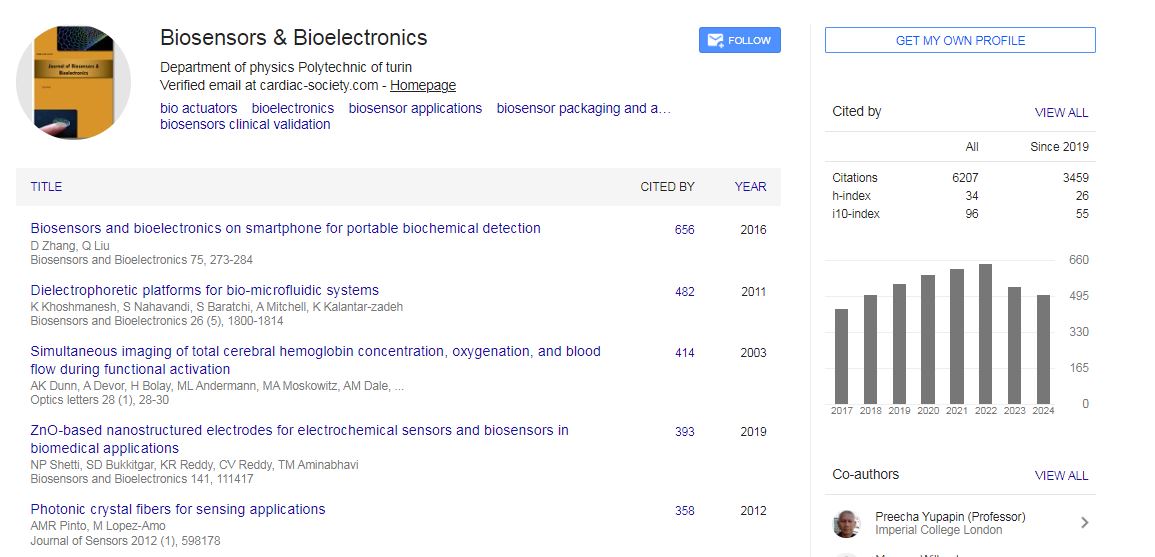
Biosensors & Bioelectronics received 6207 citations as per Google Scholar report