Short Communication - (2025) Volume 15, Issue 6
Received: 02-Dec-2025, Manuscript No. jeat-26-188658;
Editor assigned: 04-Dec-2025, Pre QC No. P-188658;
Reviewed: 18-Dec-2025, QC No. Q-188658;
Revised: 23-Dec-2025, Manuscript No. R-188658;
Published:
30-Dec-2025
, DOI: 10.37421/2161-0525.2025.15.878
Citation: Otieno, Joseph. ”Advanced Water Toxicity Assessment:
Methods and Applications.” J Environ Anal Toxicol 15 (2025):878.
Copyright: © 2025 Otieno J. This is an open-access article distributed under the terms of the Creative Commons Attribution License, which permits unrestricted use, distribution
and reproduction in any medium, provided the original author and source are credited.
The investigation into the complex landscape of environmental water quality necessitates robust analytical approaches to ensure the health of aquatic ecosystems and human populations. Advances in analytical science have been crucial in developing sophisticated methods for detecting and quantifying a diverse array of contaminants. This field is continuously evolving to address emerging threats and to improve the precision and sensitivity of existing techniques. The drive towards more accurate risk assessments underpins much of this research, aiming to mitigate the adverse effects of pollution on both the environment and public health. This area of study is particularly focused on chemical toxicity, a pervasive issue in water bodies worldwide. Understanding the precise nature and concentration of toxic substances is the first step in developing effective remediation and management strategies. The methodologies employed must be capable of handling the complexities of real-world water samples, which often contain a multitude of substances that can interfere with analytical measurements. Therefore, researchers are constantly seeking to refine existing protocols and develop novel approaches that offer enhanced performance characteristics, such as reduced detection limits and improved selectivity [1].
Furthermore, the identification of specific pollutants and their toxicological impacts is paramount for targeted interventions. This includes not only well-established contaminants but also newly recognized substances that pose potential risks. The development of advanced spectroscopic and chromatographic techniques plays a pivotal role in this endeavor, enabling the identification of a broad spectrum of pollutants. The continuous effort to improve sensitivity and selectivity is directly linked to our ability to detect and manage these contaminants effectively, particularly those considered emerging [1].
The simultaneous determination of multiple pesticide residues in various water matrices presents a significant analytical challenge, necessitating advanced techniques for reliable environmental monitoring. Such analyses are critical for assessing risks associated with agricultural runoff and for ensuring compliance with regulatory standards. The complexity of natural water samples often requires rigorous method development and validation to achieve accurate and reproducible results. This ensures that data generated is trustworthy and can be used effectively for informed decision-making regarding water resource management and public safety [2].
Moreover, the challenges associated with complex matrices in environmental water samples cannot be overstated. These matrices can contain a wide range of organic and inorganic compounds, particulate matter, and dissolved substances that can significantly impact the performance of analytical instruments and the accuracy of results. Rigorous validation of analytical methods is therefore essential to guarantee reliable data for environmental monitoring and regulatory compliance, especially when considering potential human exposure pathways through contaminated water sources [2].
The toxicological profiling of microplastics and their adsorbed contaminants in freshwater systems represents a growing area of concern. As microplastics accumulate in aquatic environments, they can act as vectors for toxic chemicals, posing a dual threat to aquatic life. Analytical strategies must be capable of characterizing both the microplastic particles themselves and the associated pollutants, assessing their leaching potential and bioavailability. This interdisciplinary approach, combining material characterization with chemical analysis, is vital for understanding the full scope of the environmental impact [3].
The development of novel sensor platforms for the real-time detection of heavy metal toxicity in industrial wastewater offers a promising avenue for immediate pollution control. Electrochemical sensors, often modified with nanomaterials, can provide high sensitivity and selectivity for toxic metal ions. The ability to monitor water quality in real-time at the source of potential contamination enables rapid response to pollution events, thereby minimizing environmental damage and protecting downstream water users. This proactive approach is crucial for industrial discharge management [4].
The use of high-resolution mass spectrometry (HRMS) for identifying and quantifying emerging contaminants, such as pharmaceuticals and personal care products (PPCPs), in surface waters has revolutionized contaminant profiling. HRMS offers unparalleled capabilities in untargeted screening and the elucidation of unknown pollutant structures. This is indispensable for understanding the potential ecological risks posed by these pervasive compounds, which are often present at low concentrations but can have significant biological effects [5].
Furthermore, the efficacy of advanced oxidation processes (AOPs) in degrading persistent organic pollutants (POPs) in treated wastewater is a critical aspect of water purification research. Analytical techniques like GC-MS and LC-MS are employed to meticulously monitor the reduction of these recalcitrant compounds and to identify any transformation products that may arise. This detailed analytical assessment provides invaluable insights into the effectiveness and limitations of various AOPs, guiding the optimization of wastewater treatment strategies for improved water quality [6].
Finally, the application of passive sampling devices for long-term monitoring of hydrophobic contaminants like polycyclic aromatic hydrocarbons (PAHs) in river water offers a significant advantage over traditional grab sampling methods. By providing time-weighted average concentrations, these devices offer a more accurate assessment of exposure and bioavailability. This approach is crucial for understanding the cumulative impact of contaminants in aquatic environments and for developing informed management strategies to protect water resources [7].
The scientific literature consistently highlights the imperative for advanced analytical methodologies in assessing the safety and quality of environmental water samples. These methods are foundational for accurate risk assessment, a critical component in safeguarding both aquatic ecosystems and human health. The continuous pursuit of improved sensitivity, selectivity, and reduced detection limits for a wide spectrum of pollutants, including emerging contaminants, drives innovation in this field. This quest for analytical excellence is essential for understanding the complex toxicological profiles of substances present in water bodies [1].
The analytical methodologies employed in environmental water analysis are diverse and continually evolving. Spectroscopic and chromatographic techniques, often coupled with mass spectrometry, form the backbone of many investigative protocols. These advanced tools allow for the detailed characterization of pollutants, providing quantitative data that informs environmental policy and management. The importance of accurate risk assessment for aquatic ecosystems and human health cannot be overstated, as it directly influences the strategies developed to mitigate pollution and its consequences [1].
Liquid chromatography-mass spectrometry (LC-MS/MS) has emerged as a powerful tool for the simultaneous determination of multiple pesticide residues in complex water matrices. The challenges inherent in such analyses, stemming from the intricate nature of environmental samples, necessitate rigorous method development and validation. Ensuring the reliability of data generated through these advanced techniques is paramount for effective environmental monitoring and for upholding regulatory compliance, particularly concerning potential human exposure pathways [2].
Moreover, the evaluation of LC-MS/MS applications underscores the critical need for validated methods in environmental science. The ability to accurately quantify a range of pesticides simultaneously simplifies the monitoring process and provides comprehensive data for risk assessment. The focus on human exposure pathways highlights the direct relevance of this analytical work to public health, emphasizing the role of analytical chemistry in environmental protection and regulatory oversight [2].
The toxicological impact of microplastics and their adsorbed contaminants in freshwater environments is a significant and growing concern. Analytical strategies are being developed to characterize microplastic particles and to assess the leaching and bioavailability of toxic chemicals, such as phthalates and heavy metals. These methods often involve a combination of spectroscopic and chromatographic techniques to provide a comprehensive understanding of the risks associated with microplastic pollution in aquatic systems [3].
The characterization of microplastics and associated contaminants requires sophisticated analytical approaches. Researchers are employing advanced spectroscopic methods to identify the composition of microplastics and chromatographic techniques to quantify adsorbed pollutants. The assessment of leaching and bioavailability is crucial for determining the actual exposure risk to aquatic organisms and for informing strategies to mitigate the impact of these pervasive pollutants [3].
In the realm of industrial wastewater, the development of novel sensor platforms for real-time heavy metal toxicity detection is a significant advancement. Electrochemical sensors, frequently enhanced with nanomaterials, exhibit high sensitivity and selectivity for toxic ions like lead, cadmium, and mercury. Such technologies enable on-site monitoring, facilitating rapid responses to pollution events and preventing the widespread dissemination of hazardous substances into the environment [4].
The potential for on-site monitoring through advanced sensor technology represents a paradigm shift in pollution control. The ability to detect heavy metal toxicity in real-time allows for immediate intervention, minimizing the environmental damage caused by industrial discharges. This proactive approach is vital for ensuring the protection of water resources and for maintaining ecological integrity [4].
High-resolution mass spectrometry (HRMS) has proven invaluable for identifying and quantifying a wide array of emerging contaminants, including pharmaceuticals and personal care products (PPCPs), in surface waters. Its untargeted screening capabilities and its power in elucidating the structures of unknown pollutants are critical for understanding the potential ecological risks associated with these substances. This technology is essential for comprehensive environmental assessment [5].
The comprehensive understanding of emerging contaminants is heavily reliant on advanced analytical techniques like HRMS. The ability to detect and identify a broad range of these substances, even at low concentrations, allows for a more thorough evaluation of their environmental fate and potential impacts. This contributes significantly to the ongoing efforts to manage and mitigate the risks posed by these ubiquitous pollutants [5].
Advanced oxidation processes (AOPs) are being rigorously evaluated for their efficacy in degrading persistent organic pollutants (POPs) in treated wastewater. Analytical techniques such as GC-MS and LC-MS are employed to monitor the reduction of target POPs and to identify any transformation products that may be formed during the degradation process. This analytical assessment provides crucial data on the effectiveness and limitations of different AOPs in water purification [6].
The analytical monitoring of AOPs is key to optimizing wastewater treatment strategies. By employing techniques like GC-MS and LC-MS, researchers can track the degradation of POPs and characterize any intermediate or final products. This detailed understanding is essential for ensuring that AOPs are effectively removing harmful pollutants and not inadvertently creating more problematic substances [6].
Passive sampling devices offer an advantageous approach for the long-term monitoring of polycyclic aromatic hydrocarbons (PAHs) in river water. These devices allow for the assessment of time-weighted average concentrations and bioavailability, providing a more representative picture of contaminant exposure compared to conventional grab sampling. This method is crucial for understanding the chronic exposure risks in aquatic environments [7].
The application of passive sampling in PAH monitoring provides a valuable perspective on the cumulative effects of these contaminants. By capturing pollutants over extended periods, these devices offer a realistic assessment of exposure levels for aquatic organisms. This data is instrumental in developing effective strategies for managing PAH contamination in river systems [7].
Ecotoxicological effects of endocrine-disrupting compounds (EDCs) in wastewater effluent are being investigated using a combination of chemical analysis and in vitro bioassays. LC-MS/MS is used to identify specific EDCs, and their concentrations are correlated with observed hormonal disruption in aquatic organisms. This integrated approach is vital for comprehensive risk assessment and for understanding the subtle yet significant impacts of these chemicals on wildlife [8].
The correlation between identified EDCs and observed biological effects is a cornerstone of modern ecotoxicology. By linking precise chemical measurements with documented physiological responses, researchers can more accurately assess the risks posed by these compounds. This interdisciplinary approach is essential for developing effective measures to protect aquatic life from hormonal disruption [8].
A novel method for determining volatile organic compounds (VOCs) in drinking water has been developed, utilizing headspace solid-phase microextraction (HS-SPME) coupled with gas chromatography-mass spectrometry (GC-MS). This validated method offers high accuracy, precision, and sensitivity for detecting common VOCs, establishing a robust tool for ensuring the quality and safety of potable water supplies [9].
The application of HS-SPME-GC-MS for VOC analysis in drinking water represents a significant improvement in water quality monitoring. This technique ensures that public health is protected by providing reliable data on the presence of these potentially harmful compounds, thereby supporting regulatory efforts and public confidence in water safety [9].
The occurrence and distribution of per- and polyfluoroalkyl substances (PFAS) in urban surface waters are being actively investigated, along with their potential transformation into more persistent forms. Analytical techniques, primarily LC-MS/MS, are employed to quantify various PFAS. The findings underscore the widespread contamination by these 'forever chemicals' and highlight the considerable challenges associated with their management [10].
The pervasive nature of PFAS contamination necessitates advanced analytical capabilities for effective monitoring. Techniques like LC-MS/MS are critical for quantifying the diverse range of PFAS found in urban waters. Understanding their transformation and persistence is crucial for developing long-term strategies to address this global environmental challenge [10].
This collection of research explores advanced analytical methodologies for assessing chemical toxicity and contaminants in environmental water samples. Studies cover techniques like advanced spectroscopy, chromatography (LC-MS/MS, GC-MS), and bioassays for detecting a wide range of pollutants, including pesticides, microplastics-adsorbed toxins, heavy metals, emerging contaminants like PPCPs and PFAS, and volatile organic compounds (VOCs). The research emphasizes the importance of method development, validation, and achieving high sensitivity and selectivity to ensure accurate risk assessment for aquatic ecosystems and human health. It also addresses challenges such as complex sample matrices, real-time monitoring needs, and the degradation of persistent pollutants through advanced oxidation processes. Passive sampling for long-term monitoring and the ecotoxicological assessment of endocrine-disrupting compounds are also key themes, all contributing to better water quality management and public safety.
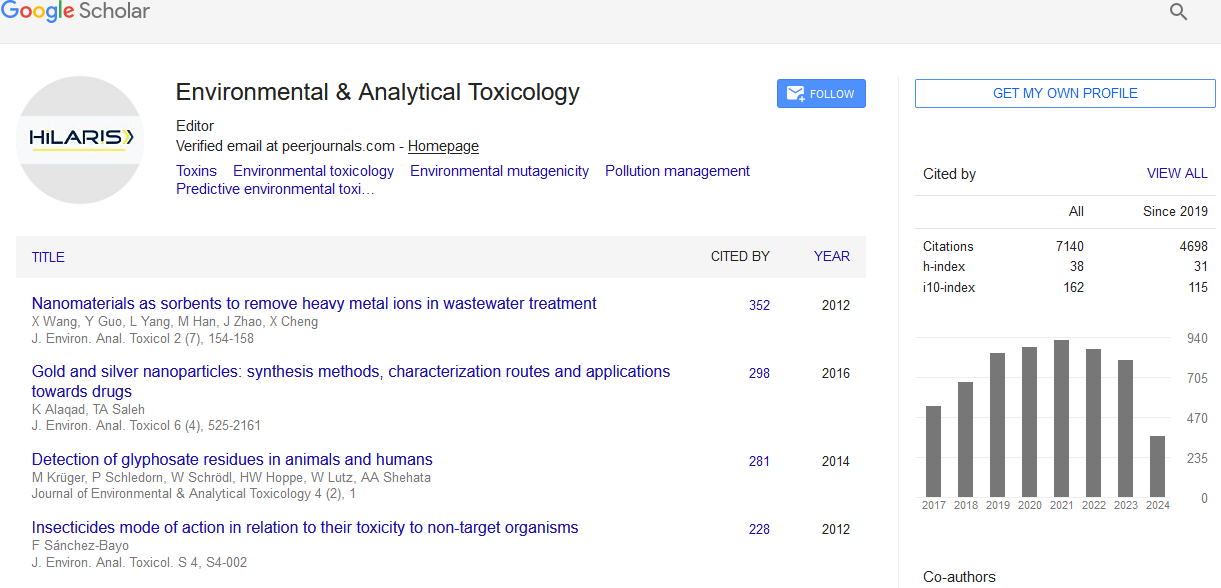
Environmental & Analytical Toxicology received 6818 citations as per Google Scholar report