Short Communication - (127) Volume 16, Issue 5
Received: 01-Sep-2025, Manuscript No. jch-26-178794;
Editor assigned: 04-Jul-2025, Pre QC No. P-178794;
Reviewed: 17-Jul-2025, QC No. Q-178794;
Revised: 22-Sep-2025, Manuscript No. R-178794;
Published:
29-Jul-2025
, DOI: 10.37421/2157-7099.2025.16.821
Citation: Menon, Priya S.. ”Advanced Staining Enhances Diagnostic Accuracy in Pathology.” J Cytol Histol 16 (2025):821.
Copyright: © 2025 Menon S. Priya This is an open-access article distributed under the terms of the Creative Commons Attribution License, which permits unrestricted use, distribution and reproduction in any medium, provided the original author and source are credited.
Recent advancements in staining techniques are profoundly reshaping the fields of cytology and histology, leading to enhanced diagnostic accuracy and a deeper understanding of subtle cellular features. Innovations such as multiplex immunohistochemistry (IHC) allow for the simultaneous detection of multiple biomarkers, significantly improving workflow efficiency and providing a more comprehensive view of tissue architecture [1].
Multiplex immunohistochemistry (mIHC) is emerging as a transformative approach in cancer diagnostics, enabling the visualization of numerous protein targets within a single tissue section. This facilitates a more nuanced understanding of tumor heterogeneity and the tumor microenvironment than traditional singleplex IHC methods [2].
The development of novel fluorescent probes and labeling strategies has markedly improved the sensitivity and specificity of immunofluorescence (IF) techniques in histology. These advancements enable the detection of low-abundance targets and the multiplexing of a greater number of antibodies, offering deeper insights into cellular processes and disease mechanisms [3].
Digital pathology, driven by advanced imaging and artificial intelligence (AI), is revolutionizing histological analysis. High-resolution whole-slide imaging combined with deep learning algorithms facilitates automated detection and quantification of various cellular features, including mitotic figures, nuclear atypia, and tumor infiltration [4].
Standardization of staining protocols remains a critical factor in ensuring the reproducibility and comparability of results in both cytology and histology. Recent efforts are directed toward developing more robust and automated staining platforms that minimize manual variations and optimize reagent concentrations, incubation times, and washing steps [5].
The application of advanced staining techniques in liquid-based cytology (LBC) has substantially improved the detection of various cytological abnormalities, including precancerous lesions. Refined Papanicolaou (Pap) staining for LBC, coupled with the integration of immunocytochemistry (ICC), enhances diagnostic confidence and reduces the need for repeat sampling [6].
Novel chromogenic substrates and counterstains are being developed to provide sharper contrast and more stable staining in immunohistochemistry (IHC). These innovations address limitations of traditional reagents, such as background staining and fading, leading to clearer visualization of cellular morphology and precise antigen localization [7].
The integration of spatial transcriptomics and multiplexed imaging techniques enables the simultaneous analysis of gene expression and protein localization within their native tissue context. This offers an unprecedented understanding of cellular heterogeneity and intercellular communication in diverse biological states [8].
The development of AI-powered image analysis platforms for histology is accelerating the interpretation of complex stained slides. These platforms can accurately identify and quantify morphological features, detect subtle anomalies, and even predict treatment responses based on visual patterns [9].
In situ hybridization (ISH) techniques continue to evolve, offering precise localization of nucleic acids within cells and tissues. Recent advancements have focused on improving sensitivity and enabling multiplexing of RNA and DNA probes, often in conjunction with IHC for protein detection, leading to more comprehensive molecular profiling of tissues [10].
Recent advancements in staining techniques are revolutionizing cytology and histology by enhancing diagnostic accuracy and uncovering subtle cellular features. Innovations include multiplex immunohistochemistry (IHC) for simultaneous detection of multiple biomarkers, improving workflow efficiency and providing a more comprehensive view of tissue architecture. Newer fluorescent probes and imaging techniques also offer superior resolution and sensitivity, aiding in the identification of early-stage disease and complex cellular interactions. Furthermore, the development of machine learning algorithms integrated with advanced staining protocols is paving the way for automated analysis and more precise quantification of cellular characteristics. These developments collectively contribute to earlier and more definitive diagnoses in various fields of pathology [1].
Multiplex immunohistochemistry (mIHC) is transforming the landscape of cancer diagnostics by enabling the simultaneous visualization of multiple protein targets within a single tissue section. This approach offers a more nuanced understanding of tumor heterogeneity and the tumor microenvironment compared to singleplex IHC. Emerging mIHC platforms are becoming more standardized, allowing for increased throughput and reproducibility. The integration of advanced imaging and computational analysis is further enhancing the interpretability of mIHC data, leading to improved patient stratification and personalized treatment strategies [2].
The development of novel fluorescent dyes and labeling strategies has significantly improved the sensitivity and specificity of immunofluorescence (IF) techniques in histology. These advancements allow for the detection of low-abundance targets and the multiplexing of a greater number of antibodies, providing deeper insights into cellular processes and disease mechanisms. Super-resolution microscopy, when combined with advanced IF, further enables the visualization of subcellular structures with unprecedented detail, aiding in the understanding of protein localization and interactions [3].
Digital pathology, powered by advanced imaging and artificial intelligence (AI), is revolutionizing histological analysis. High-resolution whole-slide imaging coupled with deep learning algorithms allows for automated detection and quantification of various cellular features, including mitotic figures, nuclear atypia, and tumor infiltration. This not only speeds up the diagnostic process but also improves consistency and reduces inter-observer variability. AI-driven image analysis tools are becoming increasingly sophisticated, assisting pathologists in identifying subtle patterns indicative of disease progression and treatment response [4].
Standardization of staining protocols is crucial for ensuring reproducibility and comparability of results in both cytology and histology. Recent efforts focus on developing more robust and automated staining platforms that minimize manual variation. This includes optimizing reagent concentrations, incubation times, and washing steps. The implementation of quality control measures and proficiency testing programs further contributes to maintaining high standards in diagnostic laboratories, particularly as newer, more complex staining techniques are introduced [5].
The application of advanced staining in liquid-based cytology (LBC) has significantly improved the detection of various cytological abnormalities, including precancerous lesions. Techniques like Papanicolaou (Pap) staining have been refined for LBC, and the integration of immunocytochemistry (ICC) on LBC samples allows for the detection of specific biomarkers, aiding in the differential diagnosis of difficult cases. This synergy between improved sample preparation and targeted staining enhances diagnostic confidence and reduces the need for repeat sampling [6].
Novel chromogenic substrates and counterstains are being developed to provide sharper contrast and more stable staining in immunohistochemistry (IHC). These innovations aim to overcome limitations of traditional reagents, such as background staining and fading over time. The development of brighter and more photostable chromogens, coupled with optimized counterstaining procedures, leads to clearer visualization of cellular morphology and precise localization of antigens, which is critical for accurate interpretation of diagnostic markers [7].
The integration of spatial transcriptomics and multiplexed imaging techniques allows for the simultaneous analysis of gene expression and protein localization within their native tissue context. This provides an unprecedented understanding of cellular heterogeneity and intercellular communication in various biological states. Advanced staining methods are essential for co-detecting RNA and protein targets, enabling detailed mapping of molecular landscapes within histological sections, which is crucial for unraveling complex disease pathogenesis [8].
The development of AI-powered image analysis platforms for histology is accelerating the interpretation of complex stained slides. These platforms can accurately identify and quantify morphological features, detect subtle anomalies, and even predict treatment responses based on visual patterns. The collaboration between pathologists and computer scientists is essential in refining these algorithms to ensure clinical utility and to adapt them to new staining methodologies, thereby enhancing diagnostic efficiency and accuracy [9].
In situ hybridization (ISH) techniques continue to evolve, offering precise localization of nucleic acids within cells and tissues. Recent advancements have focused on improving sensitivity and allowing for multiplexing of RNA and DNA probes, often in conjunction with IHC for protein detection. This enables a more comprehensive molecular profiling of tissues, aiding in the diagnosis of infectious diseases, genetic disorders, and cancer. Newer methods also streamline the workflow and reduce turnaround times, making these powerful techniques more accessible for routine diagnostic use [10].
Recent advancements in staining techniques are significantly enhancing diagnostic accuracy in cytology and histology. Innovations like multiplex immunohistochemistry (mIHC) allow for simultaneous detection of multiple biomarkers, improving workflow and providing a comprehensive view of tissue architecture. Novel fluorescent probes and advanced imaging techniques enhance resolution and sensitivity for early disease detection. Digital pathology, powered by AI and high-resolution imaging, enables automated analysis and quantification of cellular features, improving consistency and speed. Standardization of protocols remains crucial for reproducibility, with a focus on automated platforms and quality control. Advanced staining in liquid-based cytology (LBC) and immunocytochemistry (ICC) improves detection of abnormalities. New chromogenic substrates and counterstains enhance immunohistochemistry (IHC) visualization. Integration of spatial transcriptomics and multiplexed imaging offers insights into cellular heterogeneity and intercellular communication. AI-driven image analysis accelerates interpretation and aids in predicting treatment responses. Evolving in situ hybridization (ISH) techniques provide precise nucleic acid localization, enabling comprehensive molecular profiling and faster diagnostics.
None
None
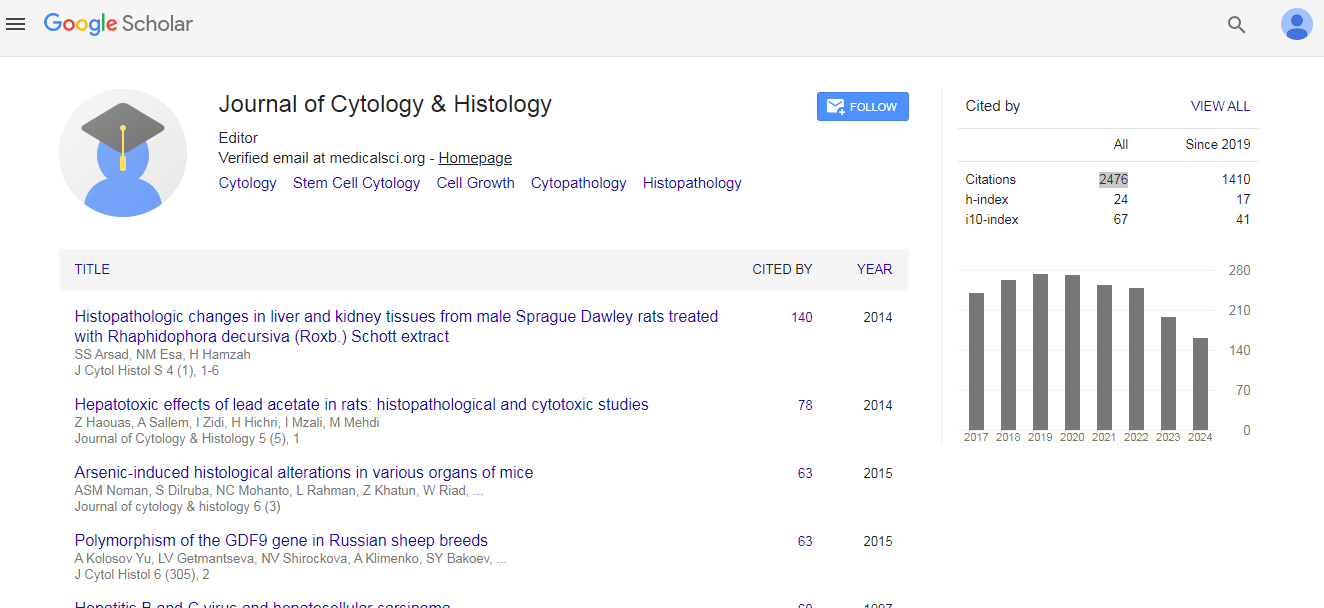
Journal of Cytology & Histology received 2476 citations as per Google Scholar report