Short Communication - (2025) Volume 16, Issue 4
Received: 01-Jul-2025, Manuscript No. jpm-26-179441;
Editor assigned: 03-Jul-2025, Pre QC No. P-179441;
Reviewed: 17-Jul-2025, QC No. Q-179441;
Revised: 22-Jul-2025, Manuscript No. R-179441;
Published:
29-Jul-2025
, DOI: 10.37421/2090-0902.2025.16.549
Citation: Lindström, Johan. ”Advanced Modeling Techniques For Complex Physical Systems.” J Phys Math 16 (2025):549.
Copyright: © 2025 Lindström J. This is an open-access article distributed under the terms of the Creative Commons Attribution License, which permits unrestricted use, distribution and reproduction in any medium, provided the original author and source are credited.
The study of complex physical systems has been revolutionized by the application of sophisticated mathematical and computational tools. Network science offers a powerful lens through which to examine the interconnectedness and emergent properties of these systems, analyzing how the structure of connections influences macroscopic behavior [1].
Similarly, agent-based modeling provides a bottom-up approach, simulating the dynamics of complex physical systems by focusing on the interactions of individual components. This method allows for the exploration of collective behaviors that are often difficult to predict from first principles [2].
In parallel, the field of machine learning, particularly neural networks, has emerged as a potent technique for learning effective models of complex physical systems. These data-driven approaches can capture intricate non-linear dynamics and uncover hidden relationships within observational data, offering a complementary perspective to traditional analytical methods [3].
The inherent randomness present in many complex physical systems necessitates the use of stochastic processes in their modeling. Diffusion processes and random walks are particularly valuable for describing particle movement, reaction kinetics, and energy transport, emphasizing the importance of incorporating uncertainty for accurate predictions [4].
Addressing the challenge of scale, multi-scale modeling frameworks have been developed to integrate models that operate at different temporal and spatial resolutions. This approach is crucial for understanding phenomena that span from microscopic interactions to macroscopic system behavior, finding applications in diverse fields such as climate modeling and materials science [5].
For systems that evolve over time, dynamic network models are essential for capturing time-varying connectivity and interactions. These models are critical for analyzing phenomena like synchronization and cascading failures, with examples found in electrical grids and biological networks [6].
The fundamental behavior of complex physical systems with interconnected components can be effectively described using differential equations. The formulation of coupled ordinary and partial differential equations is key to modeling the interactions and evolutionary trajectories of these systems, with applications in fluid dynamics and chemical kinetics [7].
Anomalous diffusion and complex dynamics in physical systems can be further elucidated through the application of fractional calculus. Fractional differential equations are adept at capturing non-local interactions and memory effects, offering a more accurate representation for certain complex phenomena compared to traditional integer-order models [8].
Furthermore, the statistical properties of complex networks are intrinsically linked to physical phenomena. By applying concepts from statistical physics, researchers can analyze network metrics such as degree distribution and clustering coefficients, revealing universal properties that manifest across various physical systems [9].
Finally, advanced simulation techniques and computational power play a pivotal role in modeling complex physical systems. The implementation of sophisticated algorithms for phenomena like turbulence, molecular dynamics, and quantum systems underscores the indispensable contribution of computation to theoretical understanding [10].
The intricate behavior of complex networks within physical systems is effectively investigated through mathematical modeling, with graph theory and statistical mechanics providing insights into emergent properties across diverse fields. The predictive power of these network models is crucial for analyzing system stability and the impact of network topology on macroscopic phenomena [1].
Agent-based modeling offers a distinct yet complementary approach by simulating the dynamics of complex physical systems through the lens of individual component interactions. This methodology is instrumental in understanding how collective behaviors arise, particularly in phenomena like phase transitions and self-organized structures within condensed matter physics [2].
Machine learning techniques, especially neural networks, have emerged as powerful tools for learning effective models of complex physical systems. These data-driven methods excel at capturing non-linear dynamics and identifying hidden relationships in observational data, providing a viable alternative to established analytical approaches in areas such as fluid dynamics and plasma physics [3].
The inherent randomness in complex physical systems is adeptly addressed by stochastic processes. Concepts like diffusion processes and random walks are fundamental for modeling particle movement, reaction kinetics, and energy transport, highlighting the necessity of incorporating uncertainty for precise system predictions [4].
Multi-scale modeling provides a critical framework for tackling the complexity of physical phenomena by integrating models that operate at different temporal and spatial resolutions. This integrated approach is vital for comprehending systems from their microscopic underpinnings to their macroscopic manifestations, with applications ranging from climate science to materials engineering [5].
Dynamic network models are specifically designed to analyze physical systems that evolve over time, focusing on changing connectivity and interactions. Such models are indispensable for understanding phenomena like synchronization and the propagation of failures in interconnected systems, exemplified by electrical grids and biological networks [6].
Differential equations serve as a foundational tool for modeling the behavior of complex physical systems characterized by interconnected components. The formulation of coupled ordinary and partial differential equations precisely describes the interactions and temporal evolution of these systems, finding utility in fields like fluid dynamics and chemical kinetics [7].
Fractional calculus offers a specialized mathematical framework for modeling anomalous diffusion and complex dynamics, particularly where non-local interactions and memory effects are significant. Fractional differential equations provide a more nuanced and accurate description for certain complex phenomena compared to their integer-order counterparts [8].
The statistical properties of complex networks are intrinsically linked to physical phenomena, and the application of statistical physics concepts is key to their analysis. Metrics such as degree distribution and clustering coefficients reveal universal characteristics that transcend specific physical systems, offering broad insights [9].
Finally, computational modeling, powered by advanced simulation techniques, is essential for the in-depth study of complex physical systems. The ability to simulate phenomena like turbulence, molecular dynamics, and quantum systems underscores the critical role of computational power in advancing our theoretical understanding and predictive capabilities [10].
This collection of research explores various advanced methodologies for understanding and modeling complex physical systems. Network science, agent-based modeling, and machine learning techniques, particularly neural networks, offer distinct yet powerful approaches to capture intricate behaviors and emergent properties. Stochastic processes and fractional calculus are employed to address inherent randomness and anomalous dynamics, respectively. Multi-scale and dynamic network models provide frameworks for systems operating at different scales or evolving over time. Differential equations form a fundamental basis for describing interactions and system evolution, while statistical physics aids in analyzing the properties of complex networks. Advanced computational modeling and simulation are crucial for simulating complex phenomena and advancing theoretical understanding across diverse fields.
None
None
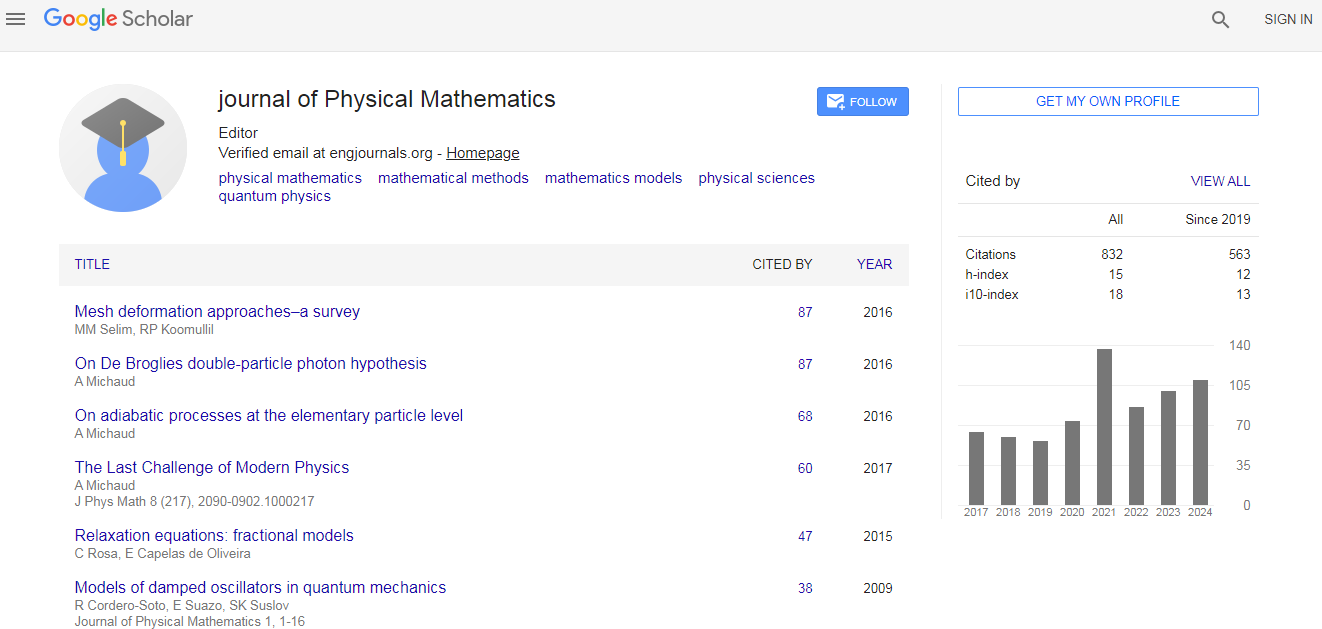
Physical Mathematics received 686 citations as per Google Scholar report