Perspective - (2025) Volume 14, Issue 5
Received: 01-Oct-2025, Manuscript No. jme-26-185229;
Editor assigned: 03-Oct-2025, Pre QC No. P-185229;
Reviewed: 17-Oct-2025, QC No. Q-185229;
Revised: 22-Oct-2025, Manuscript No. R-185229;
Published:
29-Oct-2025
, DOI: 10.37421/2169-0022.2025.14.746
Citation: Silva, Mariana. ”Advanced Materials: Mechanical Properties
and Performance.” J Material Sci Eng 14 (2025):746.
Copyright: © 2025 Silva M. This is an open-access article distributed under the terms of the Creative Commons Attribution License, which permits unrestricted use, distribution
and reproduction in any medium, provided the original author and source are credited.
The field of materials science is continuously advancing, driven by the demand for materials with superior mechanical properties for a wide range of applications. Metallic alloys, in particular, are undergoing significant development to meet these stringent requirements. One area of intense research involves the mechanical characterization of novel metallic alloys, with a specific focus on their tensile strength, ductility, and fatigue resistance. Advanced microstructural analysis is revealing intricate correlations between material structure and performance, offering crucial insights for the design of next-generation structural components [1].
Furthermore, the exploration of high-entropy alloys (HEAs) has opened new avenues in materials design. These alloys, typically composed of five or more principal elements in equimolar or near-equimolar ratios, exhibit unique properties that differ significantly from conventional alloys. Research into the creep behavior of HEAs at elevated temperatures, utilizing in-situ mechanical testing and electron microscopy, has identified key deformation mechanisms that are crucial for understanding their long-term structural integrity under stress and heat [2].
Composite materials are also at the forefront of materials innovation. Advanced aluminum matrix composites reinforced with carbon nanotubes are being investigated for their enhanced mechanical properties. The research in this area highlights the critical role of interfacial bonding strength and the dispersion of nanoparticles in dictating the material's resistance to crack propagation, a key factor for structural durability [3].
Shape memory alloys (SMAs) represent another class of advanced materials with remarkable functional properties. The study of their superelastic and damping properties is essential for their use in structural applications. Through a combination of experimental testing and sophisticated simulation techniques, researchers are elucidating the complex interplay between phase transformations and energy dissipation mechanisms, which are fundamental to their unique behavior [4].
Fatigue behavior remains a critical consideration for materials used in cyclic loading conditions. The study of fatigue crack growth in advanced steels, particularly under variable amplitude loading, is vital for predicting the service life of components operating in demanding environments. High-resolution fractography and detailed microstructural analysis are providing the essential data needed for these life prediction models [5].
Wear resistance and tribological performance are paramount in applications involving surface contact and friction. Ceramic-metal composites are being explored for their potential to offer enhanced wear resistance. Investigations into these materials, employing microhardness testing and electron microscopy, reveal how the distribution of ceramic phases critically influences wear mechanisms, such as abrasion and adhesion [6].
Metallic glasses, characterized by their amorphous atomic structure, possess unique mechanical properties that are distinct from crystalline metals. Understanding their mechanical response under dynamic impact is crucial for their application in areas requiring high energy absorption. Experiments using specialized equipment have demonstrated that shear band formation and propagation are the primary mechanisms responsible for the energy absorption capabilities of these materials [7].
Superalloys are indispensable in high-temperature applications, particularly in the aerospace industry, due to their excellent mechanical strength and resistance to creep. Research into the high-temperature mechanical behavior of these alloys, involving detailed tensile testing and creep analysis, is vital for optimizing their performance. Key factors such as precipitate strengthening and grain boundary stability are being investigated for their influence on material performance at elevated temperatures [8].
Magnesium alloys are gaining attention due to their low density and potential for lightweight structural applications. However, their mechanical properties, especially their behavior under sustained loads, require thorough investigation. Studies on the indentation creep and hardness of magnesium alloys, using advanced nanoindentation techniques, are shedding light on the influence of alloying elements and microstructure on time-dependent deformation mechanisms [9].
Finally, the surface integrity of materials plays a significant role in their overall performance, particularly in fatigue-critical applications. The study of bending fatigue performance of advanced steels with different surface treatments is crucial for optimizing their reliability. By analyzing fatigue crack initiation and propagation mechanisms through microscopy, valuable data is being generated for enhancing surface engineering strategies and improving component lifespan [10].
The mechanical characterization of novel metallic alloys is a fundamental aspect of modern materials science, encompassing the evaluation of tensile strength, ductility, and fatigue resistance. Detailed microstructural analysis has been instrumental in identifying a direct correlation between engineered grain boundaries and enhanced fracture toughness. This understanding is pivotal for the development of advanced structural materials capable of withstanding demanding operational conditions [1].
The study of creep behavior in high-entropy alloys (HEAs) at elevated temperatures provides critical insights into their long-term stability. Through the application of in-situ mechanical testing and advanced electron microscopy techniques, researchers have been able to pinpoint the primary deformation mechanisms, such as dislocation glide and grain boundary sliding. These mechanisms significantly impact the structural integrity of HEAs over extended periods of service [2].
In the realm of composite materials, the investigation into aluminum matrix composites reinforced with carbon nanotubes has revealed significant enhancements in mechanical properties. A key finding is the strong influence of interfacial bonding strength and the homogeneous dispersion of nanoparticles on the material's capacity to resist crack propagation. This knowledge is crucial for designing more robust composite structures [3].
Shape memory alloys (SMAs) exhibit unique superelastic and damping properties that make them valuable for specialized structural applications. Research efforts have focused on elucidating the fundamental mechanisms underlying these properties. By combining experimental data with molecular dynamics simulations, the role of phase transformations in facilitating energy dissipation has been thoroughly investigated [4].
Understanding and predicting fatigue crack growth in advanced steels, particularly under conditions of variable amplitude loading, is essential for ensuring the reliability of critical components. Comprehensive studies employing high-resolution fractography and detailed microstructural analysis are generating the empirical data necessary for accurate service life predictions in harsh operational environments [5].
Tribological behavior and wear resistance are critical performance metrics for materials subjected to friction and contact. In ceramic-metal composites, the distribution and characteristics of the ceramic phases have been found to significantly influence wear mechanisms, including abrasion and adhesion. Microhardness testing and scanning electron microscopy are key analytical tools in these investigations [6].
Metallic glasses, with their unique amorphous structure, exhibit fascinating mechanical responses under dynamic loading. Research has shown that the energy absorption capabilities of these materials are intrinsically linked to the formation and propagation of shear bands. Experiments utilizing split-Hopkinson pressure bar techniques have provided direct evidence for these mechanisms under high strain rate compression [7].
The high-temperature mechanical behavior of superalloys is of paramount importance for their application in extreme environments, such as those encountered in aerospace. Studies on these materials highlight the critical roles of precipitate strengthening and the stability of grain boundaries in maintaining performance at elevated temperatures, as revealed by tensile testing and creep analysis [8].
Magnesium alloys, despite their lightweight advantages, present challenges related to their mechanical behavior, particularly under sustained loads. Research employing nanoindentation techniques, coupled with in-situ microscopy, has been effective in revealing how alloying elements and microstructural variations influence time-dependent deformation mechanisms such as indentation creep [9].
Surface treatments can profoundly impact the fatigue performance of materials, especially in high-stress applications like automotive components. Investigations into the bending fatigue behavior of surface-treated steels have provided valuable insights into fatigue crack initiation and propagation mechanisms. These findings are directly applicable to optimizing surface engineering strategies for enhanced durability [10].
This collection of research explores the mechanical properties of various advanced materials, including metallic alloys, high-entropy alloys, composites, shape memory alloys, metallic glasses, and superalloys. Studies focus on tensile strength, ductility, fatigue resistance, creep behavior, wear resistance, and dynamic impact response. Key findings highlight the importance of microstructural features, interfacial strength, phase transformations, and surface treatments in dictating material performance. Advanced characterization techniques such as electron microscopy, nanoindentation, and specialized impact testing are employed to elucidate deformation mechanisms and predict service life.
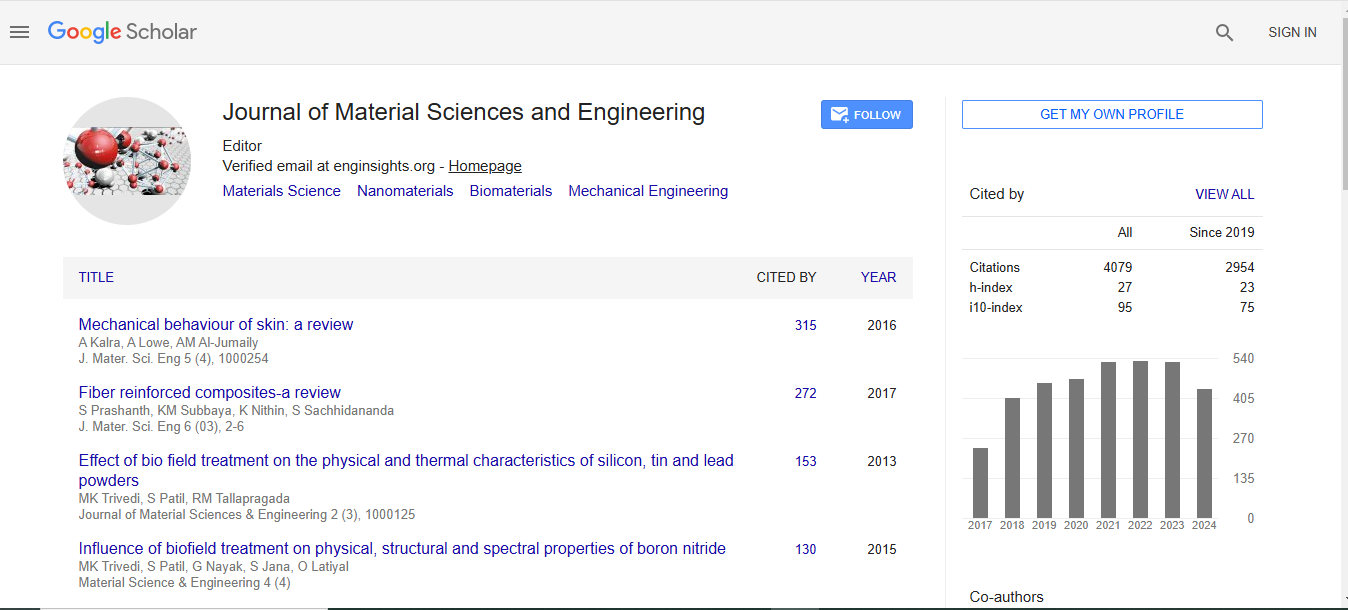
Journal of Material Sciences & Engineering received 3677 citations as per Google Scholar report