Brief Report - (2025) Volume 11, Issue 4
Received: 01-Aug-2025, Manuscript No. jctt-26-188413;
Editor assigned: 04-Aug-2025, Pre QC No. P-188413;
Reviewed: 18-Aug-2025, QC No. Q-188413;
Revised: 22-Aug-2025, Manuscript No. R-188413;
Published:
29-Aug-2025
, DOI: 10.37421/2471-9323.2024.10.331
Citation: Nowak, Katarzyna. ”Advanced Hair and Skin Health: Innovation and Biologics.” J Cosmo Tricho 11 (2025):331.
Copyright: © 2025 Nowak K. This is an open-access article distributed under the terms of the Creative Commons Attribution License, which permits unrestricted use, distribution and reproduction in any medium, provided the original author and source are credited.
The intricate connection between hair and skin health, often termed 'Whispering Glow,' is explored through advancements in trichology and aesthetic biotechnology. This field investigates how topical treatments, innovative formulations, and understanding of the skin-hair follicle microenvironment contribute to enhanced vitality and appearance. Research highlights the importance of addressing underlying biological pathways for effective hair growth stimulation and skin rejuvenation, moving beyond superficial cosmetic solutions to integrated dermatological and cosmetic science [1].
Investigating novel botanical extracts and peptides for their efficacy in promoting hair follicle regeneration and improving skin barrier function is a key area. This research focuses on how these active ingredients interact with cellular signaling pathways to stimulate keratinocyte and fibroblast activity, ultimately leading to healthier hair and more resilient skin [2].
The role of advanced biotechnological approaches, such as exosome therapy and stem cell conditioned media, in revitalizing hair follicles and improving skin texture is critically examined. These technologies offer a promising avenue for stimulating endogenous regenerative processes, addressing hair thinning and skin aging with a focus on bioactivity and targeted delivery [3].
Understanding the microbiome of the scalp and skin is crucial for developing effective haircare and skincare regimens. This research explores how imbalances in microbial communities can impact hair follicle health and lead to various dermatological conditions, and how targeted interventions can restore balance for improved outcomes [4].
The biophysical properties of the hair shaft and the stratum corneum are examined to understand how they influence product penetration and overall hair and skin appearance. Innovations in formulation science aim to enhance the delivery of active ingredients, improving moisture retention, strength, and radiance [5].
The influence of aging on the hair follicle stem cell niche and dermal papilla is a significant area of study. Research focuses on identifying factors that contribute to follicular miniaturization and hair loss in aging individuals, and exploring interventions that can support follicular stem cell function and dermal papilla viability [6].
Nutritional factors and their impact on hair and skin health are consistently highlighted. This work delves into how specific vitamins, minerals, and fatty acids support keratin synthesis, cellular turnover, and antioxidant defense mechanisms, crucial for maintaining the structural integrity and appearance of hair and skin [7].
The exploration of photobiomodulation and its effects on hair follicle regeneration and skin rejuvenation is an emerging area. Understanding how specific wavelengths of light can modulate cellular activity and promote tissue repair offers new possibilities for non-invasive aesthetic treatments [8].
The impact of environmental stressors, such as UV radiation and pollution, on hair and skin integrity is a growing concern. This research investigates the mechanisms of oxidative damage and explores protective strategies, including the use of antioxidants and barrier-enhancing ingredients [9].
Advanced diagnostic techniques for assessing hair and scalp conditions, such as trichoscopy and molecular profiling, are revolutionizing personalized treatment approaches. These methods allow for a deeper understanding of individual hair loss patterns and scalp issues, leading to more targeted and effective interventions [10].
The interplay between hair and skin health is a multifaceted field, with trichology and aesthetic biotechnology at its forefront, examining topical treatments and innovative formulations that enhance vitality and appearance by understanding the skin-hair follicle microenvironment. This research emphasizes addressing underlying biological pathways for effective hair growth stimulation and skin rejuvenation, moving beyond superficial solutions to an integrated dermatological and cosmetic science approach [1].
Novel botanical extracts and peptides are being investigated for their potential in promoting hair follicle regeneration and improving skin barrier function. These active ingredients are studied for their interaction with cellular signaling pathways, aiming to stimulate keratinocyte and fibroblast activity for healthier hair and more resilient skin [2].
Advanced biotechnological methods, including exosome therapy and stem cell conditioned media, are critically assessed for their capacity to revitalize hair follicles and improve skin texture. These cutting-edge technologies hold promise for stimulating endogenous regenerative processes to combat hair thinning and skin aging through bioactivity and targeted delivery [3].
The significance of the scalp and skin microbiome is increasingly recognized in developing effective haircare and skincare. Research is exploring how microbial imbalances can adversely affect hair follicle health and lead to dermatological issues, proposing targeted interventions to restore a balanced microbial environment for improved outcomes [4].
Understanding the biophysical properties of the hair shaft and the stratum corneum is vital for optimizing product penetration and enhancing hair and skin aesthetics. Formulation science innovations are focused on improving the delivery of active ingredients to boost moisture retention, strength, and radiance [5].
The aging process's influence on the hair follicle stem cell niche and dermal papilla is a critical research area. Studies aim to identify factors contributing to follicular miniaturization and hair loss in older individuals, seeking interventions to support the function of follicular stem cells and the viability of the dermal papilla [6].
Nutritional factors play a consistently highlighted role in maintaining hair and skin health. Research examines how specific vitamins, minerals, and fatty acids support essential processes like keratin synthesis, cellular turnover, and antioxidant defense, which are crucial for the structural integrity and appearance of hair and skin [7].
Photobiomodulation is an emerging technique being explored for its effects on hair follicle regeneration and skin rejuvenation. The understanding of how specific light wavelengths can modulate cellular activity and facilitate tissue repair opens new avenues for non-invasive aesthetic treatments [8].
Environmental stressors, including UV radiation and pollution, pose a growing threat to hair and skin integrity. Investigations focus on the mechanisms of oxidative damage caused by these factors and the development of protective strategies, such as antioxidant use and barrier-enhancing ingredients [9].
State-of-the-art diagnostic tools like trichoscopy and molecular profiling are transforming personalized approaches to hair and scalp health assessment. These advanced techniques enable a deeper comprehension of individual hair loss patterns and scalp concerns, leading to more precise and effective treatment plans [10].
Current research in hair and skin health is driven by advancements in trichology and aesthetic biotechnology, focusing on integrated dermatological and cosmetic science. This includes exploring novel botanical extracts and peptides for follicle regeneration and barrier function, alongside sophisticated biotechnological approaches like exosome therapy and stem cell conditioned media for revitalizing hair and skin. The scalp and skin microbiome's role in dermatological conditions is also a key area of investigation. Understanding biophysical properties and the impact of aging on hair follicles are crucial for developing effective treatments. Nutritional factors and environmental stressors are being studied for their influence on hair and skin integrity, with photobiomodulation emerging as a promising non-invasive therapy. Finally, advanced diagnostic techniques are revolutionizing personalized treatment strategies.
None
None
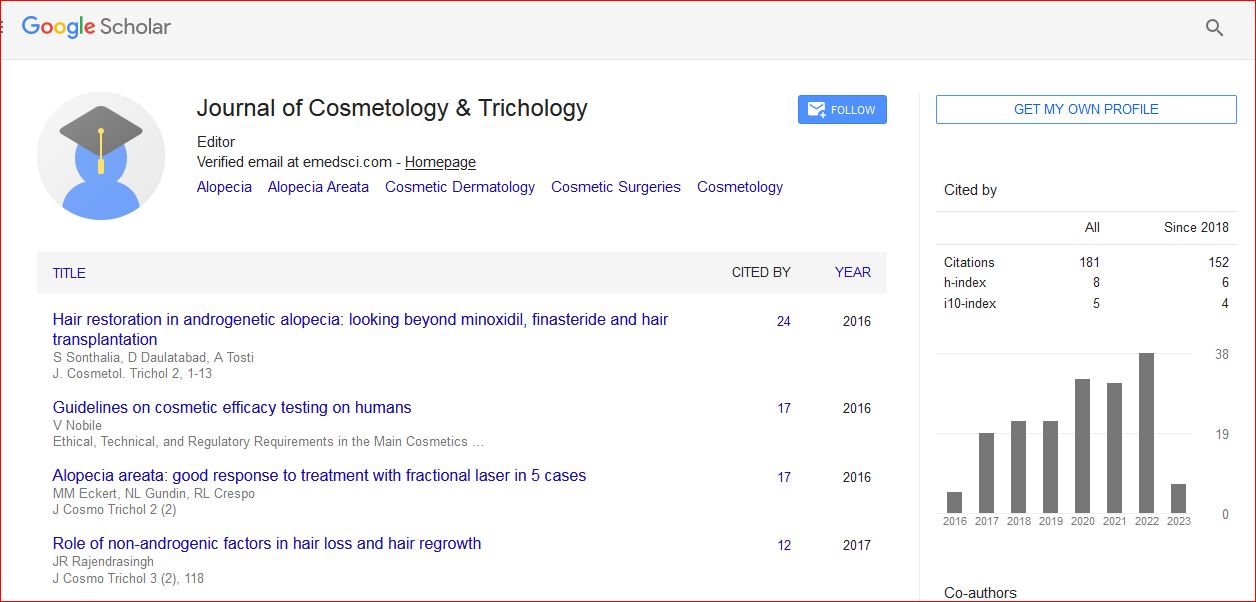
Journal of Cosmetology & Trichology received 180 citations as per Google Scholar report