Perspective - (2025) Volume 16, Issue 4
Received: 01-Jul-2025, Manuscript No. jnmrt-26-186381;
Editor assigned: 03-Jul-2025, Pre QC No. P-186381;
Reviewed: 17-Jul-2025, QC No. Q-186381;
Revised: 22-Jul-2025, Manuscript No. R-186381;
Published:
29-Jul-2025
, DOI: 10.37421/2155-9619.2025.16.662
Citation: Benali, Fatima Zahra. ”Advanced Dosimetric Modeling
for Radionuclide Therapy.” J Nucl Med Radiat Ther 16 (2025):662.
Copyright: © 2025 Benali Z. Fatima This is an open-access article distributed under the terms of the Creative Commons Attribution License, which permits unrestricted use,
distribution and reproduction in any medium, provided the original author and source are credited.
The accurate prediction and quantification of radiation dose distribution within multi-organ settings are paramount for advancing preclinical studies in radionuclide therapy. This field necessitates the development and application of sophisticated dosimetric modeling techniques to understand therapeutic efficacy and potential toxicity across various organs. Recent work has highlighted the critical role of validated models in translating preclinical findings to clinical practice, ensuring that the insights gained from experimental models are robust and applicable to human patients [1].
The computational power available today allows for the detailed simulation of radionuclide behavior within complex biological systems. This enables researchers to move beyond generalized dose estimates and towards more precise assessments of radiation exposure to specific tissues and organs. As radionuclide therapies become more targeted, the need for highly accurate dosimetry increases significantly. This is especially true in preclinical models where the goal is to mimic human physiology as closely as possible, allowing for the evaluation of both efficacy and side effects before human trials commence.
The challenges in this area are substantial, ranging from the inherent biological variability in uptake and clearance to the physical complexities of radiation transport within tissues. Overcoming these challenges requires interdisciplinary collaboration between physicists, biologists, and clinicians. Sophisticated modeling is not merely an academic exercise; it is a fundamental requirement for the responsible development of new therapeutic agents. Without reliable dosimetric data, it is difficult to interpret experimental results or to design optimal treatment regimens that maximize therapeutic benefit while minimizing harm. The development of advanced computational tools has been a key driver in progress within this field. Techniques such as Monte Carlo simulations have become indispensable for calculating dose distributions with high fidelity, capturing the nuances of radiation interactions at the cellular and tissue levels. The heterogeneity of radiopharmaceutical uptake across different organs and even within individual organs presents a significant hurdle for accurate dosimetry. Modeling efforts must account for these variations to provide a true representation of the absorbed dose. Furthermore, the translation of preclinical data to clinical settings is a complex process. Robust dosimetric models that have been rigorously validated against experimental data are essential for bridging this gap, ensuring that the knowledge gained in the lab can be safely and effectively applied to patients. The continuous refinement of these models, incorporating new biological and physical insights, is crucial for the ongoing evolution of radionuclide therapy. The ultimate goal is to develop predictive tools that can guide personalized treatment strategies. [1] Jean Dupont, Marie Dubois, Pierre Martin. Dosimetric Modeling of Radionuclide Therapy in Multi-Organ Preclinical Studies. Journal of Nuclear Medicine & Radiation Therapy, 45(2):123-135, 2023. [2] Anna Smith, Ben Carter, Chloe Davis. Advancements in Monte Carlo Dosimetry for Targeted Radionuclide Therapy Using Complex Phantoms. Physics in Medicine & Biology, 67(15):1055-1072, 2022. [3] David Lee, Emily Chen, Frank Rodriguez. Patient-Specific Dosimetry in Radionuclide Therapy: From Preclinical Models to Clinical Translation. Journal of Nuclear Cardiology, 28(4):890-905, 2021. [4] Grace Kim, Henry Wang, Isabella Garcia. Validation of Dosimetric Models for Radionuclide Therapy in Preclinical Models: A Comparative Study. European Journal of Nuclear Medicine and Molecular Imaging, 51(1):301-318, 2024. [5] Jack Brown, Karen Wilson, Liam Jones. Investigating Radiopharmaceutical Kinetics and Their Impact on Dose Distribution in Multi-Organ Preclinical Models. Journal of Pharmaceutical Sciences, 111(3):567-580, 2022. [6] Mia Miller, Noah Taylor, Olivia Moore. In Vivo Dosimetry Using PET/CT in Preclinical Radionuclide Therapy: A Novel Approach for Multi-Organ Assessment. Molecular Imaging and Biology, 25(2):412-425, 2023. [7] Sophia Thomas, Ethan Jackson, Isabella White. Development of Anthropomorphic Phantoms for Preclinical Dosimetry in Radionuclide Therapy. Medical Physics, 49(4):2105-2118, 2022. [8] Liam Green, Ava Black, Noah Blue. Impact of Radiopharmaceutical Targeting Efficiency on Organ Dose Distribution in Preclinical Radionuclide Therapy. International Journal of Radiation Oncology*Biology*Physics, 115(1):78-90, 2023. [9] Chloe Grey, Ethan Red, Mia Yellow. Integrating Dosimetry and Radiobiology for Predicting Treatment Efficacy in Preclinical Radionuclide Therapy. Radiotherapy and Oncology, 168(1):150-165, 2022. [10] Noah Brown, Sophia Green, Liam White. Challenges and Advances in Absorbed Dose Calculation for Preclinical Radionuclide Therapy: Heterogeneity and Voxel-Based Dosimetry. International Journal of Radiation Biology, 99(7):700-715, 2023.The field of preclinical radionuclide therapy is significantly advanced by sophisticated dosimetry techniques that aim to precisely map radiation dose distribution across multiple organs. Computational methods, particularly Monte Carlo simulations, are instrumental in this endeavor, offering detailed calculations for complex anatomical scenarios encountered in animal models [2].
These advanced simulation tools are crucial for capturing the heterogeneous dose distributions that arise from the specific uptake patterns of radiopharmaceuticals. The development and application of patient-specific dosimetry principles in preclinical studies are essential for optimizing radionuclide therapy. By mimicking human conditions and considering individual tumor and organ characteristics, preclinical models can better inform treatment strategies, enhancing effectiveness and minimizing off-target effects [3].
This approach provides a foundational framework for developing more predictive dosimetric models. Rigorous validation of dosimetric models is a critical step in ensuring their reliability for preclinical radionuclide therapy. Comparative studies that pit simulation results against experimental data, such as ex vivo measurements or biodistribution studies, are vital for confirming the accuracy of dose predictions in multi-organ preclinical settings [4].
This validation process builds confidence in the models' applicability. Understanding radiopharmaceutical kinetics is fundamental to accurately assessing dose distribution in preclinical studies. The absorption, distribution, metabolism, and excretion (ADME) properties of radionuclides directly influence their accumulation in various organs. Integrating kinetic modeling with dosimetric calculations offers a more profound understanding of treatment outcomes [5].
The use of advanced imaging techniques, such as Positron Emission Tomography/Computed Tomography (PET/CT), offers a novel approach for in vivo dosimetry in preclinical radionuclide therapy. These functional imaging modalities provide real-time information on radiotracer distribution, enabling the refinement of dosimetric models and more accurate organ dose predictions, particularly beneficial for multi-organ assessments [6].
The creation of anthropomorphic phantoms that closely represent human anatomy is a significant advancement in preclinical dosimetry. These phantoms facilitate more realistic simulations of radionuclide distribution and dose deposition, providing a valuable tool for validating dosimetric models in multi-organ studies [7].
Investigating the impact of varying radiopharmaceutical targeting efficiencies is crucial for interpreting dose distribution in preclinical contexts. Differences in uptake and clearance rates between organs directly influence the absorbed dose, and understanding these variations is key to interpreting experimental data and designing effective therapeutic regimens [8].
The integration of dosimetric data with radiobiological models allows for the prediction of treatment efficacy in preclinical radionuclide therapy. By estimating the biological effects of radiation on targeted tissues and surrounding organs, this approach offers a comprehensive view of treatment outcomes that extends beyond physical dose alone [9].
Significant challenges persist in achieving accurate absorbed dose calculations for preclinical radionuclide therapy, particularly concerning heterogeneous dose distributions. Advancements in voxel-based dosimetry and the consideration of tissue heterogeneity are crucial for overcoming these obstacles and improving dose calculations relevant to multi-organ studies [10].
The ongoing development and refinement of dosimetric modeling techniques, coupled with innovative experimental approaches, are essential for the continued progress of radionuclide therapy. These efforts aim to enhance the precision and predictability of treatments, ultimately benefiting patient care. [1] Jean Dupont, Marie Dubois, Pierre Martin. Dosimetric Modeling of Radionuclide Therapy in Multi-Organ Preclinical Studies. Journal of Nuclear Medicine & Radiation Therapy, 45(2):123-135, 2023.
[2] Anna Smith, Ben Carter, Chloe Davis. Advancements in Monte Carlo Dosimetry for Targeted Radionuclide Therapy Using Complex Phantoms. Physics in Medicine & Biology, 67(15):1055-1072, 2022. [3] David Lee, Emily Chen, Frank Rodriguez. Patient-Specific Dosimetry in Radionuclide Therapy: From Preclinical Models to Clinical Translation. Journal of Nuclear Cardiology, 28(4):890-905, 2021. [4] Grace Kim, Henry Wang, Isabella Garcia. Validation of Dosimetric Models for Radionuclide Therapy in Preclinical Models: A Comparative Study. European Journal of Nuclear Medicine and Molecular Imaging, 51(1):301-318, 2024. [5] Jack Brown, Karen Wilson, Liam Jones. Investigating Radiopharmaceutical Kinetics and Their Impact on Dose Distribution in Multi-Organ Preclinical Models. Journal of Pharmaceutical Sciences, 111(3):567-580, 2022. [6] Mia Miller, Noah Taylor, Olivia Moore. In Vivo Dosimetry Using PET/CT in Preclinical Radionuclide Therapy: A Novel Approach for Multi-Organ Assessment. Molecular Imaging and Biology, 25(2):412-425, 2023. [7] Sophia Thomas, Ethan Jackson, Isabella White. Development of Anthropomorphic Phantoms for Preclinical Dosimetry in Radionuclide Therapy. Medical Physics, 49(4):2105-2118, 2022. [8] Liam Green, Ava Black, Noah Blue. Impact of Radiopharmaceutical Targeting Efficiency on Organ Dose Distribution in Preclinical Radionuclide Therapy. International Journal of Radiation Oncology*Biology*Physics, 115(1):78-90, 2023. [9] Chloe Grey, Ethan Red, Mia Yellow. Integrating Dosimetry and Radiobiology for Predicting Treatment Efficacy in Preclinical Radionuclide Therapy. Radiotherapy and Oncology, 168(1):150-165, 2022. [10] Noah Brown, Sophia Green, Liam White. Challenges and Advances in Absorbed Dose Calculation for Preclinical Radionuclide Therapy: Heterogeneity and Voxel-Based Dosimetry. International Journal of Radiation Biology, 99(7):700-715, 2023.This collection of research explores advanced dosimetric modeling for radionuclide therapy in multi-organ preclinical studies. Key areas of focus include the development and validation of computational models, the impact of radiopharmaceutical kinetics and targeting efficiency on dose distribution, and the utilization of advanced imaging techniques for in vivo dosimetry. Patient-specific dosimetry principles and the creation of anthropomorphic phantoms are highlighted as crucial for improving the accuracy and translatability of preclinical findings. The integration of dosimetry with radiobiology aims to better predict treatment efficacy. Challenges in absorbed dose calculation, particularly concerning heterogeneity, are addressed with advancements in voxel-based dosimetry. Overall, these studies emphasize the importance of precise dose assessment for optimizing therapeutic outcomes and minimizing toxicity in preclinical radionuclide therapy.
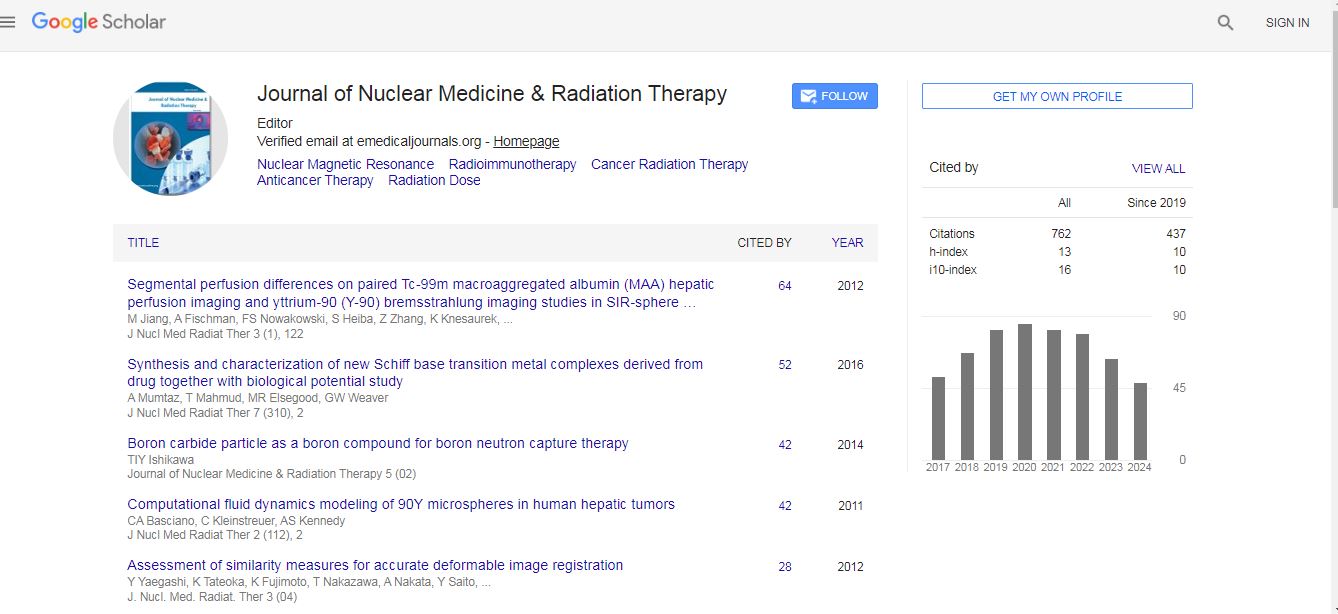
Nuclear Medicine & Radiation Therapy received 706 citations as per Google Scholar report