Commentary - (2025) Volume 16, Issue 3
Received: 02-Jun-2025, Manuscript No. jbsbe-26-183300;
Editor assigned: 04-Jun-2025, Pre QC No. P-183300;
Reviewed: 18-Jun-2025, QC No. Q-183300;
Revised: 23-Jun-2025, Manuscript No. R-183300;
Published:
30-Jun-2025
, DOI: 10.37421/2165-6210.2025.16.506
Citation: Leclerc, Andre. ”Advanced Data Processing for Biosensor Technology.” J Biosens Bioelectron 16 (2025):506.
Copyright: © 2025 Leclerc A. This is an open-access article distributed under the terms of the Creative Commons Attribution License, which permits unrestricted use, distribution and reproduction in any medium, provided the original author and source are credited.
The realm of biosensor technology is undergoing a profound transformation, driven by the imperative to extract actionable intelligence from increasingly complex biological data. Signal processing and data analytics have emerged as cornerstones in this endeavor, providing the essential tools and methodologies to unlock the full potential of biosensor systems for diverse applications, ranging from disease diagnosis to environmental monitoring [1].
The sophistication of these analytical approaches directly correlates with the ability to discern subtle biological signals from noisy backgrounds, thereby enhancing the overall performance and reliability of biosensing platforms. Advanced algorithms are key to addressing fundamental challenges such as noise reduction, signal amplification, and precise feature extraction, which are critical for accurate analyte quantification and definitive disease identification. The advent of machine learning, particularly deep learning architectures, has ushered in a new era of biosignal analysis. These powerful computational tools are adept at identifying intricate patterns within vast datasets that might elude traditional analytical methods. Their application to biosensor data promises significant improvements in the early detection of diseases and the identification of specific biomarkers, effectively translating raw sensor outputs into meaningful diagnostic information [2].
This transformative power of artificial intelligence is reshaping how we interpret biological signals, moving towards more predictive and personalized healthcare solutions. The continuous evolution of deep learning models, trained on extensive biological datasets, offers unprecedented opportunities for enhancing diagnostic accuracy and efficiency. A fundamental challenge in biosensor data processing is the inherent presence of noise, which can significantly degrade the quality and interpretability of the acquired signals. Consequently, robust noise reduction techniques are indispensable for ensuring the accuracy and sensitivity of biosensing measurements. Various filtering methodologies, including sophisticated approaches like wavelet denoising and adaptive filtering, have been developed and compared to systematically enhance signal-to-noise ratios, particularly crucial when dealing with low-concentration analytes [3].
The development and refinement of these techniques are paramount for the reliable operation of biosensors in real-world scenarios. Beyond noise reduction, the effective extraction of relevant features from raw biosensor signals is paramount for translating these signals into diagnostic indicators. Feature extraction strategies are tailored to the specific characteristics of different biosensor outputs, such as those from electrochemical or optical platforms. Novel approaches are continually being developed to identify features that possess enhanced discriminative power, especially when analyzing complex biological samples, thereby improving the accuracy of disease detection and classification [4].
The selection of appropriate features significantly influences the performance of downstream analytical models. The increasing demand for real-time monitoring and rapid diagnostic capabilities has spurred the integration of edge computing with biosensor systems. This paradigm shift allows for the immediate processing of sensor data directly at the point of care or within the sensing device itself. Such distributed processing reduces latency, minimizes data transmission overhead, and enables faster clinical decision-making, particularly in scenarios requiring continuous health monitoring or remote patient management [5].
Edge computing empowers biosensors to deliver timely insights, overcoming the limitations of centralized cloud-based processing. Ensuring the reliability and validity of biosensor data is a critical aspect of their deployment in diagnostic and clinical settings. Statistical methods play a pivotal role in establishing a rigorous framework for data validation and quality control. Techniques encompassing calibration procedures, drift correction algorithms, and comprehensive uncertainty quantification are essential for robustly evaluating biosensor performance and ensuring the trustworthiness of the diagnostic outcomes derived from them [6].
A well-defined statistical framework underpins the credibility of biosensor-based diagnostics. Biosensor systems are increasingly being designed to detect multiple analytes simultaneously, a capability known as multiplexing. The analysis of data from such multi-analyte arrays necessitates advanced multivariate data analysis techniques. Methods like Principal Component Analysis (PCA) and Partial Least Squares (PLS) are instrumental in deconvoluting complex signals, enabling the simultaneous identification of multiple disease biomarkers from a single biosensing platform, thereby offering a more comprehensive diagnostic picture [7].
These techniques are crucial for extracting meaningful information from high-dimensional biosensor data. Wearable biosensor systems present unique signal processing challenges, primarily due to the inherent motion artifacts and environmental noise encountered during continuous monitoring. Addressing these issues requires sophisticated signal processing strategies, including advanced filtering techniques and sensor fusion algorithms. These methods are vital for maintaining signal integrity and ensuring the accuracy of health data collected from wearable devices, thereby enabling reliable continuous health monitoring applications [8].
The robustness of signal processing is key to the success of wearable health technologies. The interpretation of biosensor data often involves dealing with inherent imprecision and uncertainty. Hybrid approaches that combine the strengths of fuzzy logic and neural networks offer a powerful solution for addressing these challenges. Fuzzy-neural networks provide a robust framework for handling vague or imprecise information, leading to more accurate, adaptive, and resilient diagnostic systems capable of making reliable decisions even with imperfect data [9].
This integration enhances the decision-making capabilities of biosensor systems. Spectroscopic techniques, such as Fourier Transform Infrared (FTIR) spectroscopy, when coupled with chemometric analysis, offer powerful capabilities for the identification and quantification of complex biological samples. The effectiveness of these combined approaches hinges on meticulous data preprocessing and strategic feature selection. These steps are critical for achieving high accuracy in differentiating between various sample types and accurately quantifying their concentrations, thereby enhancing their utility in biosensing applications [10].
Advanced analytical processing is essential for unlocking the full potential of spectroscopic biosensing.
Signal processing and data analytics represent the vanguard of biosensor technology, providing the fundamental methodologies for extracting valuable insights from intricate biological signals. This field is crucial for enhancing the sensitivity, specificity, and overall reliability of biosensing platforms, addressing persistent challenges like noise reduction, signal amplification, and precise feature extraction necessary for accurate analyte quantification and disease diagnosis [1].
The relentless pursuit of more accurate and dependable biosensing solutions is directly fueled by advancements in these analytical domains. The integration of machine learning, particularly deep learning, into the analysis of biosensor data has proven to be a transformative development. These sophisticated algorithms excel at discerning subtle patterns within complex datasets, leading to significantly improved performance in identifying early disease indicators or specific biomarkers. This capability highlights the profound impact of artificial intelligence in converting raw sensor signals into actionable diagnostic information, thereby revolutionizing clinical decision-making [2].
The continued exploration of deep learning models promises even greater strides in biosensor data interpretation. Noise is an ubiquitous challenge in biosensor data acquisition, and its effective mitigation is essential for maintaining signal integrity and ensuring accurate measurements. Consequently, the development and comparative analysis of various noise reduction techniques are critical. Methods such as wavelet denoising and adaptive filtering are employed to systematically improve signal-to-noise ratios, which is particularly vital for detecting low-concentration analytes and enhancing the overall sensitivity of biosensing applications [3].
The quest for cleaner signals remains a central theme in biosensor research. For biosensor data to be clinically relevant, raw signals must be transformed into interpretable diagnostic features. This is achieved through sophisticated feature extraction strategies, which are often tailored to the specific nature of the biosensor's output, whether electrochemical, optical, or other modalities. The aim is to identify features that possess superior discriminative power, enabling more accurate differentiation of complex biological samples and improved diagnostic accuracy [4].
The development of novel feature extraction methods continues to be an active area of research. The deployment of biosensors in real-time monitoring and point-of-care applications necessitates efficient data processing capabilities. Edge computing offers a compelling solution by enabling data analytics to be performed directly on or near the biosensor device. This distributed processing approach significantly reduces latency, conserves bandwidth, and accelerates clinical decision-making, particularly in remote monitoring scenarios where rapid responses are crucial [5].
Edge analytics empowers biosensors with immediate intelligence. Establishing the trustworthiness of biosensor data is paramount, especially in diagnostic contexts. Statistical approaches provide a robust foundation for data validation and quality control, encompassing essential processes such as calibration, drift correction, and uncertainty quantification. These methods ensure that biosensor performance is rigorously evaluated, leading to reliable and reproducible diagnostic outcomes [6].
Statistical rigor is non-negotiable for clinical biosensor applications. Mixed-analyte detection, or multiplexing, is a growing area in biosensor technology, requiring advanced analytical tools to interpret the complex data generated. Multivariate data analysis techniques, including Principal Component Analysis (PCA) and Partial Least Squares (PLS), are employed to deconvolve the intricate signals from multiple sensors. This enables the simultaneous identification of various disease biomarkers from a single biosensing platform, offering a more holistic diagnostic assessment [7].
Multivariate analysis is key to unlocking multiplexed biosensor potential. Wearable biosensors, while offering continuous health monitoring, face significant challenges related to motion artifacts and environmental interference. Advanced signal processing techniques, such as adaptive filtering and sensor fusion, are critical for overcoming these obstacles. By integrating data from multiple sensors or applying sophisticated filtering, signal integrity can be maintained, ensuring the accuracy and reliability of the collected physiological data for effective health tracking [8].
Robust signal processing is essential for wearable biosensing. The inherent uncertainty and imprecision often present in biosensor data require advanced interpretation methods. Hybrid models, such as fuzzy-neural networks, combine the rule-based reasoning of fuzzy logic with the learning capabilities of neural networks. This synergistic approach offers a robust mechanism for handling imprecise information, resulting in more accurate, adaptive, and reliable diagnostic systems that can navigate the complexities of biological data [9].
Fuzzy-neural networks enhance biosensor interpretability. Fourier Transform Infrared (FTIR) spectroscopy, when integrated with chemometric analysis, provides a powerful avenue for analyzing complex biological samples. The efficacy of this approach is highly dependent on rigorous data preprocessing and judicious feature selection. These steps are critical for achieving high accuracy in differentiating sample types and quantifying their concentrations, thereby maximizing the utility of FTIR spectroscopy in biosensing applications [10].
Advanced data processing is integral to spectroscopic biosensing.
This collection of research explores the critical role of advanced data processing techniques in biosensor technology. Signal processing and data analytics are fundamental to extracting meaningful insights from biosensor systems, enhancing sensitivity, specificity, and reliability. Advanced algorithms and machine learning, particularly deep learning, are shown to improve the identification of subtle disease patterns and biomarkers. Noise reduction techniques are essential for improving signal-to-noise ratios and detecting low-concentration analytes. Feature extraction methods are crucial for translating raw signals into diagnostic information. The integration of edge computing allows for real-time data analytics at the point of care, reducing latency. Statistical methods are vital for validating biosensor data and ensuring quality control, while multivariate analysis techniques are used for multiplexed biosensor systems. Signal processing challenges in wearable biosensors, such as motion artifacts, are addressed with filtering and sensor fusion. Hybrid approaches like fuzzy-neural networks offer robust data interpretation. Finally, chemometric analysis of spectroscopic data, like FTIR, combined with data preprocessing and feature selection, enhances accuracy in sample identification and quantification.
None
None
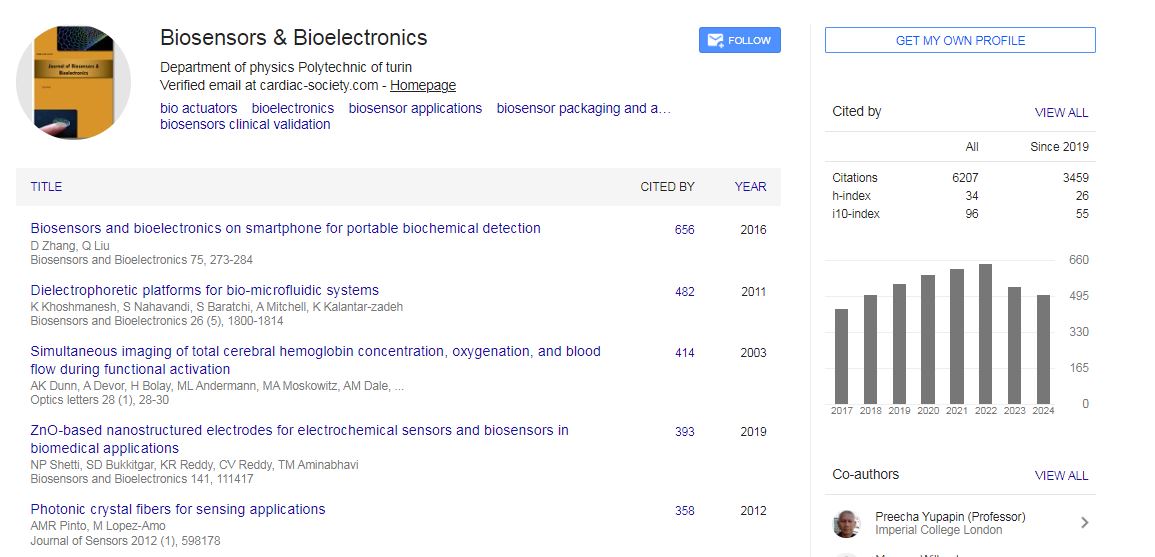
Biosensors & Bioelectronics received 6207 citations as per Google Scholar report