Perspective - (2025) Volume 12, Issue 6
Received: 01-Dec-2025, Manuscript No. reac-26-185816;
Editor assigned: 03-Dec-2025, Pre QC No. P-185816;
Reviewed: 17-Dec-2025, QC No. Q-185816;
Revised: 22-Dec-2025, Manuscript No. R-185816;
Published:
29-Dec-2025
, DOI: 10.37421/2380-2391.2025.12.457
Citation: Al-Hassan, Mariam. ”Advanced Computational Methods For Environmental Contaminant Prediction.” J Environ Anal Chem 12 (2025):457.
Copyright: © 2025 Al-Hassan M. This is an open-access article distributed under the terms of the Creative Commons Attribution License, which permits unrestricted use,
distribution and reproduction in any medium, provided the original author and source are credited.
The prediction of environmental contaminant spread is a critical area of research with significant implications for public health, ecological preservation, and emergency response. Machine learning and artificial intelligence techniques have emerged as powerful tools for addressing the complexities of contaminant dispersion across various environmental media. These advanced computational methods enable more accurate and timely forecasting, which is essential for effective mitigation and management strategies. The rapid advancements in data collection and processing capabilities have further fueled the development and application of these predictive models. Machine learning models, particularly deep learning architectures and ensemble methods, are revolutionizing the accuracy and speed of predicting the spatial and temporal spread of environmental contaminants. By analyzing complex datasets encompassing atmospheric conditions, hydrological patterns, and emission sources, these techniques forecast contaminant plumes and inform emergency response. The integration of diverse data streams is emphasized for more precise predictions [1].
Artificial intelligence, specifically algorithms like random forest and gradient boosting, are proving effective in modeling the dispersion of airborne pollutants. These models assess contaminant concentrations under various meteorological scenarios, enabling real-time risk assessment and public health advisories. Feature selection is highlighted as crucial for improving model performance [2].
Convolutional neural networks (CNNs) are being investigated for their ability to predict the spread of waterborne contaminants from industrial discharge. By analyzing spatial-temporal patterns in water quality and hydrological data, CNNs can forecast the extent and persistence of contamination events, capturing intricate spatial relationships valuable for water resource management [3].
Recurrent neural networks (RNNs), including Long Short-Term Memory (LSTM) networks, are employed for forecasting the long-term spread of soil contaminants after accidental spills. These networks leverage historical data and environmental parameters to predict future contaminant migration patterns, effectively modeling sequential dependencies for long-term environmental risk assessment [4].
Hybrid approaches combining geographical information systems (GIS) with machine learning algorithms, such as support vector machines, are being used to predict the spread of hazardous materials in urban environments. By integrating spatial data, traffic patterns, and building footprints, these models simulate contaminant plumes and identify high-risk areas, underscoring the synergy between spatial analysis and predictive modeling [5].
Ensemble learning techniques, including stacking and bagging, are being utilized to enhance the robustness and accuracy of predicting microplastic contamination spread in marine ecosystems. These methods analyze oceanographic data and current patterns to forecast microplastic distribution, demonstrating that ensemble approaches reduce prediction variance and improve overall model performance [6].
Fuzzy logic and neural networks are being integrated to predict the spread of chemical contaminants through complex geological formations. This approach combines geological survey data, hydrological flow, and chemical properties to model contaminant transport, offering improved predictive capabilities for subsurface contamination scenarios [7].
Bayesian networks are explored for probabilistic modeling of radioactive contaminant spread following nuclear accidents. These networks incorporate uncertainty quantification from meteorological data and source term estimations to provide probabilistic dispersion assessments, which are vital for risk management in emergency situations [8].
Deep reinforcement learning (DRL) is being applied to optimize sensor placement for real-time monitoring of airborne contaminant spread. DRL develops intelligent sensor networks that adapt to changing environmental conditions, ensuring optimal coverage for early detection and tracking of pollutant plumes, demonstrating DRL's potential for dynamic monitoring systems [9].
Generative adversarial networks (GANs) are being evaluated for their efficacy in simulating realistic scenarios of heavy metal contaminant spread in river systems. GANs generate synthetic yet plausible datasets of contaminant plumes under various conditions, aiding in training and validating other predictive models and addressing data scarcity issues [10].
The scientific literature extensively documents the application of advanced computational techniques for predicting the complex phenomenon of environmental contaminant spread. These methods aim to provide accurate forecasts that support proactive decision-making and effective risk management across diverse environmental contexts. From atmospheric pollutants to waterborne and soil contaminants, a range of predictive models are being developed and refined. Machine learning models, particularly deep learning architectures and ensemble methods, significantly enhance the accuracy and speed of predicting the spatial and temporal spread of environmental contaminants. These techniques are applied to analyze complex datasets, including atmospheric conditions, hydrological patterns, and emission sources, to forecast contaminant plumes and inform emergency response and mitigation strategies. The integration of diverse data streams is highlighted for its contribution to more precise predictions [1].
Artificial intelligence, exemplified by random forest and gradient boosting algorithms, is employed to model the dispersion of airborne pollutants. These methods assess contaminant concentrations under varying meteorological scenarios, demonstrating their potential for real-time risk assessment and the development of proactive public health advisories. The importance of feature selection for improving model performance is emphasized [2].
Convolutional neural networks (CNNs) are being utilized for predicting the spread of waterborne contaminants originating from industrial discharge. These networks analyze spatial-temporal patterns in water quality data and hydrological features to forecast the extent and persistence of contamination events, highlighting CNNs' capability to capture intricate spatial relationships for water resource management and pollution control [3].
Recurrent neural networks (RNNs), including LSTMs, are evaluated for forecasting the long-term spread of soil contaminants following accidental spills. By leveraging historical soil contamination data, environmental parameters, and remediation efforts, these models predict future contaminant migration patterns and demonstrate the capability of RNNs to model sequential dependencies for long-term environmental risk assessment [4].
Hybrid approaches that combine geographical information systems (GIS) with machine learning algorithms, such as support vector machines, are presented for predicting the spread of hazardous materials in urban environments. These integrated systems analyze spatial data, traffic patterns, and building footprints to simulate potential contaminant plumes and identify high-risk areas, underscoring the synergy between spatial analysis and predictive modeling [5].
Ensemble learning techniques, specifically stacking and bagging, are employed to improve the robustness and accuracy of predicting microplastic contamination spread in marine ecosystems. By utilizing oceanographic data, current patterns, and pollution sources, these methods forecast microplastic distribution, showing that ensemble methods can reduce prediction variance and enhance overall model performance [6].
The integration of fuzzy logic and neural networks is investigated for predicting the spread of chemical contaminants through complex geological formations. This approach combines geological survey data, hydrological flow, and chemical properties to model contaminant transport, offering enhanced predictive capabilities for subsurface contamination scenarios [7].
Bayesian networks are used for probabilistic modeling of radioactive contaminant spread after nuclear accidents. These networks incorporate uncertainty quantification from various data sources to provide a probabilistic assessment of contaminant dispersion, which is crucial for risk management and decision-making in emergency situations [8].
Deep reinforcement learning (DRL) is explored for optimizing the placement of sensors to monitor the spread of airborne contaminants in real-time. DRL facilitates the development of intelligent sensor networks that adapt to changing environmental conditions, ensuring optimal coverage for early detection and tracking of pollutant plumes, showcasing DRL's potential for dynamic monitoring systems [9].
Generative adversarial networks (GANs) are assessed for their effectiveness in simulating realistic scenarios of heavy metal contaminant spread in river systems. GANs generate synthetic datasets of contaminant plumes under various conditions, which are then used to train and validate other predictive models, thereby aiding in addressing data scarcity issues [10].
This collection of research explores the application of advanced computational methods for predicting the spread of environmental contaminants. Machine learning, deep learning, and artificial intelligence techniques, including CNNs, RNNs, ensemble methods, fuzzy logic, Bayesian networks, and GANs, are utilized across various media such as air, water, soil, and marine ecosystems. These models analyze complex datasets from atmospheric conditions, hydrology, geological formations, and urban environments to forecast contaminant plumes, assess risks, and inform mitigation strategies. Hybrid approaches integrating GIS with machine learning and DRL for sensor placement optimization are also presented. The overarching goal is to enhance prediction accuracy and speed, thereby improving environmental management, public health advisories, and emergency response capabilities, particularly in scenarios with limited data.
None
None
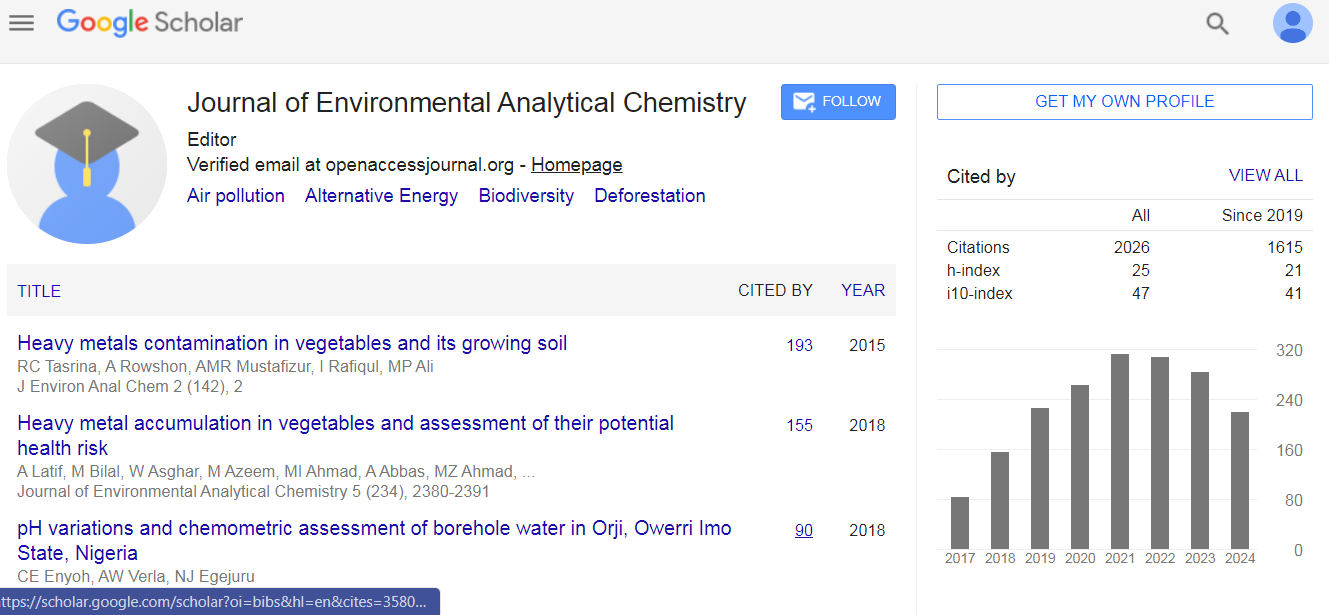
Journal of Environmental Analytical Chemistry received 1781 citations as per Google Scholar report