Commentary - (2025) Volume 14, Issue 6
Received: 01-Dec-2025, Manuscript No. jme-26-185237;
Editor assigned: 03-Dec-2025, Pre QC No. P-185237;
Reviewed: 17-Dec-2025, QC No. Q-185237;
Revised: 22-Dec-2025, Manuscript No. R-185237;
Published:
29-Dec-2025
, DOI: 10.37421/2169-0022.2025.14.753
Citation: Smith, David. ”Advanced Coatings for Extreme Material
Performance.” J Material Sci Eng 14 (2025):753.
Copyright: © 2025 Smith D. This is an open-access article distributed under the terms of the Creative Commons Attribution License, which permits unrestricted use, distribution
and reproduction in any medium, provided the original author and source are credited.
The relentless pursuit of enhanced material performance under extreme conditions has driven significant advancements in surface engineering, particularly in the realm of advanced coatings. These coatings are instrumental in extending the service life and operational efficiency of components subjected to high temperatures, corrosive environments, and severe mechanical stresses. The development of novel coating materials and architectures plays a pivotal role in addressing these challenges across various industries, including aerospace, energy, and manufacturing. One critical area of focus is the improvement of wear and oxidation resistance in aerospace components. Advanced coatings, encompassing both ceramic and metallic compositions, are being engineered to withstand the harsh thermal and mechanical loads encountered during flight. Research into their microstructural evolution, mechanical properties, and performance under extreme stresses is crucial for developing next-generation materials [1].
Furthermore, the integration of nanoscale reinforcement within coating materials has emerged as a promising strategy to achieve synergistic improvements in tribological properties and high-temperature oxidation resistance. Nanocomposite coatings incorporating hard ceramic nanoparticles within a metallic matrix have demonstrated substantial reductions in friction coefficients and wear rates compared to monolithic counterparts, offering a pathway to next-generation wear-resistant surfaces [2].
Multilayer coating systems, designed with specific combinations of hard ceramic and diffusion barrier layers, are also being investigated to enhance adhesion and prevent interdiffusion at high temperatures. These layered structures have shown superior hardness and toughness, along with significantly improved oxidation resistance, making them robust solutions for demanding environments [3].
High-entropy alloys (HEAs) represent another class of materials being explored for extreme environment applications. Their inherent phase stability and resistance to oxidation and corrosion make them attractive candidates for protective coatings. Studies on HEA coatings have demonstrated remarkable stability and minimal degradation under cyclic oxidation conditions at high temperatures [4].
Functionally graded materials (FGMs) offer a unique approach by allowing for a gradual variation in composition and microstructure across the coating thickness. This gradient is designed to optimize thermal expansion coefficients and mechanical properties, leading to enhanced spallation resistance and reduced thermal conductivity, crucial for thermal barrier applications and extending component lifespan [5].
Novel oxy-nitride coatings are being developed to enhance wear and oxidation resistance at elevated temperatures. By carefully controlling the oxygen and nitrogen content, specific oxy-nitride compositions can form protective, slow-growing oxide scales, leading to improved long-term stability and reduced wear through microstructural mechanisms [6].
Plasma-enhanced chemical vapor deposition (PECVD) is a versatile technique employed for developing amorphous carbon-based coatings with excellent wear resistance and low friction coefficients. Tailoring PECVD parameters, such as plasma power and gas mixture, allows for the promotion of specific carbon allotropes, further enhancing tribological performance for demanding applications [7].
Thermal barrier coatings (TBCs) based on Yttria-Stabilized Zirconia (YSZ) are being modified with rare-earth oxides to improve oxidation resistance. Doping with elements like gadolinium oxide (Gd2O3) can enhance phase stability and promote the formation of more stable oxide layers, crucial for prolonging the lifespan of components in high-temperature applications [8].
Finally, carbide-based coatings, such as Tungsten Carbide-Carbon (WC-C) composites, are being optimized for improved wear resistance in harsh industrial environments. By controlling the WC-C ratio, enhanced mechanical properties and the formation of a protective graphitic layer can be achieved, leading to superior wear resistance and reduced friction [9].
The critical role of advanced coatings in enhancing the wear and oxidation resistance of aerospace components is underscored by research into novel ceramic and metallic materials. These studies delve into the microstructural evolution, mechanical properties, and performance under extreme thermal and mechanical stresses, comparing different coating architectures like multilayer and functionally graded materials to achieve synergistic improvements in surface integrity and service life. Process parameters and alloying elements are highlighted as key factors influencing coating adhesion and oxidation kinetics [1].
Exploration of advanced nanocomposite coatings incorporating hard ceramic nanoparticles within a metallic matrix reveals synergistic effects on tribological properties and high-temperature oxidation resistance. These coatings demonstrate a substantial reduction in friction coefficients and wear rates compared to monolithic coatings. The analysis also covers the influence of the matrix material and nanoparticle dispersion on the coating's ability to withstand oxidative degradation at elevated temperatures, suggesting a promising avenue for next-generation wear-resistant surfaces [2].
Research into multilayer coatings designed to improve both wear and oxidation resistance examines various combinations of hard ceramic layers and diffusion barrier layers. These designs aim to enhance adhesion and prevent interdiffusion at high temperatures. Mechanical testing, including nanoindentation and scratch testing, consistently reveals superior hardness and toughness, while oxidation tests show significantly improved performance with reduced oxide scale formation and better structural integrity of the coating system, offering a robust solution for demanding environments [3].
High-entropy alloy (HEA) coatings are being investigated for their unique properties in extreme environment applications. The inherent phase stability and resistance to oxidation and corrosion of HEAs are leveraged when applied as protective coatings. Studies detail the deposition process and resulting microstructures, often exhibiting a single solid solution phase. Performance evaluations under cyclic oxidation conditions at high temperatures demonstrate remarkable stability and minimal degradation, positioning HEAs as a promising class of materials for advanced protective coatings [4].
Functionally graded materials (FGMs) are examined for thermal barrier applications, with a focus on improved oxidation resistance and thermal shock tolerance. The gradual variation in composition and microstructure across the coating thickness is engineered to optimize thermal expansion coefficients and mechanical properties. Experimental results highlight enhanced spallation resistance and reduced thermal conductivity compared to uniform coatings, with clear implications for extending the lifespan of high-temperature components in aerospace and power generation [5].
A comprehensive study on novel oxy-nitride coatings for enhanced wear and oxidation resistance at elevated temperatures investigates the effect of varying oxygen and nitrogen content. This variation influences the coating's phase composition, hardness, and oxidation kinetics. Findings indicate that specific oxy-nitride compositions can form protective, slow-growing oxide scales, leading to improved long-term stability and reduced wear. The paper discusses the microstructural mechanisms responsible for these enhancements [6].
The influence of plasma-enhanced chemical vapor deposition (PECVD) parameters on amorphous carbon-based coatings for wear resistance is examined. The study correlates plasma power, gas mixture, and substrate temperature with coating hardness, internal stress, and tribological performance. Excellent wear resistance and low friction coefficients are achieved, particularly with tailored gas compositions that promote the formation of specific carbon allotropes, highlighting the potential for these coatings in applications requiring low friction and high wear resistance [7].
Yttria-Stabilized Zirconia (YSZ) based thermal barrier coatings (TBCs) modified with rare-earth oxides are investigated for enhanced oxidation resistance. The study focuses on the impact of doping with elements like gadolinium oxide (Gd2O3) on the phase stability and sintering behavior of the YSZ. Experimental results show that Gd2O3 addition significantly improves oxidation resistance by promoting a more stable and less permeable oxide layer at the coating-substrate interface, which is crucial for high-temperature applications [8].
Novel carbide-based coatings, specifically Tungsten Carbide-Carbon (WC-C) composites, are developed for improved wear resistance in demanding industrial environments. The study analyzes the effect of varying carbon content on the microstructure, hardness, and tribological behavior of coatings deposited via physical vapor deposition (PVD). Superior wear resistance and reduced friction are observed for coatings with optimized WC-C ratios, attributed to the formation of a protective graphitic layer and enhanced mechanical properties [9].
Silicide-based coatings are investigated for their efficacy in high-temperature oxidation protection, focusing on the formation of protective silicide oxide scales that act as diffusion barriers. Different silicide compositions and deposition techniques are evaluated, demonstrating excellent resistance to oxidation and corrosion in aggressive environments. The study highlights the role of microstructure and phase evolution in the performance of these coatings, offering a pathway for extending the operational life of high-temperature metallic components [10].
This collection of research focuses on advanced coatings designed to enhance material performance under extreme conditions, particularly wear and oxidation resistance. Key areas of investigation include novel ceramic and metallic coatings for aerospace components, nanocomposite coatings with nanoscale reinforcement, and multilayered systems offering improved adhesion and diffusion barriers. High-entropy alloys and functionally graded materials are explored for their inherent stability and tailored properties. Additionally, research into oxy-nitride, amorphous carbon-based, YSZ-based thermal barrier coatings, and silicide-based coatings addresses specific needs for high-temperature applications. These studies highlight the importance of microstructural control, material composition, and processing parameters in achieving superior wear, oxidation, and corrosion resistance, ultimately aiming to extend the service life and reliability of critical components in demanding environments.
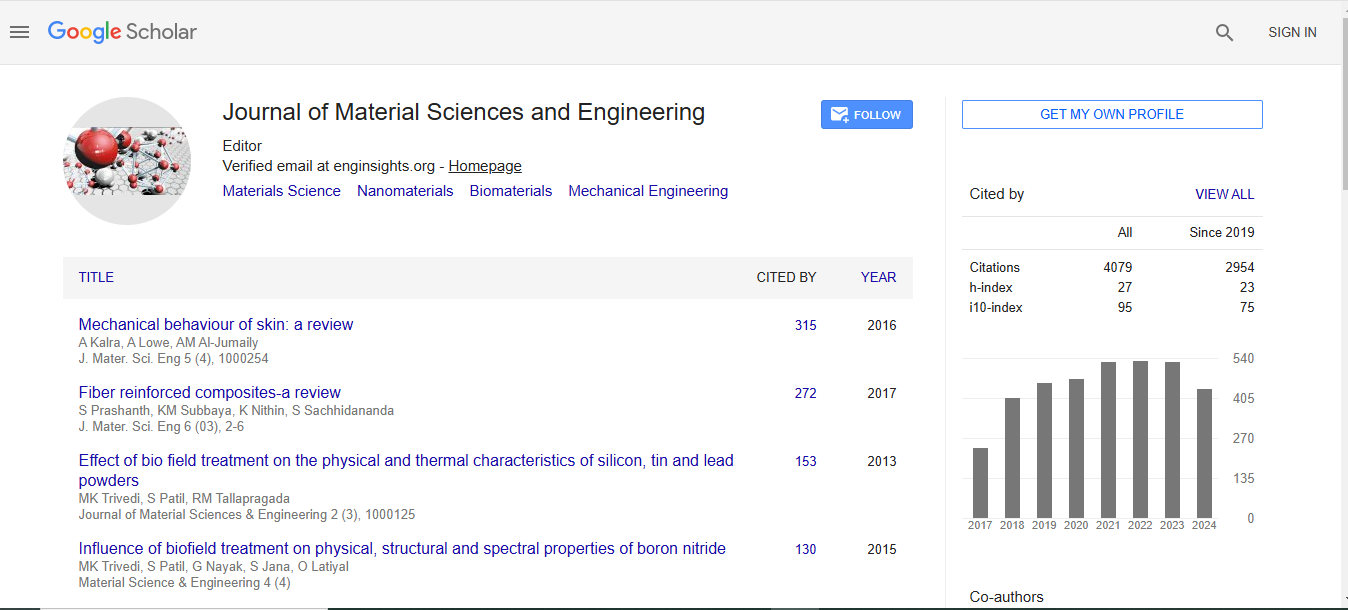
Journal of Material Sciences & Engineering received 3677 citations as per Google Scholar report