Perspective - (2025) Volume 14, Issue 2
Received: 01-Apr-2025, Manuscript No. jme-26-185198;
Editor assigned: 03-Apr-2025, Pre QC No. P-185198;
Reviewed: 17-Apr-2025, QC No. Q-185198;
Revised: 22-Apr-2025, Manuscript No. R-185198;
Published:
29-Apr-2025
, DOI: 10.37421/2169-0022.2025.14.716
Citation: Weiss, Jurgen. ”Advanced Ceramics: Innovation, Applications,
and Future Frontiers.” J Material Sci Eng 14 (2025):716.
Copyright: © 2025 Weiss J. This is an open-access article distributed under the terms of the Creative Commons Attribution License, which permits unrestricted use, distribution
and reproduction in any medium, provided the original author and source are credited.
The field of advanced ceramics has witnessed remarkable growth and diversification, driven by their exceptional material properties and expanding application spectrum. These materials, characterized by their inorganic, non-metallic nature, offer unique combinations of hardness, thermal stability, and chemical resistance, making them indispensable in numerous demanding engineering sectors. The continuous pursuit of enhanced performance and novel functionalities has led to significant advancements in their processing, characterization, and integration into complex systems. This introduction will explore the breadth of these advancements by reviewing key contributions to the understanding and application of advanced ceramics, covering diverse areas from fundamental material science to cutting-edge technological implementations. One significant area of development involves the fundamental properties and applications of advanced ceramics in various engineering domains. Their inherent strengths, such as high hardness, exceptional thermal stability, and robust chemical inertness, position them as critical materials for environments where conventional materials falter. The ongoing research in this domain aims to precisely tailor these properties for specific engineering challenges, enabling more efficient and durable solutions in demanding applications. This foundational understanding is crucial for unlocking the full potential of ceramic materials [1].
The realm of surface engineering has seen substantial progress through the application of ceramic coatings. These coatings are engineered to impart enhanced wear resistance, provide superior corrosion protection, and offer effective thermal barrier properties, thereby extending the lifespan and improving the performance of components. The development of advanced deposition techniques has been pivotal in achieving uniform and well-adhered ceramic layers, addressing critical challenges in surface modification for extreme operational conditions [2].
Structural ceramics are critical for applications demanding high mechanical integrity, especially under extreme thermal loads. Research into their high-temperature mechanical behavior, including fracture toughness, creep resistance, and fatigue life, is paramount for industries like aerospace and energy. Advanced modeling techniques are increasingly being employed to predict and optimize the performance of these materials, ensuring their reliability in high-stress environments [3].
The biomedical field has greatly benefited from the unique properties of bioceramics. Materials such as hydroxyapatite and zirconia are extensively used in medical implants and tissue engineering due to their biocompatibility and bioactivity, facilitating seamless integration with biological tissues. Furthermore, innovations in additive manufacturing are enabling the creation of complex ceramic scaffolds with controlled porosity, opening new avenues for regenerative medicine [4].
Nanostructured ceramics represent a frontier in material science, where controlling grain size at the nanoscale leads to dramatic improvements in mechanical properties like strength, toughness, and hardness. The synthesis of these materials involves sophisticated techniques aimed at achieving uniform nanoscale structures. Their potential for advanced engineering components is significant, promising breakthroughs in material performance and miniaturization [5].
Functional ceramics are at the core of many modern electronic and energy technologies. Their unique electrical and magnetic properties are leveraged in a wide array of devices, including sensors, actuators, and energy storage systems. Understanding the intricate relationship between microstructure, processing conditions, and functional performance is key to developing next-generation ceramic-based technologies, particularly in the fields of piezoelectricity and thermoelectricity [6].
Ceramic matrix composites (CMCs) offer a compelling solution for high-temperature structural applications by combining the benefits of ceramic fibers with a ceramic matrix. This synergistic approach significantly enhances fracture toughness and damage tolerance compared to monolithic ceramics. The fabrication of CMCs and their performance evaluation in extreme environments, such as gas turbine engines, are crucial areas of ongoing research and development [7].
Additive manufacturing (AM) is revolutionizing the production of ceramic components, offering unprecedented design freedom and enabling the creation of complex geometries and customized parts. Various 3D printing techniques, including stereolithography and binder jetting, are being adapted for ceramic materials. The impact of AM on process efficiency and the resulting material properties are key areas of investigation [8].
Advanced ceramic membranes are playing an increasingly vital role in separation processes across various industries. Materials like alumina, zirconia, and titania are employed for microfiltration, ultrafiltration, and gas separation. The design of these membranes, focusing on pore structure, surface modification, and overall assembly, is critical for achieving high separation efficiency and selectivity [9].
Finally, the ongoing advancements in processing and characterization techniques are fundamental to the progress of advanced ceramics. Novel synthesis routes and sophisticated characterization methods are essential for understanding and controlling material behavior at the micro and nanoscale. This continuous refinement of processing and characterization capabilities underpins the development of new and improved ceramic materials for diverse applications [10].
The evolution of advanced ceramics is intricately linked to their inherent properties, which enable their deployment in environments where conventional materials fall short. High hardness, exceptional thermal stability, and robust chemical inertness are hallmarks of these materials, making them crucial for demanding engineering applications. The ongoing research in this domain focuses on refining these properties to meet specific engineering needs, ensuring enhanced efficiency and durability in critical systems. This foundational understanding is the bedrock upon which new ceramic technologies are built and implemented [1].
In the sphere of surface engineering, ceramic coatings have emerged as a powerful tool for enhancing material performance. These specialized layers are engineered to provide superior wear resistance, robust corrosion protection, and effective thermal insulation, significantly extending the operational life of components. The successful application of these coatings hinges on advanced deposition techniques that ensure uniform thickness, excellent adhesion, and desired microstructural characteristics, thereby overcoming the challenges associated with modifying surfaces for extreme conditions [2].
The mechanical behavior of structural ceramics, particularly under high-temperature conditions, is a critical area of study for applications in aerospace and energy sectors. Investigations into fracture toughness, creep resistance, and fatigue life are essential for ensuring the reliability and longevity of components operating in these demanding environments. The use of sophisticated modeling approaches to predict performance and guide material optimization further underscores the scientific rigor applied in this field [3].
Bioceramics have revolutionized medical applications, offering materials with exceptional biocompatibility and bioactivity suitable for implantation and tissue engineering. Compounds like hydroxyapatite and zirconia are preferred for their ability to integrate harmoniously with biological tissues. Advances in additive manufacturing are also enabling the creation of intricate ceramic structures with tailored porosity, paving the way for more effective regenerative therapies [4].
The exploration of nanostructured ceramics has opened up new frontiers in material science, where nanoscale grain control leads to remarkable improvements in mechanical properties such as strength, toughness, and hardness. The synthesis of these materials requires precise control over processing parameters to achieve the desired nanostructure. The potential applications for nanostructured ceramics in advanced engineering components are vast, promising significant performance enhancements [5].
Functional ceramics are integral to the advancement of modern electronics and energy technologies, owing to their unique electrical and magnetic characteristics. Their application spans a wide range of devices, including sensors, actuators, and energy storage solutions. A deep understanding of the interplay between microstructure, processing, and functional output is paramount for innovation, particularly in the development of advanced piezoelectric and thermoelectric ceramics [6].
Ceramic matrix composites (CMCs) represent a significant advancement for high-temperature structural applications. By embedding ceramic fibers within a ceramic matrix, these composites achieve superior fracture toughness and damage tolerance compared to monolithic ceramics. Research into their fabrication and performance in challenging environments, such as gas turbine engines, is crucial for their widespread adoption [7].
The advent of additive manufacturing (AM) is transforming the production landscape for ceramic components. AM technologies offer unparalleled design flexibility, allowing for the creation of highly complex geometries and personalized parts. The focus of current research is on optimizing AM processes for ceramics, evaluating their impact on efficiency, and understanding how they influence the final material properties [8].
High-performance ceramic membranes are indispensable for efficient separation processes in diverse industrial applications. Materials such as alumina, zirconia, and titania are utilized in filtration and gas separation technologies. The efficacy of these membranes is closely tied to the control of their pore structure, surface characteristics, and the overall assembly of the membrane system [9].
Finally, continuous advancements in the processing and characterization of advanced ceramic materials are pivotal. Novel synthesis techniques and sophisticated analytical methods are essential for gaining a comprehensive understanding of material behavior at the atomic and microstructural levels. This ongoing refinement of methodologies ensures the development of superior ceramic materials for an ever-expanding range of applications [10].
This collection of research highlights the multifaceted advancements in advanced ceramics across various engineering and scientific domains. It covers their fundamental properties and applications, including their use in surface engineering through ceramic coatings, and their critical mechanical behavior at high temperatures. The papers also delve into the application of bioceramics in medicine, the enhanced properties of nanostructured ceramics, and the role of functional ceramics in electronics and energy. Furthermore, ceramic matrix composites are discussed for high-temperature applications, while additive manufacturing is explored as a transformative production method. The development of high-performance ceramic membranes for separation processes and the latest progress in ceramic processing and characterization techniques are also key themes. Overall, these studies underscore the continuous innovation and expanding utility of advanced ceramics in addressing complex technological challenges.
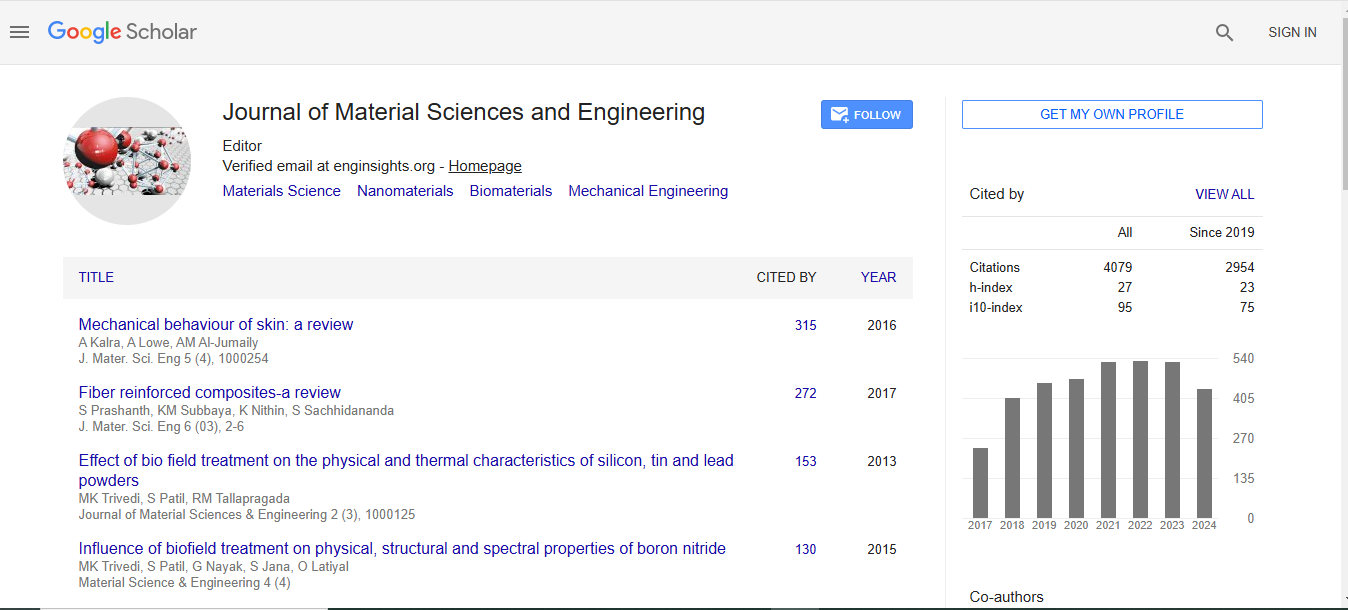
Journal of Material Sciences & Engineering received 3677 citations as per Google Scholar report