Perspective - (2025) Volume 15, Issue 6
Received: 02-Dec-2025, Manuscript No. jeat-26-188664;
Editor assigned: 04-Dec-2025, Pre QC No. P-188664;
Reviewed: 18-Dec-2025, QC No. Q-188664;
Revised: 23-Dec-2025, Manuscript No. R-188664;
Published:
30-Dec-2025
, DOI: 10.37421/2161-0525.2025.15.884
Citation: Rahman, Noor. ”Advanced Analytical Techniques
for Environmental Chemical Hazard Assessment.” J Environ Anal Toxicol 15
(2025):884. Page 2
Copyright: © 2025 Rahman N. This is an open-access article distributed under the terms of the Creative Commons Attribution License, which permits unrestricted use,
distribution and reproduction in any medium, provided the original author and source are credited.
The assessment of environmental chemical hazards is a complex undertaking that demands a sophisticated and integrated analytical strategy. This approach is essential for understanding the potential risks posed by various chemical substances present in our ecosystems. Advanced analytical techniques form the bedrock of this assessment, providing the precision and sensitivity required to detect and quantify even minute levels of contaminants. Spectroscopic methods, including Inductively Coupled Plasma Mass Spectrometry (ICP-MS) and Gas Chromatography-Mass Spectrometry (GC-MS), are paramount in this regard, enabling the accurate identification and measurement of trace contaminants that could otherwise go unnoticed [1].
The capabilities of these advanced techniques have been significantly enhanced over time, allowing for more comprehensive environmental monitoring. For instance, Liquid Chromatography coupled with tandem Mass Spectrometry (LC-MS/MS) has emerged as a revolutionary tool for the detection of emerging contaminants. This method is particularly effective for identifying substances like pharmaceuticals and personal care products within diverse environmental matrices, offering high sensitivity and specificity crucial for assessing long-term ecological risks [2].
Inductively Coupled Plasma Mass Spectrometry (ICP-MS) itself is an indispensable instrument for trace element analysis in environmental samples. It provides exceptional sensitivity for the detection of heavy metals, which are a significant concern due to their toxicity and persistence. Furthermore, its capacity to differentiate between isotopes is invaluable for conducting source apportionment studies, helping to trace the origins of pollutants and understand their movement within ecosystems [3].
Similarly, Gas Chromatography-Mass Spectrometry (GC-MS) continues to be a cornerstone technique for analyzing volatile and semi-volatile organic compounds found in environmental matrices. This method is vital for evaluating the risks associated with pesticides, polycyclic aromatic hydrocarbons (PAHs), and industrial solvents, providing detailed structural information necessary for precise identification and risk assessment [4].
Beyond instrumental analysis, bioassays offer a complementary approach to assessing environmental chemical hazards. These assays provide a rapid and often cost-effective means of evaluating the biological activity of contaminants. By employing genetically modified microorganisms or cell lines, researchers can detect a broad spectrum of toxic endpoints, including genotoxicity, mutagenicity, and endocrine disruption, thereby offering a functional assessment of hazard [5].
Complementing traditional methods, molecular techniques are increasingly being utilized to delve into the mechanistic basis of chemical toxicity. Approaches such as DNA sequencing and gene expression analysis are crucial for identifying specific cellular pathways affected by environmental pollutants. This understanding aids in the development of predictive toxicology models and more accurate risk assessment strategies [6].
The characterization of nanomaterials is another critical area within environmental hazard assessment. Techniques like Transmission Electron Microscopy (TEM) and Dynamic Light Scattering (DLS) are essential for determining the physical properties of nanomaterials, such as their size, shape, and aggregation state. These properties significantly influence their environmental fate and their potential toxicological effects [7].
Furthermore, the development of portable and field-deployable analytical devices, particularly sensor-based systems, is crucial for real-time monitoring of environmental contaminants. These innovative technologies facilitate rapid screening and early detection of pollutants, enabling timely intervention and the implementation of effective risk management strategies [8].
Isotope Dilution Mass Spectrometry (IDMS) stands out as a primary analytical method for achieving highly accurate quantification of analytes. It offers remarkable precision and low uncertainty, making it a gold standard for calibrating other analytical methods and ensuring the overall reliability of environmental hazard assessment data [9].
Finally, chemometrics plays a vital role in extracting meaningful insights from the complex analytical data generated during environmental hazard assessments. The application of multivariate statistical methods helps in identifying patterns, establishing correlations between chemical exposure and biological effects, and ultimately enhancing the efficiency and effectiveness of analytical workflows [10].
The evaluation of environmental chemical hazards necessitates a sophisticated, multi-faceted analytical approach. This includes the utilization of advanced instrumentation capable of detecting and quantifying contaminants at very low concentrations. Spectroscopic techniques, such as ICP-MS and GC-MS, are instrumental in identifying and measuring trace levels of hazardous substances present in the environment. These methods provide the foundational data for understanding the scope of contamination [1].
In recent years, significant advancements have been made in analytical methodologies, particularly in the realm of emerging contaminants. LC-MS/MS has become a transformative technique for the detection of substances like pharmaceuticals and personal care products in various environmental samples. Its high sensitivity and specificity are vital for monitoring the potential long-term ecological consequences of these persistent pollutants [2].
Inductively Coupled Plasma Mass Spectrometry (ICP-MS) is an indispensable tool for analyzing trace elements in environmental samples. It offers unparalleled sensitivity for detecting heavy metals, which pose significant risks to both environmental and human health. The ability of ICP-MS to perform isotopic analysis is particularly valuable for tracing the origins of metals and understanding their biogeochemical cycles within ecosystems [3].
Gas Chromatography-Mass Spectrometry (GC-MS) remains a key technique for the identification of volatile and semi-volatile organic compounds. This method is critical for assessing the risks posed by pesticides, PAHs, and industrial solvents. GC-MS provides detailed structural information that is essential for accurate compound identification and risk assessment [4].
Complementing instrumental analysis, bioassays offer a functional approach to hazard assessment. They provide a rapid and cost-effective means to evaluate the biological activity of environmental contaminants. By using specific biological systems, such as genetically modified microorganisms or cell lines, researchers can assess toxic endpoints like genotoxicity, mutagenicity, and endocrine disruption [5].
Molecular techniques are increasingly being employed to elucidate the mechanistic underpinnings of chemical toxicity. Methods like DNA sequencing and gene expression analysis help identify the specific cellular pathways that are impacted by environmental pollutants. This knowledge is crucial for developing predictive toxicology models and refining risk assessment procedures [6].
The characterization of nanomaterials is a crucial aspect of evaluating their environmental impact. Techniques such as Transmission Electron Microscopy (TEM) and Dynamic Light Scattering (DLS) are used to determine key properties like size, shape, and aggregation state, which are critical determinants of their environmental behavior and potential toxicity [7].
The development of portable and field-deployable analytical devices, including sensor-based systems, is essential for real-time environmental monitoring. These technologies allow for rapid screening and early detection of contaminants, which is vital for timely intervention and effective risk management strategies [8].
Isotope Dilution Mass Spectrometry (IDMS) is recognized as a primary method for achieving highly accurate and precise quantification of analytes. Its application in environmental analysis serves as a benchmark for method calibration and ensures the reliability of hazard assessment data, contributing to a robust understanding of chemical risks [9].
Finally, chemometrics plays a significant role in analyzing the complex datasets generated from environmental hazard assessments. Multivariate statistical methods are employed to identify patterns, establish relationships between chemical exposures and observed effects, and optimize analytical workflows, thereby enhancing the overall efficiency and interpretability of environmental data [10].
Assessing environmental chemical hazards requires a multi-faceted approach involving advanced analytical techniques. Spectroscopic methods like ICP-MS and GC-MS are vital for identifying and quantifying trace contaminants. LC-MS/MS revolutionizes the detection of emerging contaminants, offering high sensitivity. ICP-MS excels in trace element analysis, especially for heavy metals, while GC-MS is crucial for volatile organic compounds. Bioassays provide a rapid assessment of biological activity and toxic endpoints. Molecular techniques, such as DNA sequencing, elucidate the mechanisms of toxicity. Nanomaterial characterization using TEM and DLS is essential for understanding their environmental behavior. Portable sensor-based devices enable real-time monitoring. IDMS offers a gold standard for accurate quantification. Chemometrics helps extract meaningful information from complex analytical data, improving efficiency and understanding of environmental risks.
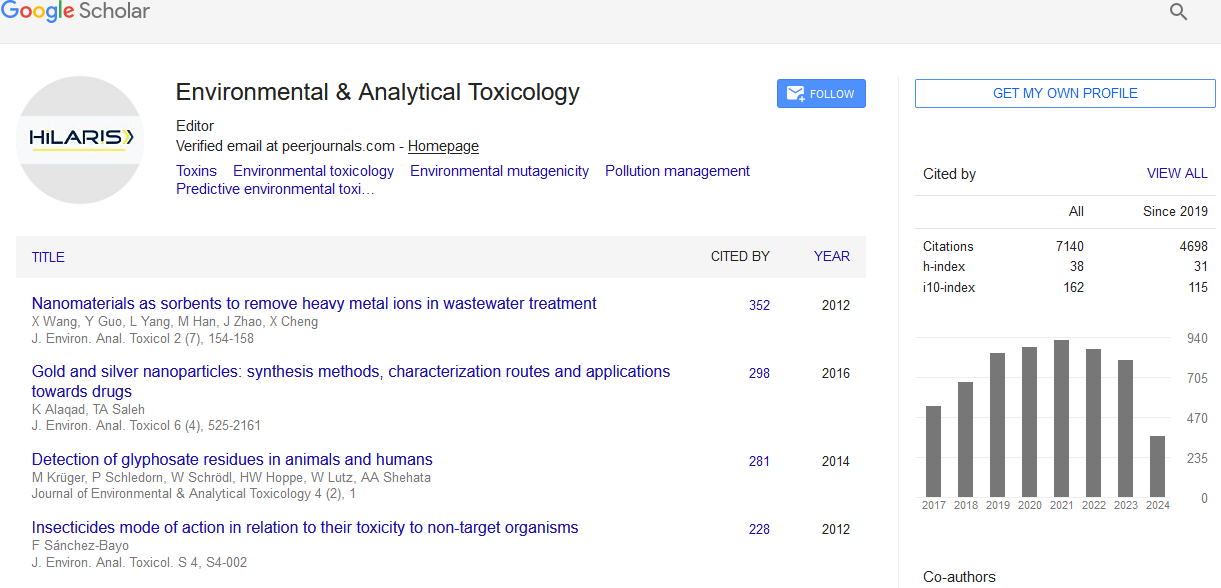
Environmental & Analytical Toxicology received 6818 citations as per Google Scholar report