Brief Report - (2025) Volume 15, Issue 6
Received: 02-Dec-2025, Manuscript No. jeat-26-188656;
Editor assigned: 04-Dec-2025, Pre QC No. P-188656;
Reviewed: 18-Dec-2025, QC No. Q-188656;
Revised: 23-Dec-2025, Manuscript No. R-188656;
Published:
30-Dec-2025
, DOI: 10.37421/2161-0525.2025.15.876
Citation: Mendes, Carlos. ”Advanced Analytical Methods for Environmental
Sediment Contaminants.” J Environ Anal Toxicol 15 (2025):876.
Copyright: © 2025 Mendes C. This is an open-access article distributed under the terms of the Creative Commons Attribution License, which permits unrestricted use,
distribution and reproduction in any medium, provided the original author and source are credited.
The intricate composition of environmental sediments renders them a critical matrix for assessing the persistence and impact of various chemical contaminants. Understanding the analytical methodologies employed for their detection and quantification is paramount for effective environmental stewardship and public health protection. This review synthesizes recent advancements in the analytical determination of a diverse range of pollutants found within these complex matrices, highlighting the evolution of techniques aimed at achieving greater sensitivity, selectivity, and accuracy. Recent advancements in the analytical determination of persistent organic pollutants (POPs) in environmental sediments have been driven by the need for more precise quantification and the identification of emerging contaminants. These studies emphasize improvements in sample preparation, extraction techniques, and sophisticated instrumental analysis, all crucial for accurate risk assessment and environmental monitoring. The focus is on developing sensitive and selective methods capable of detecting even trace amounts of these persistent compounds [1].
The analysis of trace levels of heavy metals in marine sediments presents significant challenges, particularly in understanding their bioavailability and toxicity. Speciation analysis, which determines the different chemical forms of a metal, is crucial for this understanding. Comparative studies of various digestion and analytical techniques, such as ICP-MS and AAS, alongside robust quality control measures, are vital for obtaining reliable results in environmental toxicology [2].
In the pursuit of more sustainable analytical practices, the development of novel, greener analytical methods for determining polycyclic aromatic hydrocarbons (PAHs) in river sediments has gained traction. These methods explore techniques like microwave-assisted extraction and liquid chromatography coupled with fluorescence detection, aiming to minimize solvent consumption and analysis time while upholding high accuracy and reliability [3].
Emerging contaminants, including pharmaceuticals and personal care products (PPCPs), pose a growing concern in urban wastewater sediments. Analytical strategies are being developed to address the challenges in their detection and quantification, with high-resolution mass spectrometry (HRMS) playing a key role in their identification. The need for robust methodologies to monitor these ubiquitous pollutants is increasingly evident [4].
Organochlorine pesticides (OCPs) remain a significant class of pollutants in sediments, necessitating optimized analytical approaches. The evaluation of different solid-phase extraction (SPE) techniques for preconcentration prior to GC-MS analysis is crucial. Insights into optimizing SPE parameters are vital for achieving lower detection limits and enhancing the reliability of OCP determination in environmental samples [5].
Dioxins and furans, potent environmental toxins, require accurate quantification in sediments. The application of isotope dilution mass spectrometry (IDMS) offers significant benefits in this regard. IDMS effectively compensates for matrix effects and variability in extraction efficiency, leading to highly reliable measurements essential for comprehensive risk assessment [6].
Flame retardants, such as polybrominated diphenyl ethers (PBDEs), are frequently detected in complex sediment matrices. Improved methods for their extraction and determination are continually being developed, with gas chromatography coupled with tandem mass spectrometry (GC-MS/MS) offering enhanced selectivity and sensitivity for their identification and quantification [7].
Mycotoxins, naturally occurring toxins that can contaminate agricultural sediments, require rapid and efficient analytical methods. Ultrasound-assisted extraction coupled with ultra-high-performance liquid chromatography (UHPLC-DAD) presents a promising approach for their monitoring, facilitating the assessment of potential risks to food safety and environmental health [8].
Volatile organic compounds (VOCs) are often present in sediments, and their accurate determination is crucial for environmental assessment. Headspace solid-phase microextraction (HS-SPME) combined with gas chromatography-mass spectrometry (GC-MS) provides a solvent-free and automatable method for their analysis, offering advantages for routine environmental monitoring [9].
Metalloids, such as arsenic and selenium, can exhibit significant mobility and toxicity in aquatic sediments. A comprehensive review of analytical techniques for their determination, including speciation studies, extraction methods, and advanced instrumentation, is vital for understanding their behavior and impact in benthic environments [10].
The analytical chemistry landscape for environmental sediment analysis is characterized by a constant drive for enhanced precision and scope. Persistent organic pollutants (POPs), a class of compounds known for their environmental longevity and potential for bioaccumulation, are a major focus. Recent research highlights advancements in sample preparation and extraction, alongside the utilization of sophisticated instrumental techniques to achieve greater sensitivity and selectivity. These developments are critical for accurate risk assessment and effective environmental monitoring, particularly in detecting emerging POPs [1].
Heavy metals in marine sediments pose a significant threat due to their potential toxicity and bioavailability. Speciation analysis, which identifies the different forms of metals, is indispensable for understanding these risks. Comparative studies examining various digestion and analytical methods, including inductively coupled plasma-mass spectrometry (ICP-MS) and atomic absorption spectrometry (AAS), are essential. Rigorous quality control measures are emphasized to ensure the reliability of results in environmental toxicology [2].
A growing emphasis on environmental sustainability has spurred the development of greener analytical methods for compounds like polycyclic aromatic hydrocarbons (PAHs) in river sediments. Techniques such as microwave-assisted extraction and liquid chromatography with fluorescence detection are being employed to reduce solvent usage and analysis time while maintaining high accuracy. This shift towards eco-friendly methodologies is a significant trend in analytical chemistry [3].
Emerging contaminants, particularly pharmaceuticals and personal care products (PPCPs), are increasingly being detected in urban wastewater sediments. High-resolution mass spectrometry (HRMS) is proving invaluable for their identification and quantification. The development of robust analytical methodologies is crucial to address the widespread presence of these compounds and their potential environmental impact [4].
Organochlorine pesticides (OCPs) continue to be relevant environmental contaminants in sediments. Optimizing solid-phase extraction (SPE) techniques is key to improving their preconcentration and subsequent analysis by gas chromatography-mass spectrometry (GC-MS). Fine-tuning SPE parameters allows for lower detection limits and more reliable OCP measurements [5].
Accurate quantification of potent environmental toxins such as dioxins and furans in sediments is essential for risk assessment. Isotope dilution mass spectrometry (IDMS) stands out for its ability to compensate for matrix effects and variations in extraction efficiency. This technique ensures highly reliable measurements, crucial for understanding the distribution and impact of these compounds [6].
Flame retardants, including polybrominated diphenyl ethers (PBDEs), are commonly found in complex sediment matrices. Advanced analytical methods are being refined for their extraction and determination. Gas chromatography coupled with tandem mass spectrometry (GC-MS/MS) provides enhanced selectivity and sensitivity, enabling precise identification and quantification of these chemicals [7].
Mycotoxins, which can contaminate agricultural sediments, require rapid and efficient analytical techniques. The combination of ultrasound-assisted extraction and ultra-high-performance liquid chromatography with diode-array detection (UHPLC-DAD) offers a promising method for their monitoring. This approach is vital for assessing potential risks associated with these naturally occurring toxins [8].
Volatile organic compounds (VOCs) in sediments are often analyzed using headspace solid-phase microextraction (HS-SPME) coupled with GC-MS. This method is favored for its solvent-free nature and its potential for automation, making it an efficient tool for environmental monitoring programs [9].
Metalloids like arsenic and selenium present unique challenges in aquatic sediments due to their varied chemical forms and potential toxicity. Comprehensive analytical strategies are needed, encompassing speciation studies, optimized extraction methods, and advanced instrumentation. Understanding their mobility and toxicological relevance in benthic ecosystems is a key objective [10].
This collection of research explores advanced analytical methodologies for quantifying various contaminants in environmental sediments. Studies cover persistent organic pollutants, heavy metals, polycyclic aromatic hydrocarbons, emerging contaminants like pharmaceuticals, organochlorine pesticides, dioxins, furans, flame retardants, mycotoxins, volatile organic compounds, and metalloids. The focus is on improving sample preparation, extraction efficiency, and the application of sophisticated instrumental techniques such as ICP-MS, AAS, HRMS, GC-MS, GC-MS/MS, and UHPLC-DAD. The research emphasizes the development of sensitive, selective, and greener methods to ensure accurate risk assessment and environmental monitoring. Key techniques highlighted include solid-phase extraction, microwave-assisted extraction, ultrasound-assisted extraction, and isotope dilution mass spectrometry for enhanced reliability and lower detection limits.
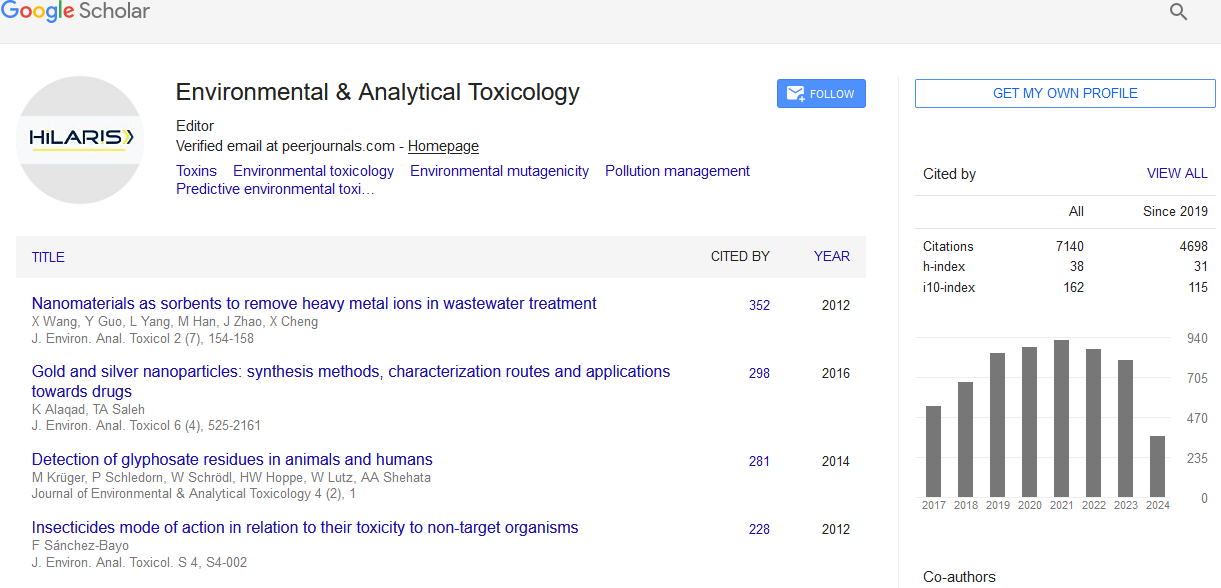
Environmental & Analytical Toxicology received 6818 citations as per Google Scholar report