Brief Report - (2025) Volume 15, Issue 5
Received: 02-Oct-2025, Manuscript No. jeat-26-188654;
Editor assigned: 06-Oct-2025, Pre QC No. P-188654;
Reviewed: 20-Oct-2025, QC No. Q-188654;
Revised: 23-Oct-2025, Manuscript No. R-188654;
Published:
30-Oct-2025
, DOI: 10.37421/2161-0525.2025.15.874
Citation: Papadopoulos, George. ”Advanced Analytical Methods
for Environmental Monitoring.” J Environ Anal Toxicol 15 (2025):874.
Copyright: © 2025 Papadopoulos G. This is an open-access article distributed under the terms of the Creative Commons Attribution License, which permits unrestricted use,
distribution and reproduction in any medium, provided the original author and source are credited.
The evaluation of environmental chemical hazards necessitates robust analytical techniques to ensure accurate risk assessment and informed regulatory decisions. Advanced methodologies are crucial for detecting and quantifying trace levels of contaminants, forming the bedrock of reliable environmental monitoring strategies [1].
The application of sophisticated analytical tools, particularly chromatography and mass spectrometry, has become indispensable for identifying and characterizing emerging contaminants present in various water matrices. Addressing challenges posed by low concentrations and complex sample compositions requires optimized extraction and sensitive detection techniques [2].
In parallel, the development of biosensors offers a promising avenue for rapid and on-site detection of specific environmental toxins. These novel sensing platforms, characterized by high sensitivity and selectivity, have the potential to revolutionize field monitoring and emergency response protocols [3].
The pervasive issue of microplastics in environmental matrices presents unique analytical challenges. Spectroscopic and chromatographic methods are vital for their identification, characterization, and quantification, underscoring the need for standardized protocols to ensure comparability of results and understanding of their environmental fate [4].
Monitoring volatile organic compounds (VOCs) in indoor air benefits from novel approaches such as solid-phase microextraction coupled with gas chromatography-mass spectrometry. This methodology enhances extraction efficiency and reduces solvent usage, offering an environmentally friendly and cost-effective solution for indoor air quality assessment [5].
The analysis of persistent organic pollutants (POPs) in challenging environmental matrices like sediment and biota demands sophisticated sample preparation and high-resolution mass spectrometry. These advanced techniques are essential for accurate identification and quantification, aiding in the tracking of long-range transport and bioaccumulation [6].
For the rapid assessment of heavy metal contamination in soils, portable spectroscopic devices, such as X-ray fluorescence (XRF), offer significant advantages. These instruments facilitate on-site screening, minimizing the need for extensive laboratory analysis and enabling immediate environmental management decisions [7].
The detection of endocrine-disrupting chemicals (EDCs) in diverse environmental compartments poses considerable analytical hurdles due to their low concentrations and complex mixtures. Techniques like liquid chromatography-tandem mass spectrometry (LC-MS/MS) are crucial for sensitive and selective analysis, informing assessments of ecological and human health risks [8].
Passive sampling techniques provide a valuable approach for monitoring a broad spectrum of organic contaminants in surface waters. These devices offer time-weighted average concentrations, reducing sampling frequency and associated costs, which is critical for comprehensive environmental risk assessment [9].
Furthermore, the environmental monitoring of emerging flame retardants requires advanced analytical methods capable of sensitive and selective detection in complex matrices. Hyphenated techniques like GC-MS/MS and LC-MS/MS are instrumental in assessing the potential risks posed by these increasingly prevalent chemicals [10].
The critical role of analytical techniques in evaluating the hazards of environmental chemicals is highlighted, emphasizing advanced methodologies for detecting and quantifying trace contaminants to support risk assessment and regulatory decisions. Accurate data derived from validated methods are essential for reliable environmental monitoring [1].
Chromatography and mass spectrometry are extensively applied for identifying and characterizing emerging contaminants in water. The inherent challenges of low concentrations and complex matrices are addressed through improved extraction and sensitive detection strategies, with hyphenated techniques proving effective for unambiguous identification and quantification [2].
Biosensors are being developed for rapid, on-site detection of specific environmental toxins, offering high sensitivity and selectivity. These platforms can significantly reduce sample preparation time and analytical turnaround, vital for emergency response and diffuse pollution assessment [3].
The analytical challenges associated with microplastics in environmental samples like soil and water are reviewed. Various spectroscopic and chromatographic techniques are employed, and the necessity for standardized protocols is stressed to ensure comparable results and a better understanding of microplastic fate and transport [4].
A novel approach using solid-phase microextraction coupled with gas chromatography-mass spectrometry (SPME-GC-MS) is presented for the sensitive determination of volatile organic compounds (VOCs) in indoor air. This method improves extraction efficiency and reduces solvent consumption, making it an environmentally friendly and cost-effective option for monitoring and risk assessment [5].
Analysis of persistent organic pollutants (POPs) in complex environmental matrices like sediment and biota is addressed through advanced sample preparation techniques and high-resolution mass spectrometry. This is crucial for accurate identification and quantification to track long-range transport and bioaccumulation [6].
Portable spectroscopic devices, such as X-ray fluorescence (XRF), are examined for their utility in the rapid assessment of heavy metal contamination in soils. Their on-site screening capabilities can reduce laboratory dependence and facilitate immediate remediation planning [7].
Advanced analytical techniques are being developed for detecting endocrine-disrupting chemicals (EDCs) in environmental compartments. Liquid chromatography-tandem mass spectrometry (LC-MS/MS) is highlighted for its sensitivity and selectivity in analyzing these chemicals, which is important for understanding ecological and human health risks [8].
Passive sampling techniques are explored for monitoring organic contaminants in surface waters, offering advantages such as time-weighted average concentration data, reduced sampling frequency, and minimized costs. Proper calibration and deployment are key for obtaining reliable data for environmental risk assessment [9].
Emerging flame retardants in environmental samples are monitored using advanced analytical techniques. Hyphenated methods like GC-MS/MS and LC-MS/MS are detailed for their sensitive and selective detection capabilities, essential for assessing the risks associated with these prevalent chemicals [10].
This collection of research highlights the critical advancements in analytical methodologies for environmental monitoring. Studies explore sophisticated techniques such as chromatography, mass spectrometry, and biosensors for the detection and quantification of a wide range of environmental contaminants, including emerging pollutants, microplastics, volatile organic compounds, persistent organic pollutants, heavy metals, endocrine-disrupting chemicals, and flame retardants. Emphasis is placed on developing sensitive, selective, and rapid analytical approaches, including portable devices and passive sampling, to improve accuracy, reduce costs, and facilitate timely risk assessment and environmental management. The research underscores the importance of validated methods and standardized protocols for reliable environmental surveillance and protection.
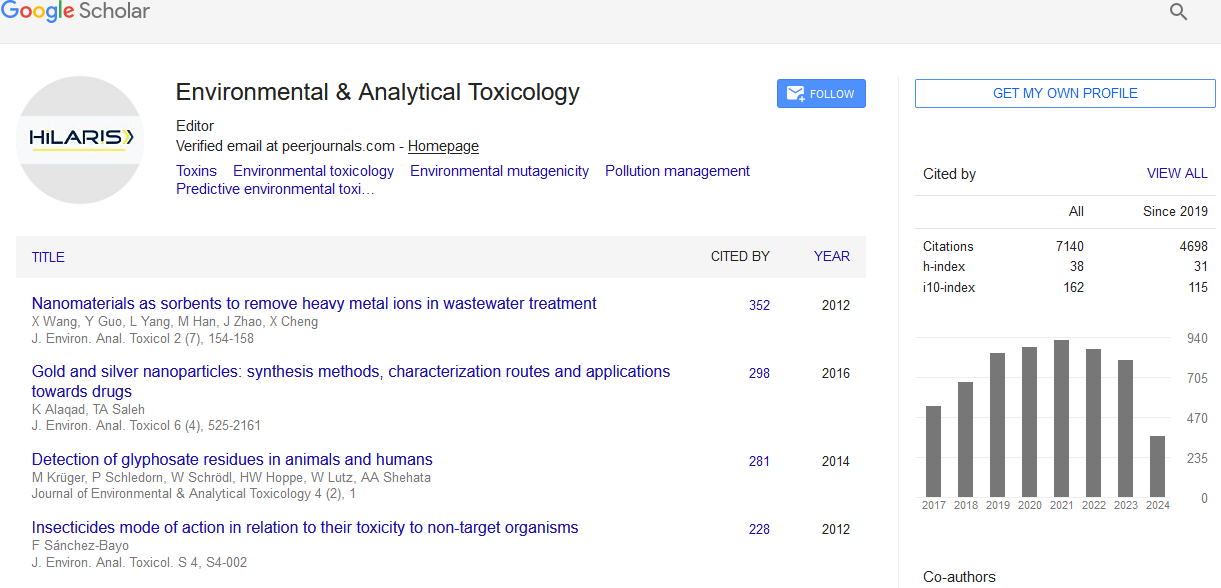
Environmental & Analytical Toxicology received 6818 citations as per Google Scholar report