Short Communication - (2025) Volume 15, Issue 2
Received: 01-Apr-2025, Manuscript No. jeat-26-188601;
Editor assigned: 03-Apr-2025, Pre QC No. P-188601;
Reviewed: 17-Apr-2025, QC No. Q-188601;
Revised: 22-Apr-2025, Manuscript No. R-188601;
Published:
29-Apr-2025
, DOI: 10.37421/2161-0525.2025.15.842
Citation: Schneider, Lucas. ”Advanced Analytical Methods for
Emerging Environmental Pollutants.” J Environ Anal Toxicol 15 (2025):842.
Copyright: © 2025 Schneider L. This is an open-access article distributed under the terms of the Creative Commons Attribution License, which permits unrestricted use,
distribution and reproduction in any medium, provided the original author and source are credited.
The detection of emerging environmental pollutants presents a substantial scientific and societal challenge, necessitating the development of advanced analytical methodologies. These contaminants, often present at low concentrations and with complex chemical structures, demand sensitive, selective, and rapid detection techniques to ensure environmental and human health [1].
The evolving landscape of chemical production and use continuously introduces novel substances into the environment, requiring continuous innovation in analytical chemistry to keep pace with these changes. Per- and polyfluoroalkyl substances (PFAS) represent a significant class of emerging contaminants due to their widespread use, persistence, and potential adverse health effects. Their diverse chemical structures and ubiquity in various environmental matrices pose considerable analytical hurdles, demanding comprehensive profiling strategies for accurate assessment [2].
The persistence of PFAS means they can accumulate in the environment and living organisms, leading to long-term contamination concerns that require robust monitoring. Microplastic pollution has emerged as another critical environmental issue, with microplastics being found in virtually all ecosystems. Reliable methods for their detection and characterization are essential for understanding their distribution, impact, and potential remediation strategies. Spectroscopic techniques, such as Raman spectroscopy, offer non-destructive and highly sensitive approaches for identifying and quantifying microplastics in complex samples [3].
The widespread presence of microplastics necessitates standardized and efficient analytical protocols. Furthermore, the need for portable and on-site analytical tools is paramount for the rapid detection of emerging pollutants, enabling immediate response and mitigation efforts. Electrochemical sensor arrays, for instance, show promise for the simultaneous detection of multiple contaminants in situ, offering high sensitivity and selectivity for field applications [4].
The development of such rapid detection systems is crucial for effective environmental management. Antibiotic resistance genes (ARGs) are increasingly recognized as emerging environmental pollutants, contributing to the growing global threat of antimicrobial resistance. Understanding their prevalence and dissemination pathways in wastewater treatment plants and the wider environment is critical. Techniques like quantitative polymerase chain reaction (qPCR) and next-generation sequencing (NGS) provide powerful tools for profiling ARGs and their potential sources [5].
The spread of ARGs through environmental pathways is a major public health concern. Endocrine-disrupting chemicals (EDCs), including bisphenols and phthalates, are a group of compounds that can interfere with hormonal systems. Their presence in food packaging materials and subsequent migration into food necessitate sensitive and specific analytical methods to ensure food safety and protect public health. Hyphenated techniques like GC-MS/MS and LC-MS/MS are instrumental in achieving accurate quantification [6].
The continuous exposure to EDCs, even at low levels, can have significant health implications. Pharmaceuticals and personal care products (PPCPs) are a diverse group of chemicals that, when released into aquatic environments, can exert ecological effects. Advanced oxidation processes (AOPs) combined with appropriate analytical monitoring techniques offer effective strategies for both the removal and detection of these micropollutants from wastewater, safeguarding water quality [7].
The increasing consumption of pharmaceuticals leads to their continuous discharge into aquatic systems. The environmental fate and transport of engineered nanomaterials represent a new frontier in environmental analysis. Robust analytical methods are required to characterize their size, concentration, and behavior in complex matrices such as soil and sediment. Single-particle inductively coupled plasma mass spectrometry (spICP-MS) is a valuable tool for this purpose, providing detailed insights into nanoparticle characteristics [8].
The potential environmental impacts of nanomaterials necessitate thorough investigation. Volatile organic compounds (VOCs) emitted from industrial activities and other sources can significantly impact air quality and pose risks to human health. The development of selective and sensitive monitoring techniques for trace VOCs in ambient air is essential. Novel porous adsorbents coupled with gas chromatography-mass spectrometry (GC-MS) offer a promising solution for accurate and reliable air quality assessment [9].
The ubiquitous presence of VOCs in urban environments makes their monitoring crucial. Flame retardants, widely used in consumer products, are of growing environmental concern due to their persistence and potential toxicity. The development of multi-residue analytical methods capable of determining various flame retardants in environmental samples, such as indoor dust, is vital for exposure assessment. Liquid chromatography-tandem mass spectrometry (LC-MS/MS) has proven effective for this purpose, contributing to a better understanding of human exposure pathways [10].
The widespread use of flame retardants in everyday items contributes to their environmental presence.
The detection of emerging environmental pollutants necessitates sophisticated analytical strategies capable of addressing their complex nature and often low concentrations. This comprehensive review highlights recent advancements in chromatography, mass spectrometry, and biosensing, specifically focusing on their application to novel contaminants such as per- and polyfluoroalkyl substances (PFAS) and microplastics. The overarching aim is to develop sensitive, selective, and rapid methods for real-time monitoring and effective risk assessment [1].
The analysis of per- and polyfluoroalkyl substances (PFAS) in environmental matrices poses significant analytical challenges due to their structural diversity and inherent persistence. This study critically examines the efficacy of high-resolution mass spectrometry coupled with liquid chromatography (LC-HRMS) for the comprehensive profiling of PFAS in water samples, demonstrating enhanced detection limits and identification capabilities for a broader spectrum of congeners [2].
Microplastic pollution has emerged as a pervasive environmental concern, underscoring the urgent need for reliable methods for its detection and characterization. This research investigates the utility of Raman spectroscopy, particularly surface-enhanced Raman spectroscopy (SERS), for the identification and quantification of microplastics within complex environmental samples, offering a non-destructive and highly sensitive analytical approach [3].
The development of portable and on-site analytical tools is paramount for the rapid detection of emerging pollutants, facilitating immediate environmental monitoring and response. This paper introduces a novel electrochemical sensor array engineered for the simultaneous detection of multiple pesticide residues in water, showcasing remarkable sensitivity, selectivity, and considerable potential for field deployment [4].
Antibiotic resistance genes (ARGs) are increasingly recognized as significant emerging environmental pollutants, contributing to the escalating global challenge of antimicrobial resistance. This study evaluates the application of quantitative polymerase chain reaction (qPCR) combined with next-generation sequencing (NGS) for the comprehensive profiling of ARGs in wastewater treatment plant effluents, providing crucial insights into their dissemination pathways [5].
The analysis of endocrine-disrupting chemicals (EDCs) demands analytical methods that are both highly sensitive and specific. This work demonstrates the significant utility of hyphenated techniques, such as GC-MS/MS and LC-MS/MS, for the precise quantification of bisphenols and phthalates in food packaging materials, thereby ensuring food safety and contributing to environmental protection [6].
Novel organic pollutants, including pharmaceutical residues and personal care products (PPCPs), are being increasingly detected in aquatic environments globally. This paper reviews the effectiveness of advanced oxidation processes (AOPs) when coupled with appropriate analytical monitoring techniques for the efficient removal and detection of these micropollutants from wastewater streams [7].
The environmental fate and transport characteristics of nanomaterials necessitate the development of robust analytical methods for their accurate characterization. This research discusses the application of single-particle inductively coupled plasma mass spectrometry (spICP-MS) for the precise size and concentration analysis of engineered nanoparticles within complex environmental matrices such as soil and sediment [8].
Volatile organic compounds (VOCs) emitted from various industrial activities can pose substantial risks to human health and the environment. This study details the development of a novel porous adsorbent strategy, integrated with gas chromatography-mass spectrometry (GC-MS), for the selective and highly sensitive monitoring of trace VOCs present in ambient air [9].
The increasing environmental prevalence of flame retardants warrants the development of effective and comprehensive analytical methodologies. This paper presents a multi-residue analytical method employing liquid chromatography-tandem mass spectrometry (LC-MS/MS) for the accurate determination of various brominated and organophosphate flame retardants found in indoor dust, a critical medium for human exposure assessment [10].
This collection of research explores advanced analytical techniques for detecting and quantifying emerging environmental pollutants. Key areas covered include chromatographic and mass spectrometric methods for PFAS and microplastics, electrochemical sensors for pesticides, qPCR and NGS for antibiotic resistance genes, GC-MS/MS and LC-MS/MS for EDCs and flame retardants, AOPs for PPCPs, and spICP-MS for engineered nanoparticles. The focus is on developing sensitive, selective, and rapid methods for environmental monitoring and risk assessment. Portable on-site tools and comprehensive profiling are highlighted as crucial for addressing these complex contaminants.
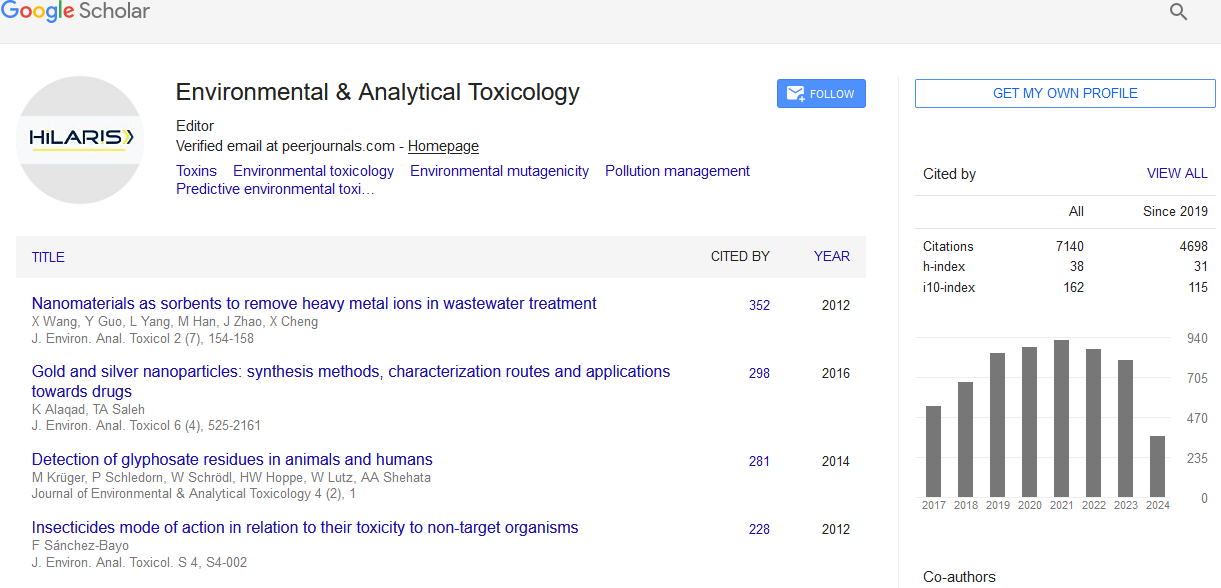
Environmental & Analytical Toxicology received 6818 citations as per Google Scholar report