Brief Report - (2025) Volume 15, Issue 4
Received: 02-Aug-2025, Manuscript No. jeat-26-188640;
Editor assigned: 04-Aug-2025, Pre QC No. P-188640;
Reviewed: 18-Aug-2025, QC No. Q-188640;
Revised: 25-Aug-2025, Manuscript No. R-188640;
Published:
01-Sep-2025
, DOI: 10.37421/2161-0525.2025.15.861
Citation: Kovalenko, Natalia. ”Advanced Analysis of Petroleum
Contamination: Research.” J Environ Anal Toxicol 15 (2025):861.
Copyright: © 2025 Kovalenko N. This is an open-access article distributed under the terms of the Creative Commons Attribution License, which permits unrestricted use,
distribution and reproduction in any medium, provided the original author and source are credited.
The environmental impact of petroleum products necessitates rigorous analytical assessment to understand and mitigate contamination. The identification and quantification of a broad spectrum of hydrocarbons present significant challenges, demanding sophisticated analytical methodologies to accurately gauge pollution levels in diverse environmental matrices such as soil, water, and air. This comprehensive approach is crucial for evaluating the extent of contamination and its subsequent effects on ecosystems and human well-being, underscoring the imperative for robust environmental monitoring and remediation strategies [1].
Advanced chromatographic and spectroscopic techniques play a pivotal role in the detection and precise quantification of specific contaminants like polycyclic aromatic hydrocarbons (PAHs) within petroleum-affected soils. The efficacy of these methods is often enhanced through optimized sample preparation protocols, which are vital for improving analytical sensitivity and ensuring the accuracy of results. Understanding the persistence and mobility of these recalcitrant pollutants within terrestrial ecosystems is a key focus of such research [2].
The development and validation of novel analytical methods are essential for addressing complex environmental scenarios, such as the simultaneous determination of both aliphatic and aromatic hydrocarbons in water samples impacted by oil spills. Gas chromatography-mass spectrometry (GC-MS) stands out as a powerful tool in this regard, and its application, coupled with stringent quality control measures, is paramount for achieving reliable environmental monitoring data [3].
Emerging technologies like biosensors offer promising avenues for rapid and cost-effective detection of petroleum-based contaminants. These technologies are being continuously advanced, with a focus on their practical application in field screening for oil pollution and the development of effective early warning systems to alert authorities to potential environmental hazards [4].
Investigating the environmental fate and transport of petroleum hydrocarbons within subsurface environments is critical for predicting their behavior and impact. The application of modeling techniques allows for the estimation of pollutant movement and transformation, providing vital insights into the potential for groundwater contamination and informing risk assessment strategies, highlighting the synergy between analytical and modeling approaches [5].
Assessing the multifaceted impact of oil spills on marine ecosystems requires a comprehensive analytical framework. This framework often involves the identification of specific petroleum biomarkers and the analysis of their distribution within various marine organisms, offering crucial insights into exposure pathways and the ecological consequences of such events [6].
The analysis of intricate mixtures of petroleum contaminants, particularly in industrial wastewater, presents unique analytical challenges. Hyphenated techniques, such as comprehensive two-dimensional gas chromatography coupled with time-of-flight mass spectrometry (GCxGC-TOF-MS), are instrumental in achieving enhanced separation and identification of target compounds, which is vital for effective wastewater treatment and adherence to environmental regulations [7].
For airborne pollution originating from industrial activities involving petroleum products, methods like solid-phase microextraction (SPME) combined with GC-MS are invaluable. SPME offers advantages for in-situ sampling, enabling efficient pre-concentration and subsequent analysis of petroleum hydrocarbons in air samples, thereby contributing to effective monitoring of atmospheric pollution [8].
Investigating the isotopic composition of carbon within petroleum contaminants provides a powerful means to trace their origin and understand their degradation pathways in the environment. Stable isotope ratio analysis offers critical information for environmental forensics and the development of targeted risk management strategies to address petroleum pollution [9].
Despite advancements, significant analytical challenges persist in the assessment of persistent organic pollutants (POPs) associated with petroleum products, including complex compounds like dioxins and furans. The establishment of standardized analytical protocols and the promotion of inter-laboratory comparisons are crucial for ensuring the reliability and comparability of data used for regulatory decision-making [10].
The analytical assessment of environmental contamination by petroleum products involves intricate challenges in identifying and quantifying a wide array of hydrocarbons. This necessitates the application of advanced analytical techniques to accurately determine the extent of pollution across various environmental matrices, including soil, water, and air, thereby evaluating potential risks to ecosystems and human health [1].
Advanced chromatographic and spectroscopic methods are central to the detection and quantification of specific petroleum-derived pollutants, such as polycyclic aromatic hydrocarbons (PAHs), in contaminated soils. The effectiveness of these analytical approaches is significantly influenced by the meticulousness of sample preparation techniques, which are designed to enhance sensitivity and accuracy. Understanding how these persistent and mobile contaminants behave in terrestrial ecosystems is a primary goal of such studies [2].
Developing and validating novel analytical methodologies is critical for addressing complex contamination scenarios, particularly for the simultaneous analysis of diverse hydrocarbon fractions in petroleum-affected water bodies. Gas chromatography-mass spectrometry (GC-MS) is a cornerstone technique in this area, and its rigorous application, supported by robust quality control protocols, is indispensable for obtaining dependable environmental monitoring data [3].
Innovative technologies, including biosensors, are emerging as rapid and cost-effective tools for detecting petroleum-based contaminants. Ongoing research focuses on enhancing biosensor capabilities and demonstrating their practical utility for on-site environmental screening and the establishment of early warning systems for oil pollution incidents [4].
Understanding the environmental fate and transport of petroleum hydrocarbons within subsurface environments is paramount for predicting their movement and transformation. Modeling approaches are employed to forecast pollutant behavior, offering crucial insights into the risks of groundwater contamination and informing comprehensive risk assessment frameworks, emphasizing the integration of analytical and predictive methodologies [5].
Assessing the ecological consequences of oil spills on marine environments requires a sophisticated analytical framework. This typically involves the identification of characteristic petroleum biomarkers and the analysis of their distribution patterns in marine organisms, which provides vital information on exposure routes and the overall impact on marine biodiversity [6].
Analyzing complex mixtures of petroleum contaminants in challenging matrices like industrial wastewater presents considerable analytical hurdles. Advanced techniques, such as comprehensive two-dimensional gas chromatography coupled with time-of-flight mass spectrometry (GCxGC-TOF-MS), are crucial for achieving superior separation and identification of target analytes, thereby supporting effective wastewater treatment and regulatory compliance [7].
For the monitoring of airborne petroleum hydrocarbons, particularly those originating from industrial emissions, methods like solid-phase microextraction (SPME) coupled with GC-MS offer significant advantages. SPME facilitates efficient in-situ sampling and pre-concentration, contributing to the accurate determination of airborne pollutants [8].
Stable isotope analysis, specifically of carbon isotopes in petroleum contaminants, serves as a powerful tool for source apportionment and the elucidation of degradation pathways. This approach provides invaluable data for environmental forensic investigations and the development of effective risk management strategies concerning petroleum pollution [9].
The analytical landscape for persistent organic pollutants (POPs) associated with petroleum products, including dioxins and furans, continues to present challenges. The development of standardized analytical methods and the implementation of inter-laboratory validation studies are essential to guarantee the reliability and comparability of data for regulatory and scientific purposes [10].
This collection of research highlights the critical need for advanced analytical techniques in assessing environmental contamination by petroleum products. Studies cover the identification and quantification of hydrocarbons in various matrices like soil, water, and air, employing methods such as chromatography and mass spectrometry. The research also explores the environmental fate and transport of these pollutants, the development of novel detection tools like biosensors, and the use of isotopic analysis for tracing contaminant origins. Additionally, challenges in analyzing complex mixtures and persistent organic pollutants are discussed, emphasizing the importance of rigorous monitoring, remediation strategies, and standardized protocols for effective environmental protection and risk management.
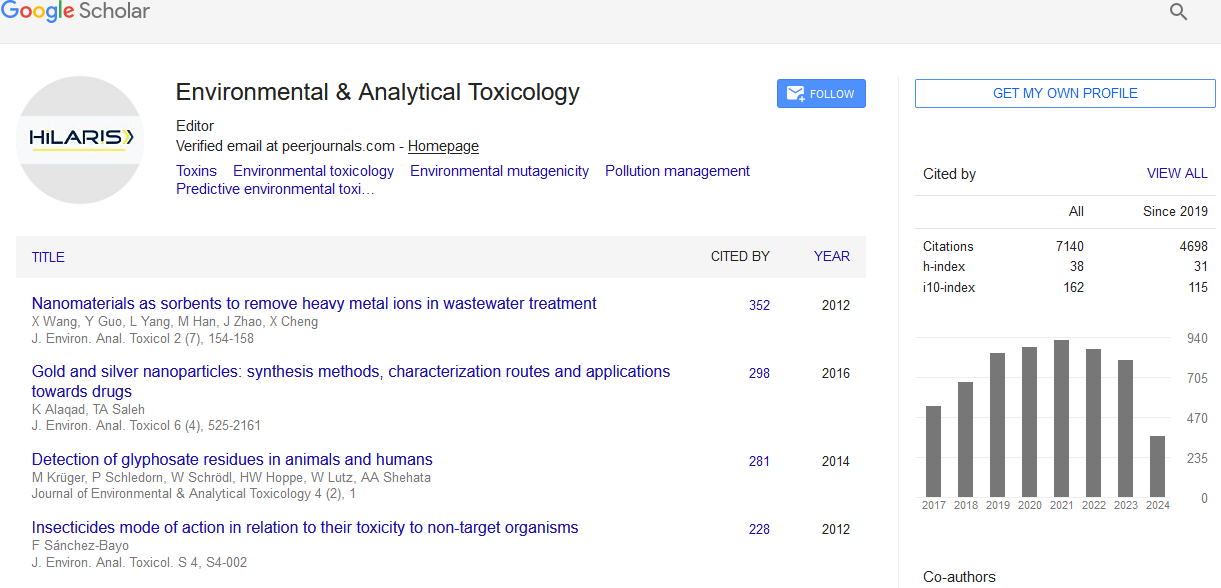
Environmental & Analytical Toxicology received 6818 citations as per Google Scholar report