Perspective - (2025) Volume 16, Issue 3
Received: 01-Apr-2025, Manuscript No. hycr-25-172520;
Editor assigned: 03-Apr-2025, Pre QC No. P-172520;
Reviewed: 17-Apr-2025, QC No. Q-172520;
Revised: 22-Apr-2025, Manuscript No. R-172520;
Published:
29-May-2025
, DOI: 10.37421/2157-7587.2025.16.602
Citation: Sund, Freja. ”Addressing Interconnected Crises for a Sustainable Future.” Hydrol Current Res 16(2025):602.
Copyright: © 2025 Sund F. This is an open-access article distributed under the terms of the Creative Commons Attribution License, which permits unrestricted use, distribution
and reproduction in any medium, provided the original author and source are credited.
The intricate relationship between climate change and biodiversity loss represents a paramount global challenge. It summarizes the critical interlinkages between these two crises, emphasizing the immediate need for integrated policy responses and conservation strategies. The goal is to mitigate irreversible damage to ecosystems and human well-being, recognizing that addressing both simultaneously is essential for effective global environmental stewardship. [1] Simultaneously, the escalating scale of plastic waste entering marine environments poses a severe threat. Current international commitments are proving insufficient to curb this pervasive problem. This situation highlights an urgent imperative for a drastic reduction in plastic production and consumption, coupled with significantly improved waste management practices. These measures are critical to prevent severe ecological and economic consequences from unfolding. [2] Moreover, ensuring global food security in the face of a changing climate requires an integrated approach to sustainable agriculture. This involves advocating for strategies such as climate-smart farming, efficient resource management, and embracing technological innovations. These elements are identified as crucial for enhancing agricultural resilience and securing food supplies for future generations. [3] The global health landscape is significantly impacted by environmental factors, notably ambient particulate matter pollution. This comprehensive analysis quantifies the substantial global health burden attributed to this form of pollution, revealing its persistent role as a leading risk factor for premature mortality and disability worldwide. The study underscores the urgent need for stringent air quality policies to protect public health, particularly by addressing geographical disparities in pollution exposure. [4] Discussions around environmental justice are increasingly intertwined with climate change adaptation. This includes examining the sociopolitical complexities involved in planning for climate-induced population displacement. There's a strong argument for developing equitable and inclusive adaptation strategies that consciously prioritize vulnerable communities. Such approaches are designed to address historical injustices, ensuring that climate responses do not inadvertently exacerbate existing inequalities and create new forms of marginalization. [5] A transition towards more environmentally responsible economic models hinges on sustainable consumption and production practices. This area synthesizes the current landscape of such practices, meticulously identifying their key drivers, existing barriers, and emerging trends. It also outlines essential future research directions and policy recommendations, all aimed at accelerating the global shift towards more sustainable resource utilization patterns. [6] The fundamental links between healthy ecosystems, the services they provide, and various dimensions of human health and well-being are also critically explored. This overview identifies existing research gaps and proposes future directions for effectively integrating ecosystem services into public health policies. It emphatically emphasizes the profound co-benefits that conservation efforts bring, not just for the environment, but also for human systems as a whole. [7] Deforestation represents another significant contributor to climate change, with forest loss directly impacting greenhouse gas emissions and altering regional climate patterns. This systematic review synthesizes this complex relationship, detailing the mechanisms through which forest destruction exacerbates climate change. It clearly underscores the vital role of forest conservation and sustainable land management practices as indispensable components of global climate mitigation efforts. [8] In pursuit of environmental sustainability, the circular economy emerges as a transformative framework, offering a paradigm shift away from linear 'take-make-dispose' models. This paper highlights its immense potential for achieving reduced waste, enhanced resource efficiency, and a minimized ecological footprint. This is achieved through the adoption of design principles that inherently focus on durability, extensive reuse, and effective recycling throughout product lifecycles. [9] Finally, the positive impacts of urban green spaces on the mental and physical health of children and adolescents are systematically evaluated. This review reveals a compelling association between access to nature in urban environments and improved psychological well-being, reduced stress levels, and increased physical activity among young populations. This research strongly advocates for greater integration of green infrastructure into future city planning, recognizing its crucial role in fostering healthier urban communities. [10]
The multifaceted nature of global environmental challenges is a central theme throughout this compilation of studies. Specifically, research highlights the critical interlinkages between climate change and biodiversity loss, underscoring an immediate need for integrated policy responses and robust conservation strategies [1]. Such concerted action is crucial to mitigate irreversible damage to ecosystems and human well-being, affirming that simultaneous consideration of both crises is fundamental for effective global environmental stewardship. Complementing this, the destructive cycle of deforestation is systematically reviewed, revealing its complex relationship with climate change [8]. Forest loss significantly contributes to greenhouse gas emissions and directly alters regional climate patterns, emphasizing the vital role of forest conservation and sustainable land management in comprehensive global climate mitigation efforts. In the agricultural sector, an integrated approach to sustainable farming is advocated to directly address climate change impacts [3]. Strategies like climate-smart farming, efficient resource management, and technological innovations are identified as pivotal for enhancing agricultural resilience and ensuring long-term global food security in an increasingly variable climate.
The profound impact of environmental conditions on human health is extensively documented. A comprehensive analysis quantifies the substantial global health burden attributed to ambient particulate matter pollution, which persistently acts as a leading risk factor for premature mortality and disability across the world [4]. This critical finding necessitates urgent implementation of stringent air quality policies globally to safeguard public health, particularly addressing observed geographical disparities. Beyond direct pollution, the intrinsic links between healthy ecosystems, the essential services they provide, and various dimensions of human health and well-being are thoroughly explored [7]. This overview identifies critical research gaps and proposes future directions for integrating ecosystem services into public health policies, emphasizing the numerous co-benefits of conservation for both ecological and human systems. Furthermore, the positive influence of urban green spaces on the mental and physical health of children and adolescents is systematically evaluated. Access to nature in urban environments is strongly associated with improved psychological well-being, reduced stress levels, and increased physical activity, advocating strongly for greater incorporation of green infrastructure in contemporary city planning [10].
Addressing issues of waste and resource scarcity is another critical area of focus. An assessment projects the escalating scale of plastic waste infiltrating the marine environment, indicating that current international commitments are proving woefully insufficient to curb this growing problem [2]. This situation highlights an urgent need for a drastic reduction in plastic production and consumption, coupled with vastly improved waste management systems, to prevent severe ecological and economic consequences. In response to such linear consumption models, the circular economy is presented as a transformative framework for achieving comprehensive environmental sustainability [9]. This paradigm shifts away from traditional 'take-make-dispose' models, instead emphasizing the potential for significantly reduced waste, enhanced resource efficiency, and a minimized ecological footprint. This is achieved through innovative design principles focused on maximizing product durability, facilitating extensive reuse, and promoting robust recycling initiatives throughout entire product lifecycles. These interconnected strategies collectively offer pathways toward more sustainable resource utilization.
Effective governance, policy development, and social equity considerations are indispensable for navigating environmental challenges. The intersection of environmental justice and climate change adaptation is critically examined, with particular attention to the sociopolitical complexities inherent in planning for climate-induced population displacement [5]. The research argues compellingly for equitable and inclusive adaptation strategies that consciously prioritize vulnerable communities and actively work to address historical injustices. This approach aims to ensure that climate responses do not inadvertently exacerbate existing inequalities or create new forms of marginalization within affected populations. Complementing this, a comprehensive review synthesizes the current landscape of sustainable consumption and production practices [6]. This work meticulously identifies key drivers, persistent barriers, and emerging trends within this crucial field. It also outlines essential future research directions and concrete policy recommendations necessary to accelerate the global transition towards more environmentally responsible economic models and efficient resource utilization patterns. These policy-oriented discussions are vital for guiding effective governmental and societal responses, ultimately fostering a more sustainable and just future for all.
The ongoing global environmental crisis demands immediate and integrated solutions across multiple sectors. Key research identifies critical interlinkages between climate change and biodiversity loss, stressing the need for simultaneous action to prevent irreversible ecological damage and protect human well-being. Addressing these twin crises effectively is fundamental for responsible global environmental stewardship. Another significant concern is the escalating issue of plastic waste in marine environments. Current global commitments fall short, necessitating a drastic reduction in plastic production and consumption, along with vastly improved waste management systems, to avert severe ecological and economic repercussions. Furthermore, sustainable agriculture, incorporating climate-smart farming and efficient resource management, stands out as crucial for enhancing resilience and ensuring global food security in a changing climate. The global health burden from ambient particulate matter pollution is substantial, representing a leading risk factor for premature mortality and disability. This issue highlights the urgent need for stringent air quality policies globally. Additionally, environmental justice is pivotal in climate change adaptation, especially concerning climate-induced population displacement. Strategies must be equitable and inclusive, prioritizing vulnerable communities to avoid exacerbating existing inequalities. Moving towards sustainable economic models, discussions center on sustainable consumption and production practices, identifying key drivers and barriers while outlining future policy recommendations. Healthy ecosystems and their services are intrinsically linked to human health and well-being, suggesting a need to integrate ecosystem services into public health policies. The complex relationship between deforestation and climate change also demands attention, with forest conservation being vital for climate mitigation. Finally, the circular economy offers a transformative framework for environmental sustainability through reduced waste and enhanced resource efficiency, while urban green spaces are shown to positively impact mental and physical health, especially for children and adolescents, advocating for more green infrastructure in city planning.
None
None
Indexed at, Google Scholar, Crossref
Indexed at, Google Scholar, Crossref
Indexed at, Google Scholar, Crossref
Indexed at, Google Scholar, Crossref
Indexed at, Google Scholar, Crossref
Indexed at, Google Scholar, Crossref
Indexed at, Google Scholar, Crossref
Indexed at, Google Scholar, Crossref
Indexed at, Google Scholar, Crossref
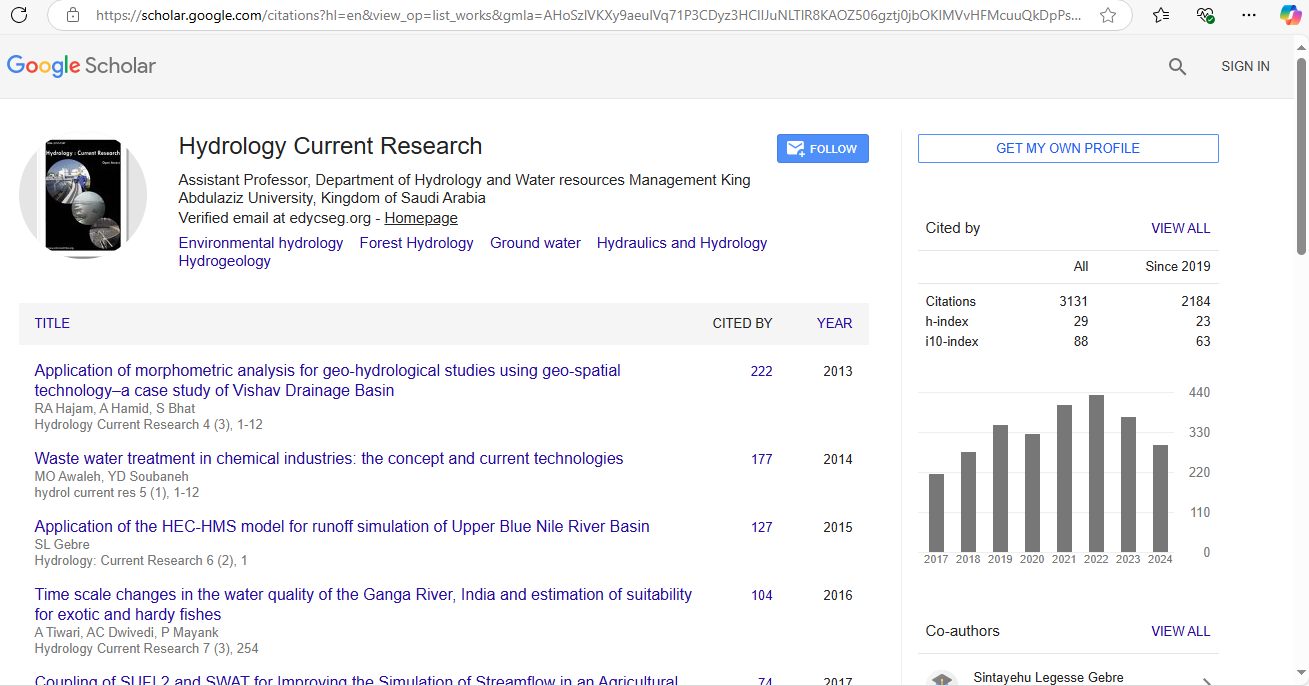
Hydrology: Current Research received 2843 citations as per Google Scholar report