Human-computer interaction (HCI) studies the design and use of computer technology, focusing on the interfaces between people (users) and computers. HMI researchers are observing the ways humans interact with computers and designing technologies that allow humans to interact with computers in innovative ways. As a research area, human-computer interaction is at the intersection of computer science, behavioral sciences, design, media studies and many other fields of study. The term was popularized by Stuart K. Card, Allen Newell and Thomas P. Moran in their 1983 founding book, The Psychology of Human - Computer Interaction, although the authors first used it in 1980 and the first known use occurred in 1975. The term implies that, unlike other limited-use tools (such as a wooden mallet, useful for hitting objects, but not much else), a computer has many uses and this takes place as an open dialogue between the user and the computer. The notion of dialogue compares human-computer interaction to human-to-human interaction, a crucial analogy for theoretical considerations in the field.
Research Article: Advances in Robotics & Automation
Research Article: Advances in Robotics & Automation
Research Article: Advances in Robotics & Automation
Research Article: Advances in Robotics & Automation
Research Article: Advances in Robotics & Automation
Research Article: Advances in Robotics & Automation
Research Article: Advances in Robotics & Automation
Research Article: Advances in Robotics & Automation
Editorial: Advances in Robotics & Automation
Editorial: Advances in Robotics & Automation
Scientific Tracks Abstracts: Biosensors & Bioelectronics
Scientific Tracks Abstracts: Biosensors & Bioelectronics
Accepted Abstracts: Biosensors & Bioelectronics
Accepted Abstracts: Biosensors & Bioelectronics
Scientific Tracks Abstracts: Journal of Material Sciences & Engineering
Scientific Tracks Abstracts: Journal of Material Sciences & Engineering
Posters & Accepted Abstracts: Journal of Material Sciences & Engineering
Posters & Accepted Abstracts: Journal of Material Sciences & Engineering
Scientific Tracks Abstracts: Journal of Material Sciences & Engineering
Scientific Tracks Abstracts: Journal of Material Sciences & Engineering
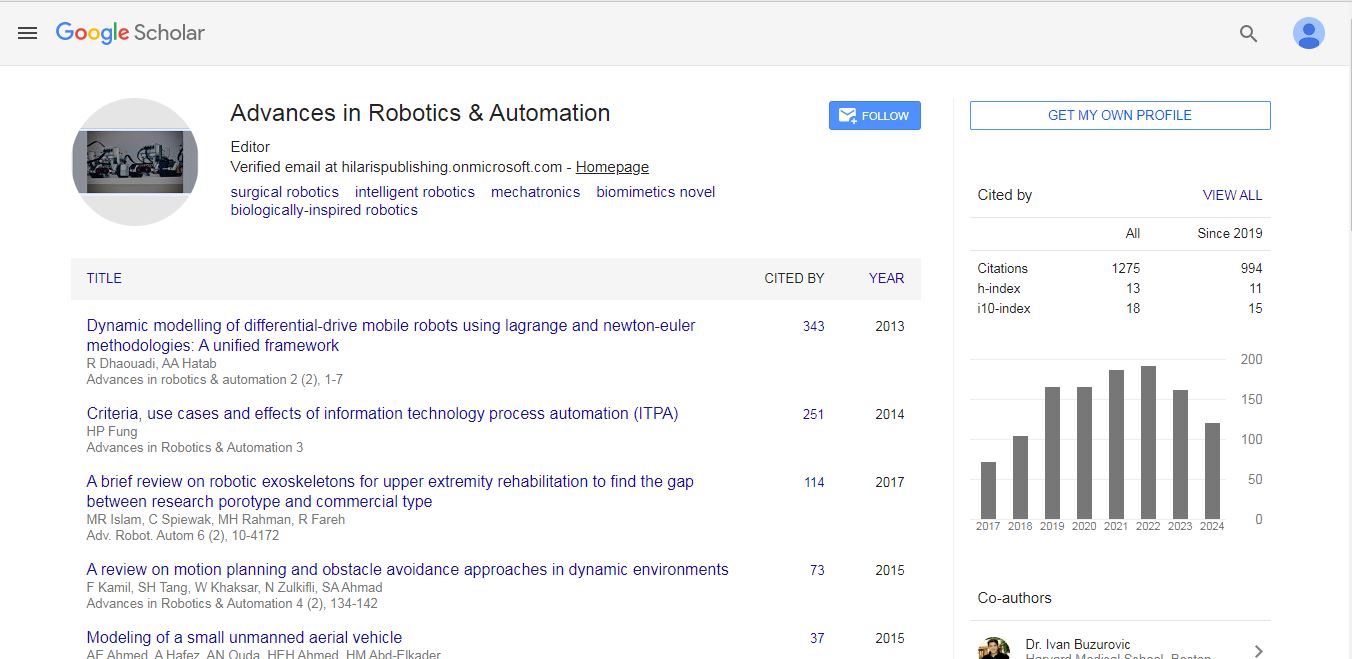
Advances in Robotics & Automation received 1275 citations as per Google Scholar report
 Spanish
  Chinese
  Russian
  German
  French
  Japanese
  Portuguese
  Hindi
Hindi 