Atherosclerosis is the most common cause of the lower extremities of chronic arterial occlusive disease. The arterial narrowing or obstruction arising from the atherosclerotic cycle decreases blood flow to the lower limb during exercise or while at rest. A spectrum of symptoms results, whose severity depends on the extent of the involvement and the collateral circulation that is available. Thus symptoms can range from sporadic claudication to rest pain. Intermittent claudication refers to pain that occurs with exercise in the affected limb, and is relieved with rest. This pain usually occurs distally to the obstruction or narrowing of the arteries. Because the superficial femoral and popliteal arteries are the vessels most frequently affected by the atherosclerotic process, the pain of intermittent claudication is most often localized to the calf.
Editor’s Note: Journal of Blood & Lymph
Editor’s Note: Journal of Blood & Lymph
Case Report: Journal of Blood & Lymph
Case Report: Journal of Blood & Lymph
Research Article: Journal of Blood & Lymph
Research Article: Journal of Blood & Lymph
Research Article: Journal of Blood & Lymph
Research Article: Journal of Blood & Lymph
Review Article: Journal of Blood & Lymph
Review Article: Journal of Blood & Lymph
Scientific Tracks Abstracts: Cancer Science & Therapy
Scientific Tracks Abstracts: Cancer Science & Therapy
Posters: Alternative & Integrative Medicine
Posters: Alternative & Integrative Medicine
Scientific Tracks Abstracts: Journal of Nephrology & Therapeutics
Scientific Tracks Abstracts: Journal of Nephrology & Therapeutics
Scientific Tracks Abstracts: Journal of Bioengineering & Biomedical Science
Scientific Tracks Abstracts: Journal of Bioengineering & Biomedical Science
Posters-Accepted Abstracts: Journal of Bioengineering & Biomedical Science
Posters-Accepted Abstracts: Journal of Bioengineering & Biomedical Science
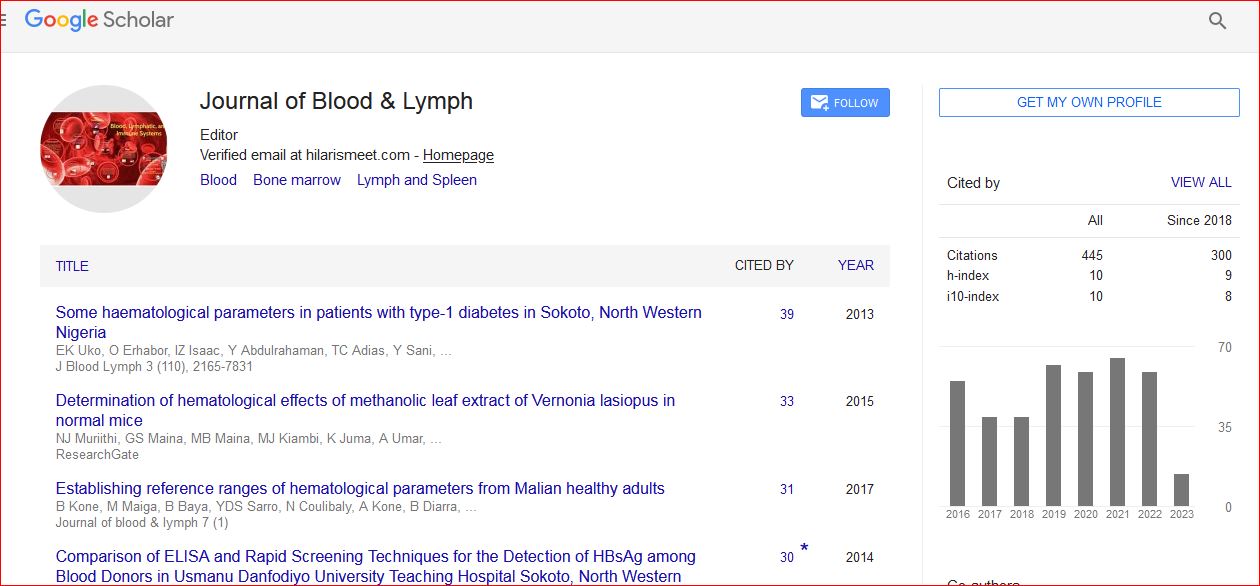
Journal of Blood & Lymph received 443 citations as per Google Scholar report
 Spanish
  Chinese
  Russian
  German
  French
  Japanese
  Portuguese
  Hindi
Hindi 