Piyush Swami and Anupama Ray
Bioelectric signals are electric currents produced by the sum of electric potential differences created across a specialized tissue, organ or cell system. This electrical activity is mainly expounded by the differences in concentrations of sodium, potassium and chlorine which results in action potential. It is very short lasting event during which the electrical membrane potential of a cell rises and falls rapidly, following a stereotyped trajectory. Resultant of these several action potentials produced by combination of different cells engenders bioelectric signals. Common types of bioelectrical signals include electroencephalogram (EEG), magneto encephalogram (MEG), electrocardiogram (ECG), galvanic skin response (GSR), electromyogram (EMG), etc. These bioelectric signals are characterized by their amplitude, frequency/ time duration and wave shape. Electrophysiological study of these bioelectric signals is helpful in monitoring and/or diagnosis. But these bioelectric signals are very weak in amplitude and they are further attenuated by the high impedance offered by the skin. Hence, various types of biopotential electrodes have been developed which transduce ionic conduction to electronic conduction thus, facilitating viewing and/ or storing of bioelectrical signals. The objective of this study is to provide an overview of the cutting-edge electrode technology used for effective acquisition of the bioelectric signals.
Piyush Swami completed his BE in Biomedical Engineering from CITM, Faridabad. Presently, he is pursuing MTech in Biomedical Engineering from NIT Rourkela. His research interests include biomaterials, rehabilitative tissue engineering, bionics and rehabilitation engineering. Anupama Ray completed her BTech in Electronic Instruments from BUIE, Bankura. Her research interests include bioinstrumentation and nanotechnology used in healthcare. Presently, she is pursuing MTech in Biomedical Engineering from NIT Rourkela.
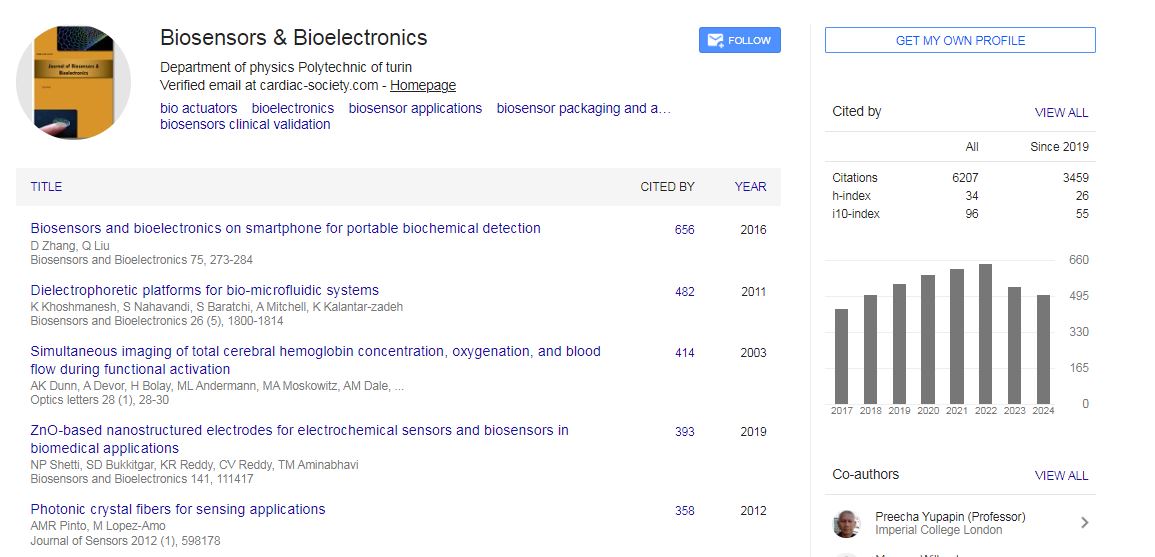
Biosensors & Bioelectronics received 6207 citations as per Google Scholar report
 Spanish
  Chinese
  Russian
  German
  French
  Japanese
  Portuguese
  Hindi
Hindi 