Chris Mallika Bhadra and Piyush Swami
Zirconia- Chitosan composite exemplifies an imperative matrix composed of Zirconia nanoparticles because of their extensive biocompatibility and a high bond forming ability. The optimization of a matrix is of paramount significance due to instability of biomolecules in the solution. This matrix has been developed using the process of electrophoretic deposition to immobilize the zirconia nanoparticles onto the surface of chitosan biopolymer. The Chit-ZrO2 film has been deposited on an ITO coated glass plate which acted as the working electrode in the process of electrophoretic deposition. This deposition method has been mainly used to observe the immobilization of DNA on the Chit-ZrO2 composite. The immobilization of DNA was further confirmed by experimental techniques such as FT-IR, Cyclic Voltammetric methods and EIS studies, as well as the scan rate effect of the Chit-ZrO2/ITO and DNA-Chit-ZrO2/ITO coated plates respectively. The SEM and the XRD studies confirmed the presence of nanocrystalline ZrO2 used in the solution.
Chris Mallika Bhadra completed her BTech in Biotechnology from HITK, Kolkata. Presently, she is pursuing MTech in Biomedical Engineering from NIT Rourkela. Her research interests include molecular biology, rDNA technology and biomaterials used in drug delivery systems. Piyush Swami completed his BE in Biomedical Engineering from CITM, Faridabad. Presently, he is pursuing MTech in Biomedical Engineering from NIT Rourkela. His research interests include biomaterials, rehabilitative tissue engineering and bionics.
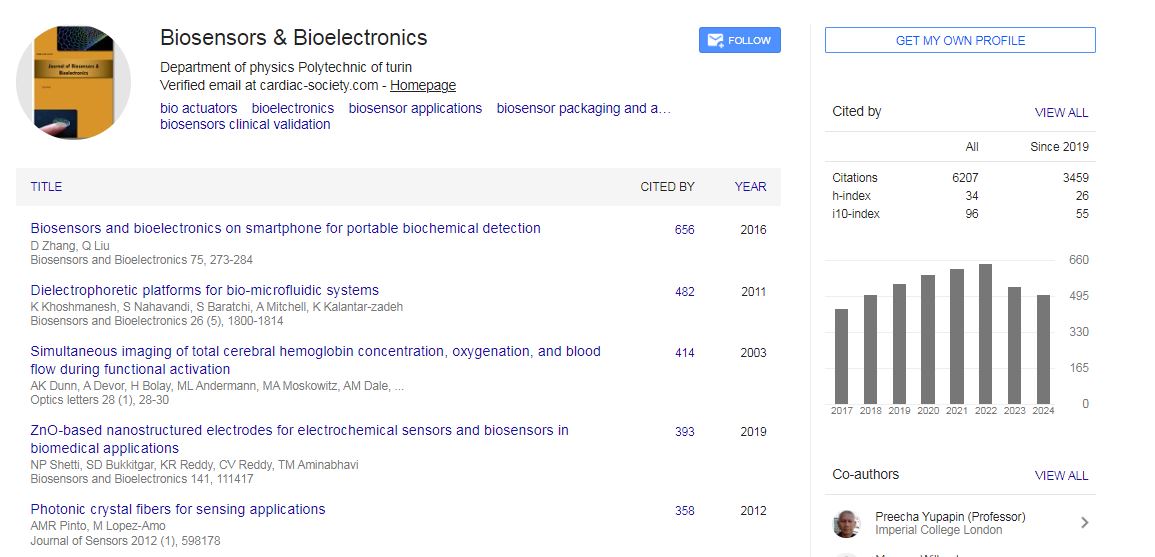
Biosensors & Bioelectronics received 6207 citations as per Google Scholar report

 Spanish
  Chinese
  Russian
  German
  French
  Japanese
  Portuguese
  Hindi
Hindi 