Amira Ben Hassine, A Valverde, V Serafin, C Munoz-San Martin, M Garranzo-Asensio, M Gamella, R Barderas, M Pedrero, N Raouafi, S Campuzano, P Yanez-Sedeno and J M Pingarron
Universidad Complutense de Madrid, Spain
University of Tunis El Manar, Tunisia
Institute of Health Carlos III, Spain
Posters & Accepted Abstracts: J Biosens Bioelectron
Metastatic processes have become the leading cause of death in patients diagnosed with cancer. Recently, two proteins: E-cadherin (E-cad) and IL-13 receptor Rα2 (IL-13Rα2), have been proposed as candidate prognostic and metastasis biomarkers in several cancer types. This work describes the development of a dual electrochemical immuno sensing platform for accurate determination of both target proteins. The proposed methodology is based on the use of sandwich immuno sensing approaches (involving HRP-labeled detector antibodies) implemented onto magnetic microbeads (MBs) and amperometric transduction at screen-printed dual carbon electrodes (SPdCEs). The magnetic bioconjugates were captured onto SPdCEs and the amperometric transduction was performed using the H2O2/hydroquinone (HQ) system. Under optimal experimental conditions, the developed bio-platform demonstrated linear concentration ranges of 1.0-25 and 5.0-100 ng/mL-1 detection limits of 0.28 and 1.04 ng/mL-1 for E-cad and IL- 13Rα2 respectively and excellent selectivity against other non-target proteins. The developed sensors also showed a good reproducibility between amperometric measurements provided by nine different sensors constructed in the same manner (RSD, 3.1 % for E-cad and RSD, 4.3 % for IL-13Rα2). The applicability of this platform for the accurate determination of these proteins in cells (both intact and lysed) with different metastatic potential and extracts from tissues of patients diagnosed with different grade colorectal cancer were also demonstrated. Interesting features in terms of simplicity, speed, portability and sample amount required, make this immuno platform more compatible with current clinical demands at the point of care than conventional methodologies.
Amira Ben Hassine has completed her Graduation as an Engineer in Industrial Chemistry from the Institute of Applied Science and Technology of Tunis in 2017. Currently, she is pursuing her PhD at the Faculty of Sciences of Tunis and carries out a research internship at the Complutense University of Madrid.
E-mail: amira.benhassine@fst.utm.tn
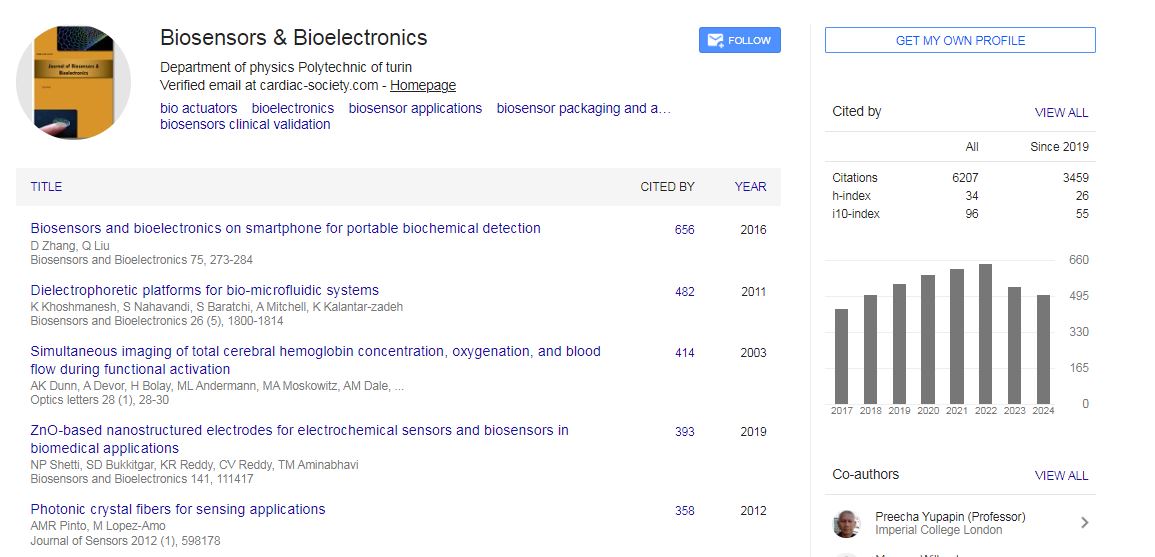
Biosensors & Bioelectronics received 6207 citations as per Google Scholar report
 Spanish
  Chinese
  Russian
  German
  French
  Japanese
  Portuguese
  Hindi
Hindi 