Manickam Pandiaraj, Thangamuthu Madasamy, Seenivasan Rajesh, Kalpana Bhargava, Kotamraju Srigiridhar, Govindaswamy Izhavazhagan and Chandran Karunakaran
Cytochrome c (cyt ) released from the mitochondria induced apoptosis, is a key event in several human diseases and the release of this protein into the circulating blood following myocardial infarctions. In this report we have developed a novel highly sensitive and selective biosensor for the direct determination of cyt c by covalent immobilization of cytochrome c reductase (CcR) in self-assembled monolayer (SAM) of cysteine on gold nanoparticles (GNP) ? polypyrrole (PPy) modified platinum electrode. The surface morphological images of GNP and micro porous PPy matrix on platinum electrode were investigated by scanning electron microscope (SEM). The cyclic voltammetric study of the fabricated biosensor revealed that the CcR immobilized electrode shows a reversible redox peaks at -0.45 V vs Ag/AgCl. Since the active site of CcR was deeply embedded in protein structure, redox mediator hydroquinone was used to shuttle the electron between active site of the enzyme and the electrode surface. This biosensor exhibited a high activity in the reduction of oxidized cyt c (Fe3+) and exhibits a linear response over the concentration range from 5μM to 1 mM with a detection limit of 5μM. It is concluded that the SAM of cysteine on GNP in PPy matrix enhanced the CcR activity towards cyt c reduction and facilitated electron transfer provide sensitive measurement of oxidized cyt c with good reproducibility. This biosensor will have a great potential for studying apoptosis in vivo and in vitro models and its inhibition by suitable drugs.
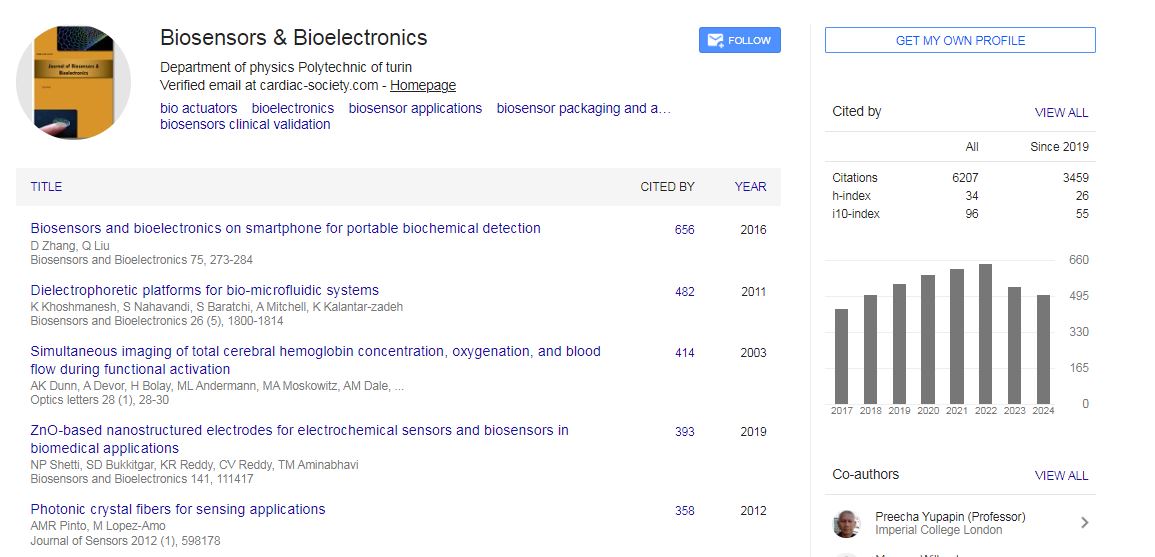
Biosensors & Bioelectronics received 6207 citations as per Google Scholar report


 Spanish
  Chinese
  Russian
  German
  French
  Japanese
  Portuguese
  Hindi
Hindi 