Ashwin Datla,
Master of Science, University of Abuja, Nigeria
As more and more organizations choose to become highly internet native, the need for a strong integration architecture that can bridge the gap between the present circumstances and future needs becomes crucial. Traditional Integration Platforms are no longer capable of keeping up with increasing challenges arising from digital transformation of organizations that is heavily reliant on API integration, IOT and cloud platforms. A hybrid cloud platform is the new way to integrate. TIBCO Flogo is essentially an open source integration framework for IoT that offers a lightweight runtime to build IoT integrations at the edge. It enables in building microservices with a browser based flow designer, making app building a faster and more efficient process. The flows can then be deployed to any infrastructure: on-premises, at the edge in devices, and in web-scale serverless environments. The framework allows for developers to build natively for multiple types of cloud platforms and devices so that a broadest range of deployment scenarios are supported without infrastructure lock-in. With Flogo Enterprise, application sizes are significantly smaller than when built using other technologies.
TIBCO provides the capability to deploy edge native microservices which can for example embed a tenser flow model on the edge device and enable the IoT device to act based on real-time data feeds coming into the system.
TIBCO Cloud Integration (TCI) is an offering that uses an API-led design approach and a deploy-anywhere model. It offers capabilities matching users of various skill levels, so they can quickly connect cloud apps, build hybrid integration flows across on-premises systems, cloud applications, develop microservices and IoT edge applications.
When these competencies are coupled with our Analytics capabilities we can truly amazing solutions which apply across multiple verticals. For example with one of our customers we were able to ingest data from traffic sensors in real-time and score these patterns against historic trends to detect the probability of an accident to occur in real-time. We took this solution a step further by also alerting law enforcement agencies to monitor that area and the IoT device would also take action by slowing down the traffic around that intersection.
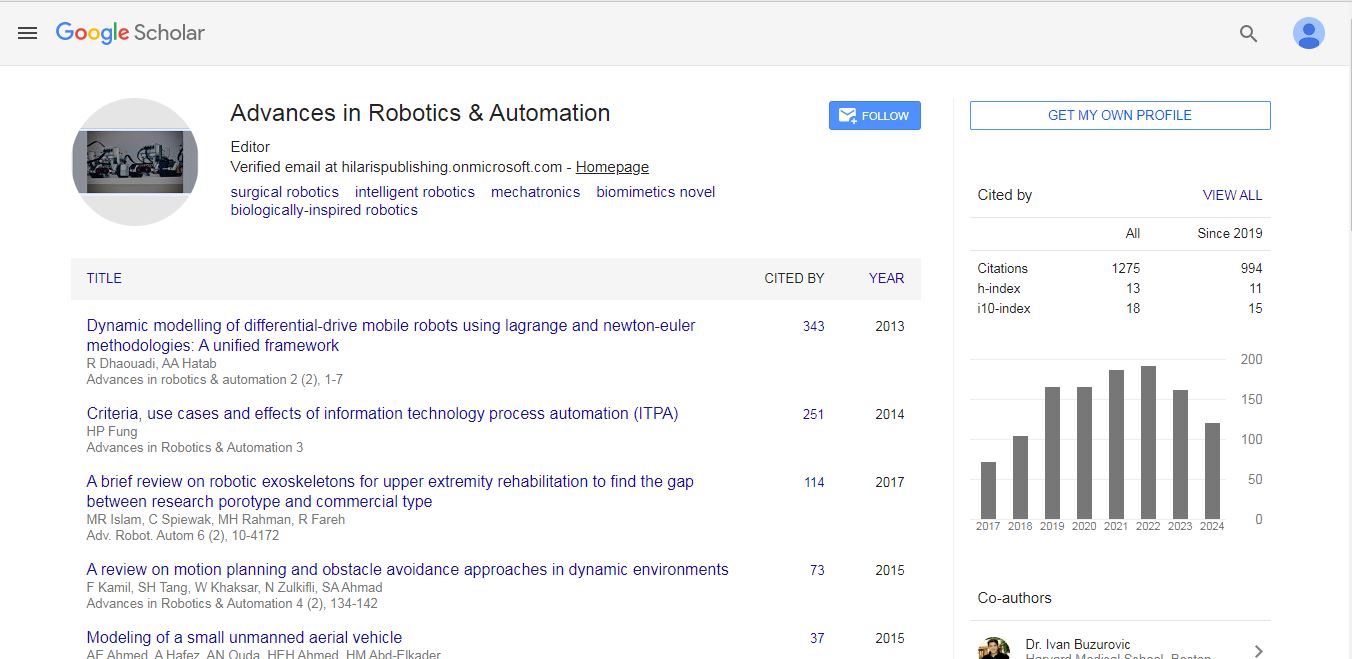
Advances in Robotics & Automation received 1275 citations as per Google Scholar report
 Spanish
  Chinese
  Russian
  German
  French
  Japanese
  Portuguese
  Hindi
Hindi 