Perspective - (2025) Volume 14, Issue 4
Received: 01-Jul-2025, Manuscript No. aim-25-177763;
Editor assigned: 03-Jul-2025, Pre QC No. P-177763;
Reviewed: 17-Jul-2025, QC No. Q-177763;
Revised: 22-Jul-2025, Manuscript No. R-177763;
Published:
29-Jul-2025
, DOI: 10.37421/2427-5162.2025.14.583
Citation: El-Sayed, Ahmed. ”Yoga and Meditation for Cardiovascular Health.” Alt Integr Med 14 (2025):583.
Copyright: © 2025 El-Sayed A. This is an open-access article distributed under the terms of the Creative Commons Attribution License, which permits unrestricted use, distribution and reproduction in any medium, provided the original author and source are credited.
A systematic review and meta-analysis explored the efficacy of yoga-based lifestyle interventions in mitigating cardiovascular risk factors. The findings consistently demonstrated significant reductions in critical markers such as blood pressure, heart rate, and body mass index across diverse populations. This research underscores that consistent engagement in yoga practices provides a tangible and measurable benefit for enhancing various indicators of heart health, offering a non-pharmacological approach to cardiovascular well-being [1].
Focusing on mindfulness-based interventions, a dedicated meta-analysis investigated their effects on blood pressure among adult participants. The study revealed a statistically significant, albeit small, reduction in systolic blood pressure. This outcome is particularly noteworthy because these interventions are non-pharmacological in nature, positioning them as a potentially valuable complementary strategy for the broader management of hypertension, contributing to an integrated healthcare approach [2].
A comprehensive review and meta-analysis provided strong evidence for the positive impact of yoga on multiple cardiovascular risk factors. These factors included not only blood pressure but also cholesterol levels and overall body weight. The profound implications of these findings suggest that regular yoga practice offers substantial benefits for both the primary prevention of heart disease, by addressing risk factors before disease onset, and secondary prevention, in managing existing conditions [3].
Further research has illuminated the multifaceted benefits of mindfulness-based interventions for cardiovascular health. These interventions have been shown to effectively lower blood pressure, reduce systemic inflammation, and significantly improve psychological well-being. Collectively, these improvements contribute synergistically to better cardiovascular outcomes, highlighting that such interventions offer a holistic and integrated strategy for cardiovascular risk reduction and overall health promotion [4].
Another meta-analysis specifically highlighted the positive influence of yoga practice on the quality of life and physical capacity among patients afflicted with chronic heart failure. The findings indicate that yoga can serve as an effective supportive therapy, considerably enhancing daily functioning and overall well-being for this particularly vulnerable patient population, thereby improving their ability to manage their condition and engage in daily activities with greater ease [5].
Evidence emerging from a systematic review posited that meditation practices can substantially improve several critical cardiovascular risk factors. These include a notable reduction in blood pressure and an improvement in lipid profiles. Furthermore, the review suggested a potential beneficial impact on the progression of atherosclerosis, positioning meditation as a promising non-pharmacological strategy within the broader framework of cardiovascular disease prevention and management [6].
A systematic review and meta-analysis specifically investigated the effects of yoga interventions on cardiovascular biomarkers and psychological stress in adult populations. The study identified improvements in various cardiovascular indicators alongside significant reductions in psychological stress levels. This dual benefit underscores that yoga provides a comprehensive approach, simultaneously addressing both the physiological and psychological dimensions essential for optimal heart health and overall well-being [7].
A thorough review focused on Transcendental Meditation, demonstrating its capacity to lower blood pressure and ameliorate other associated cardiovascular risk factors. These findings suggest its utility as a valuable complementary therapy in the medical landscape. The integration of this specific meditation technique could thus offer a non-invasive and accessible pathway to support and enhance heart health, potentially reducing reliance on pharmacological interventions alone [8].
A systematic review and meta-analysis evaluating yoga interventions for cardiovascular disease prevention concluded that they significantly improve both blood pressure and lipid profiles. This makes yoga interventions highly beneficial for both primary prevention, in averting disease onset, and secondary prevention, in managing established conditions. Consequently, yoga stands out as a powerful and adaptable tool within a comprehensive, holistic strategy for maintaining and improving heart health [9].
Finally, a meta-analysis provided confirmation that various mind-body practices, encompassing both meditation and yoga, lead to significant improvements in heart rate variability. Heart rate variability is recognized as a crucial indicator of autonomic nervous system balance and overall cardiovascular health. These practices, therefore, actively enhance the heart's intrinsic adaptability and contribute to its robust, long-term health and functional capacity [10].
The efficacy of yoga-based lifestyle interventions in positively influencing cardiovascular health has been thoroughly examined in a recent systematic review and meta-analysis. This comprehensive study elucidated that engaging in yoga consistently leads to significant reductions in several key cardiovascular risk parameters, including systolic and diastolic blood pressure, resting heart rate, and body mass index across diverse demographic groups. The implications are clear: integrating yoga into daily life offers a substantial and measurable advantage for improving overall heart health metrics and reducing disease burden [1]. Regarding the effects of mindfulness-based interventions, a recent meta-analysis provided compelling insights into their capacity to modulate blood pressure. The research specifically identified a modest but statistically significant decrease in systolic blood pressure among adult participants. Crucially, the non-pharmacological nature of these interventions suggests they represent a valuable and accessible adjunct therapy, potentially enhancing current clinical strategies for managing hypertension without additional medication [2]. Further reinforcing the benefits of traditional practices, a comprehensive review and meta-analysis specifically highlighted yoga's significant role in ameliorating various cardiovascular risk factors. The pooled data unequivocally demonstrated improvements in blood pressure regulation, favorable alterations in cholesterol levels, and a measurable reduction in body weight. These findings collectively underscore that yoga provides considerable benefits for both preventing the onset of heart disease and supporting recovery or management in existing cardiac conditions [3]. A systematic review and meta-analysis explored the profound impact of mindfulness-based interventions on a spectrum of cardiovascular health indicators. This investigation revealed that such interventions are not only effective in lowering blood pressure but also in mitigating systemic inflammation and fostering an improved state of psychological well-being. These synergistic effects converge to establish a holistic framework for cardiovascular risk reduction, emphasizing mental and physical integration [4]. In the context of specific patient populations, a meta-analysis shed light on the positive effects of regular yoga practice for individuals suffering from chronic heart failure. The study documented notable improvements in both their overall quality of life and their physical capacity. This evidence firmly positions yoga as a highly beneficial supportive therapy, capable of enhancing the daily functioning and emotional well-being of this particularly vulnerable patient demographic, improving their functional independence [5]. An extensive systematic review provided compelling data on the potential of meditation to positively influence cardiovascular risk factors. The review indicated that meditation practices can lead to favorable changes in blood pressure and lipid profiles, important markers of cardiovascular health. Moreover, preliminary evidence suggested a beneficial influence on the intricate processes contributing to atherosclerosis progression, suggesting meditation as a potent non-pharmacological tool in cardiovascular disease prevention [6]. Exploring the broader physiological and psychological dimensions, a systematic review and meta-analysis specifically focused on yoga interventions demonstrated improvements in objective cardiovascular biomarkers while simultaneously achieving significant reductions in reported psychological stress among adults. This dual impact confirms that yoga offers a comprehensive strategy, effectively addressing both the physical manifestations and the mental stressors contributing to cardiovascular health challenges [7]. The specific modality of Transcendental Meditation was thoroughly examined in a dedicated review, which established its effectiveness in reducing blood pressure and improving a range of other cardiovascular risk factors. These findings strongly advocate for its integration as a valuable complementary therapy within conventional medical approaches. The non-invasive nature of this meditation technique presents an accessible option for supporting holistic heart health management [8]. Reinforcing the therapeutic utility of ancient practices, a systematic review and meta-analysis evaluated yoga interventions within the context of cardiovascular disease prevention. The conclusions highlighted significant improvements in both blood pressure regulation and lipid profiles, positioning yoga as a critically beneficial intervention for both preventing the initial onset of cardiovascular disease and managing its progression in affected individuals. This makes yoga a fundamental component of a comprehensive health strategy [9]. Finally, a significant meta-analysis provided robust evidence confirming that various mind-body practices, including both meditation and yoga, are instrumental in significantly improving heart rate variability. As heart rate variability is a crucial physiological indicator of autonomic nervous system balance, these practices demonstrably enhance the heart's adaptive capacity and contribute substantively to its overall resilience and long-term cardiovascular health [10].
Mind-body interventions, including yoga and various forms of meditation, demonstrate significant benefits for cardiovascular health across multiple dimensions. Systematic reviews and meta-analyses consistently show that yoga-based lifestyle interventions effectively reduce cardiovascular risk factors such as blood pressure, heart rate, body mass index, cholesterol levels, and lipid profiles. These practices are also linked to improved quality of life and physical capacity, particularly in patients with chronic heart failure. Mindfulness-based interventions contribute to lower blood pressure, reduced inflammation, and enhanced psychological well-being, offering a holistic approach to cardiovascular risk reduction. Meditation, including Transcendental Meditation, has been shown to improve blood pressure, lipid profiles, and potentially impact atherosclerosis progression. Furthermore, mind-body practices are associated with improved heart rate variability, a key indicator of autonomic nervous system balance. Collectively, these findings highlight the utility of yoga and meditation as valuable non-pharmacological adjuncts for both primary and secondary prevention of cardiovascular disease, addressing both physiological and psychological aspects of heart health.
None
None
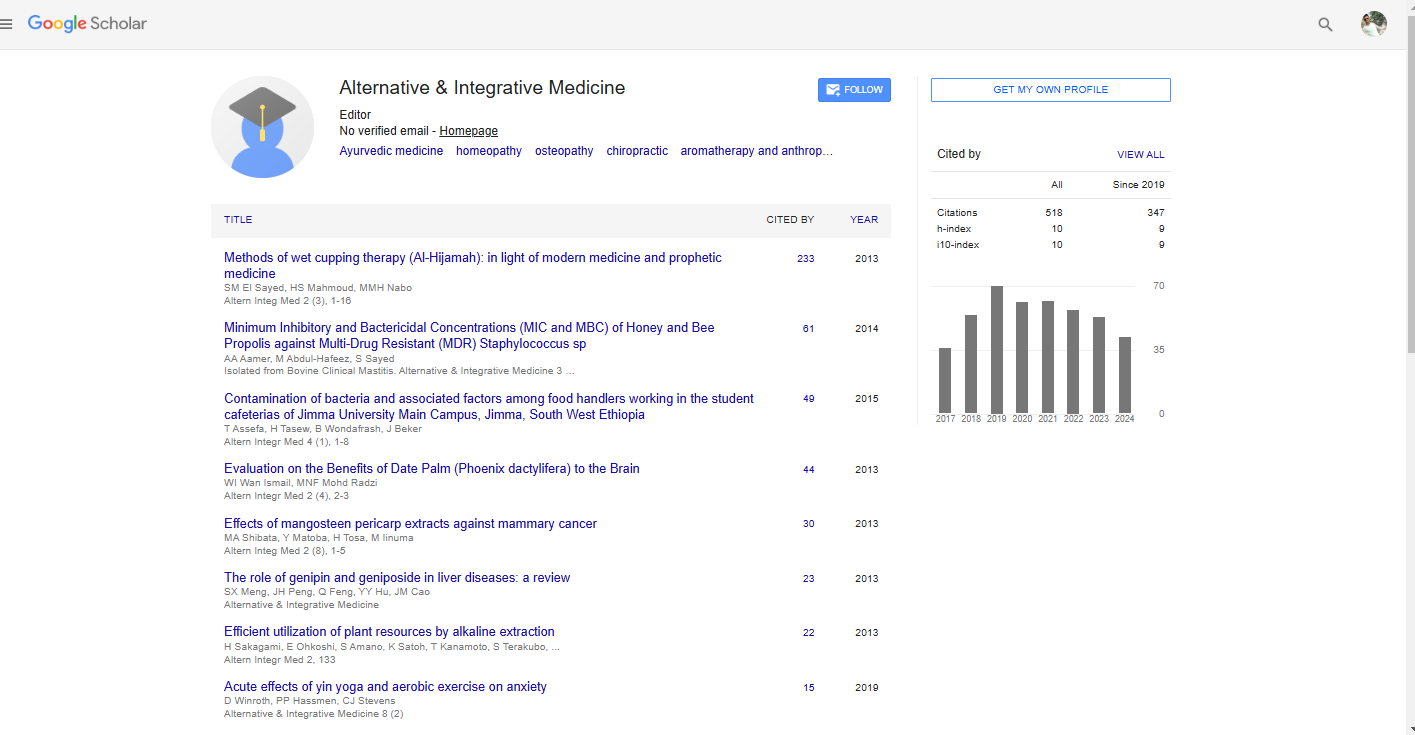
Alternative & Integrative Medicine received 476 citations as per Google Scholar report