Perspective - (2025) Volume 14, Issue 5
Received: 02-Oct-2025, Manuscript No. jeom-26-188191;
Editor assigned: 06-Oct-2025, Pre QC No. P-188191;
Reviewed: 20-Oct-2025, QC No. Q-188191;
Revised: 23-Oct-2025, Manuscript No. R-188191;
Published:
30-Oct-2025
, DOI: 10.37421/2169-026X.2025.14.552
Citation: Torres, Miguel. ”Women Entrepreneurs: Economic Empowerment Through Innovation.” J Entrepren Organiz Manag 14 (2025):552.
Copyright: © 2025 Torres M. This is an open-access article distributed under the terms of the Creative Commons Attribution License, which permits unrestricted use, distribution and reproduction in any medium, provided the original author and source are credited.
This article explores the multifaceted contributions of women entrepreneurs to economic empowerment, underscoring their vital role in job creation, poverty reduction, and the cultivation of innovation across various sectors. It delves into the systemic challenges that often impede their progress, including restricted access to financial resources, limited market penetration, and underdeveloped professional networks, while also proposing targeted policy interventions and support mechanisms designed to foster their sustained growth and amplify their impact on the broader economy [1].
The study further investigates the specific hurdles and emerging opportunities faced by women entrepreneurs operating within developing economies, with a particular emphasis on the critical issue of access to finance. It posits that the adoption of innovative financing models and the widespread integration of digital financial services are paramount for surmounting these obstacles and effectively promoting economic inclusion and empowerment for women entrepreneurs [2].
This paper examines the transformative influence of digital technologies on enhancing the operational performance and expanding the market reach of businesses led by women. It highlights how strategic utilization of e-commerce platforms, sophisticated social media marketing techniques, and comprehensive digital skills training can empower women entrepreneurs to compete more effectively in global markets and achieve a greater degree of economic independence [3].
The research systematically explores the profound influence of social capital and robust professional networks on the overall success trajectory of women entrepreneurs. It conclusively demonstrates that the establishment of strong support systems, the availability of effective mentorship, and the cultivation of active peer networks are indispensable for navigating challenges, securing essential resources, and fostering sustainable business growth, all of which are critical contributors to economic empowerment [4].
This article provides an in-depth analysis of the prevailing policy landscape specifically designed to promote women's entrepreneurship and advance economic empowerment. It meticulously identifies key policy domains, encompassing access to quality education, essential training programs, crucial financial support, and the establishment of supportive regulatory frameworks, while critically discussing their efficacy in nurturing women's economic participation and agency [5].
The study focuses intently on the intricate intersection of gender, entrepreneurship, and the imperative of sustainability, critically examining the unique ways in which women entrepreneurs contribute to achieving the global Sustainable Development Goals. It specifically highlights their innovative approaches to addressing pressing social and environmental challenges, thereby acting as catalysts for inclusive economic growth and widespread empowerment [6].
This paper delves into the psychological underpinnings that significantly influence women's entrepreneurial intentions and their ultimate success in business ventures. It focuses on key factors such as self-efficacy, resilience in the face of adversity, and a willingness to take calculated risks, suggesting that targeted interventions aimed at developing these crucial traits can further amplify economic empowerment [7].
The study rigorously examines the impact of institutional factors, including the prevailing legal frameworks and deeply ingrained cultural norms, on women's active participation in entrepreneurial activities. It compellingly argues for the necessity of comprehensive policy reforms that actively address systemic gender discrimination and foster a genuinely enabling environment conducive to women's economic empowerment [8].
This research meticulously investigates the pivotal role that education and targeted training play in the empowerment of women entrepreneurs. It concludes that specifically designed educational programs, with a strong focus on developing essential business acumen, enhancing financial literacy, and imparting critical digital competencies, significantly bolster their capacity to initiate, manage, and successfully grow their businesses, ultimately leading to improved economic outcomes [9].
This article critically examines the far-reaching impact of the COVID-19 pandemic on women entrepreneurs, analyzing their subsequent pathways toward economic recovery and enhanced resilience. It underscores the disproportionate challenges encountered by businesses led by women during the global health crisis and proposes strategic approaches for rebuilding more robustly, with a particular emphasis on accelerating digital adoption and diversifying market access [10].
The article offers a comprehensive exploration of how women entrepreneurs are pivotal in driving economic empowerment, highlighting their significant contributions to job creation, poverty alleviation, and the stimulation of innovation. It also critically examines the pervasive systemic barriers they encounter, such as restricted access to capital, markets, and professional networks, and subsequently proposes a range of policy interventions and support mechanisms aimed at nurturing their growth and maximizing their economic influence [1].
The research presents an in-depth investigation into the distinct challenges and burgeoning opportunities confronting women entrepreneurs within developing economies, with a pronounced focus on the critical issue of financial accessibility. The study argues convincingly that the adoption of novel financing models, coupled with the strategic implementation of digital financial services, is indispensable for overcoming these entrenched hurdles and effectively advancing economic inclusion and empowerment [2].
This paper scrutinizes the substantial role that digital technologies play in elevating the performance metrics and broadening the market reach of enterprises spearheaded by women. It emphatically illustrates how the strategic deployment of e-commerce platforms, adept social media marketing strategies, and specialized digital skills training initiatives can effectively empower women entrepreneurs, enabling them to vie more competitively in global marketplaces and attain a higher degree of economic autonomy [3].
The research undertakes a systematic review to elucidate the significant influence of social capital and robust network structures on the success factors for women entrepreneurs. The findings compellingly demonstrate that the establishment of strong support ecosystems, access to seasoned mentorship, and the cultivation of active peer-to-peer networks are fundamental for overcoming entrepreneurial obstacles, accessing vital resources, and fostering sustained business expansion, thereby contributing significantly to overall economic empowerment [4].
This article offers a detailed comparative analysis of policy frameworks designed to promote women's entrepreneurship and foster economic empowerment. It meticulously identifies and categorizes critical policy areas, including enhanced access to education, specialized training, adequate financing, and the creation of conducive regulatory environments, while also evaluating their effectiveness in promoting women's economic participation and agency [5].
The study centers on the critical nexus between gender considerations, entrepreneurial endeavors, and the overarching goal of sustainability. It specifically examines the contributions of women entrepreneurs towards the realization of the globally recognized Sustainable Development Goals, emphasizing their innovative methodologies in addressing complex social and environmental issues, and thereby propelling inclusive economic development and empowerment [6].
This paper delves into the psychological dimensions that shape women's entrepreneurial aspirations and their capacity for success. It focuses on attributes such as self-efficacy, resilience, and risk-taking propensity, proposing that targeted developmental interventions focused on these psychological assets can significantly amplify their economic empowerment [7].
The study critically evaluates the influence of institutional elements, encompassing legal structures and prevailing cultural norms, on women's engagement in entrepreneurship. It advocates for necessary policy reforms aimed at rectifying gender-based discrimination and cultivating an environment that is more supportive and enabling for women's economic advancement [8].
This research meticulously explores the direct correlation between educational attainment and specialized training programs and the empowerment of women entrepreneurs. The findings indicate that tailor-made educational initiatives, emphasizing core business skills, financial literacy, and crucial digital competencies, markedly improve their ability to establish, manage, and scale their ventures, leading to enhanced economic outcomes [9].
This article analyzes the profound repercussions of the COVID-19 pandemic on women entrepreneurs, charting their trajectories towards economic recovery and resilience. It highlights the disproportionate adversities faced by women-led businesses and subsequently outlines strategic imperatives for robust rebuilding, prioritizing digital transformation and the expansion of market access [10].
This collection of research highlights the significant role of women entrepreneurs in driving economic empowerment through job creation, poverty reduction, and innovation. Studies address systemic barriers like limited access to finance and networks, proposing policy interventions and digital solutions to overcome these challenges. The importance of social capital, education, training, and supportive institutional frameworks is emphasized. Women entrepreneurs are also recognized for their contributions to sustainable development and their resilience in the face of crises like the COVID-19 pandemic. Psychological factors such as self-efficacy and resilience are identified as crucial for their success.
None
None
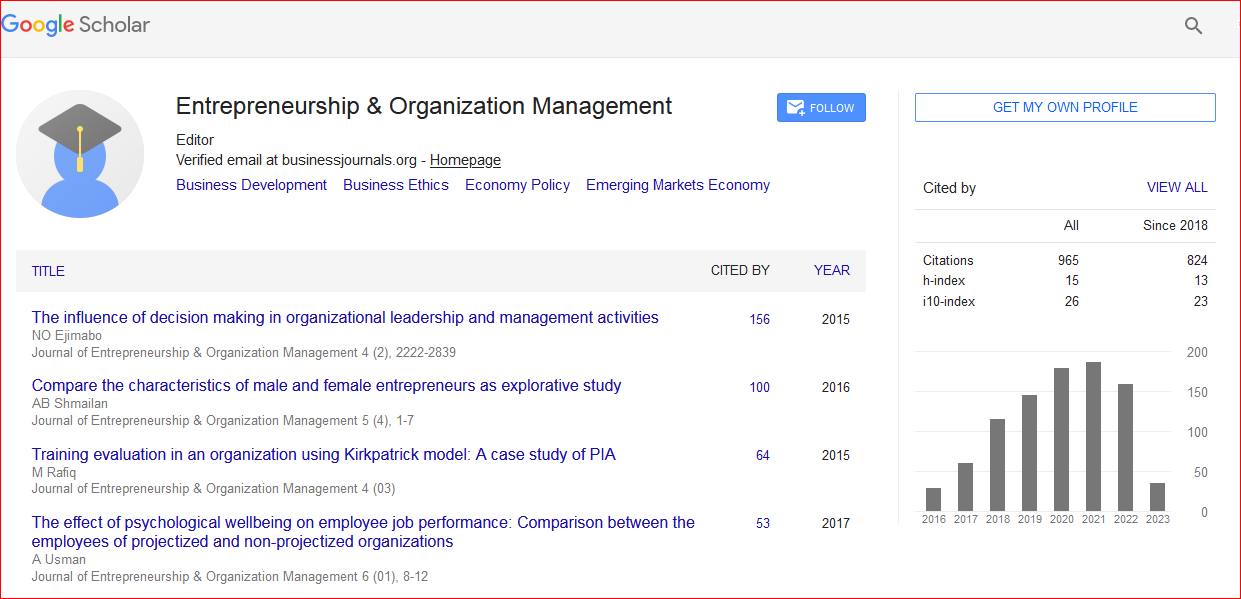
Entrepreneurship & Organization Management received 1115 citations as per Google Scholar report