Brief Report - (2025) Volume 16, Issue 6
Received: 01-Nov-2025, Manuscript No. hycr-25-175044;
Editor assigned: 03-Nov-2025, Pre QC No. P-175044;
Reviewed: 17-Nov-2025, QC No. Q-175044;
Revised: 24-Nov-2025, Manuscript No. R-175044;
Published:
01-Dec-2025
, DOI: 10.37421/2157-7587.2025.16.626
Citation: Maseko, Thabo. ”Wetlands: Vital Climate Solutions, Conservation, Management.” Hydrol Current Res 16 (2025):626
Copyright: © 2025 Maseko T. This is an open-access article distributed under the terms of the Creative Commons Attribution License, which permits unrestricted use,
distribution and reproduction in any medium, provided the original author and source are credited.
Wetlands are recognized globally for their critical role in addressing climate change. This global review emphasizes their profound significance, underscoring how these areas provide essential ecosystem services, like carbon sequestration and crucial coastal protection, which are vital for both adaptation and mitigation efforts. A comprehensive understanding of their inherent value is fundamental, as it directly informs the development and implementation of more effective conservation and strategic management plans for these irreplaceable natural assets[1].
A global meta-analysis sheds light on the dynamic changes in biodiversity observed during wetland restoration projects. The findings from this extensive analysis highlight that while restoration interventions frequently lead to an improvement in overall biodiversity, the specific ecological responses demonstrate considerable variability. This variance is largely attributable to the diverse restoration methods employed and the distinct characteristics inherent to each wetland type, thereby strongly advocating for the adoption of context-specific and highly adaptive approaches in future restoration endeavors[2].
A compelling study meticulously investigates the long-term impacts of significant land use changes, particularly focusing on the widespread and often detrimental effects of agricultural expansion, on the intricate wetland hydrology and water quality within a specific agricultural catchment. This research critically underscores how these altered land use patterns can severely degrade essential wetland functions. Such degradation carries far-reaching implications, adversely affecting both the delicate balance of ecosystem health and posing substantial challenges for sustainable water resource management[3].
This seminal paper offers a thorough review of the global carbon sequestration potential of vital blue carbon ecosystems, which crucially include coastal wetlands. It emphatically highlights their significant and often underestimated role as natural climate solutions, primarily through their remarkable capacity to absorb and store vast amounts of atmospheric carbon. This inherent capability makes their conservation and restoration not just beneficial, but absolutely crucial for effectively mitigating the escalating impacts of global climate change[4].
This insightful research delves into how the diverse plant communities in coastal wetlands respond and adapt to various complex environmental gradients and recurrent disturbances. The study emphasizes the intricate interplay between factors such as fluctuating salinity levels, the availability of essential nutrients, and the increasing pressures stemming from human-induced disturbances. These findings provide invaluable insights into the multifaceted nature of wetland resilience and help to pinpoint the fundamental drivers that shape the unique composition and distribution of wetland vegetation[5].
Adopting a comprehensive global perspective, this exploration critically examines the necessity of integrating both profound ecological insights and intricate socioeconomic factors into robust wetland management policies. It convincingly argues that achieving truly successful conservation and restoration outcomes demands a holistic approach. This approach must extend beyond solely considering biological aspects to encompass the vital human dimensions and the broad spectrum of societal benefits and services derived from healthy wetlands, ensuring long-term sustainability[6].
The article persuasively highlights urban wetlands as exceptionally crucial and multifunctional ecosystems, which are absolutely essential for ensuring the sustainability and livability of modern cities. It comprehensively discusses how these invaluable wetlands provide a diverse array of indispensable services, including critical flood control mechanisms, natural water purification processes, and the provision of vital recreational spaces. This discussion underscores their paramount importance for effective urban planning and for enhancing city resilience in the face of escalating environmental challenges and climate change impacts[7].
This rigorous study meticulously examines the intricate responses of soil microbial communities residing within coastal wetlands when exposed to varying levels of salinity and nutrient enrichment. The comprehensive findings vividly illustrate how these pervasive environmental stressors significantly alter microbial diversity and fundamentally reshape the community structure. These alterations, in turn, have profound implications, impacting key ecosystem functions such as vital nutrient cycling and the critical processes of organic matter decomposition within these unique environments[8].
This comprehensive review synthesizes the most recent and significant advancements in utilizing remote sensing data for the precise mapping and continuous monitoring of dynamic wetland systems. It specifically highlights various sophisticated satellite-based techniques and elucidates their diverse applications in accurately assessing ongoing changes in wetland extent, characteristic vegetation patterns, and crucial hydrological processes. This synthesis powerfully emphasizes the immense utility and necessity of these advanced tools for promoting highly effective wetland management and overarching conservation initiatives worldwide[9].
This focused review critically examines phytoremediation, a promising bio-engineering technique that employs specific plant species to actively mitigate heavy metal pollution in wetland environments. It discusses a wide array of different plant species and explores the intricate physiological and biochemical mechanisms involved in their capacity to absorb, accumulate, or transform heavy metals. The review unequivocally underscores the inherent potential of wetlands to serve as highly effective natural systems for the treatment and restoration of contaminated environments, offering a sustainable remediation solution[10].
Coastal wetlands are undeniably critical ecosystems that play a pivotal role in confronting global climate change. A comprehensive global review highlights their provision of essential ecosystem services, specifically carbon sequestration and crucial coastal protection, both of which are fundamental for effective climate change adaptation and mitigation efforts. Recognizing and valuing these intrinsic services is paramount, as this understanding underpins the development of more effective and sustainable conservation and management strategies for these invaluable natural assets [1]. Expanding on this, blue carbon ecosystems, a category that prominently includes coastal wetlands, are globally recognized for their substantial carbon sequestration potential. These ecosystems function as vital natural climate solutions by efficiently absorbing and storing vast quantities of atmospheric carbon, thereby making their conservation and strategic restoration not just beneficial but absolutely crucial for actively mitigating the escalating impacts of global climate change [4]. Together, these studies emphasize the indispensable, multifaceted contributions of wetlands in maintaining ecological stability and bolstering resilience against a warming planet.
The efficacy of wetland restoration projects in enhancing biodiversity is a significant area of study. A global meta-analysis provides key insights, revealing that while such restoration efforts often improve overall biodiversity, the specific ecological responses vary considerably. This variation is intrinsically linked to the particular restoration methods employed and the distinct characteristics of the wetland type being restored, which strongly implies a necessity for highly context-specific and adaptive approaches to achieve optimal conservation outcomes [2]. This ecological challenge is further exacerbated by the long-term consequences of pervasive land use changes, most notably agricultural expansion, which have demonstrably detrimental effects on wetland hydrology and water quality within agricultural catchments. Such profound alterations in land use patterns are shown to severely degrade fundamental wetland functions, leading to significant implications for both broader ecosystem health and the intricate challenges of water resource management [3].
Understanding the intricate ecological responses of wetland inhabitants is crucial for their preservation. Research meticulously investigates how diverse plant communities in coastal wetlands react and adapt to various complex environmental gradients and recurrent disturbances. This work illuminates the complex interplay between critical factors such as fluctuating salinity levels, the availability of essential nutrients, and the increasing pressures stemming from human-induced disturbances, ultimately providing invaluable insights into wetland resilience and the fundamental drivers that shape the unique composition of wetland vegetation [5]. Complementing this macro-level view, studies also delve into the intricate responses of microscopic soil microbial communities residing within coastal wetlands when subjected to varying levels of salinity and nutrient enrichment. The comprehensive findings vividly demonstrate how these pervasive environmental stressors significantly alter both microbial diversity and fundamentally reshape their community structure, thereby profoundly impacting key ecosystem functions like vital nutrient cycling and the critical processes of organic matter decomposition within these unique environments [8].
Effective and sustainable wetland management demands a comprehensive and integrated strategy that thoughtfully incorporates both profound ecological insights and intricate socioeconomic factors. A global perspective convincingly argues that truly successful conservation and restoration outcomes are not solely dependent on biological aspects but must also account for the vital human dimensions and the broad spectrum of societal benefits and services that wetlands inherently provide, ensuring long-term viability and community engagement [6]. Furthermore, urban wetlands are increasingly recognized as exceptionally crucial and multifunctional ecosystems, indispensable for ensuring the enduring sustainability and improved livability of modern cities. These invaluable wetlands furnish a diverse array of indispensable services, including critical flood control mechanisms, natural water purification processes, and the provision of vital recreational spaces, which emphatically underscores their paramount importance for effective urban planning and for bolstering city resilience in the face of escalating environmental challenges [7].
Technological advancements are revolutionizing wetland monitoring and restoration efforts. This includes a synthesizing review of advancements in leveraging remote sensing data for the precise mapping and continuous monitoring of dynamic wetland systems. This review specifically highlights various sophisticated satellite-based techniques and meticulously elucidates their diverse applications in accurately assessing ongoing changes in wetland extent, characteristic vegetation patterns, and crucial hydrological processes, powerfully emphasizing the immense utility and necessity of these advanced tools for promoting highly effective wetland management and overarching conservation initiatives worldwide [9]. In parallel, focused research critically examines phytoremediation, a promising bio-engineering technique that purposefully employs specific plant species to actively mitigate heavy metal pollution in wetland environments. This approach leverages different plant species and explores the intricate physiological and biochemical mechanisms involved in their capacity to absorb, accumulate, or transform heavy metals, unequivocally underscoring the inherent potential of wetlands to serve as highly effective natural systems for the treatment and restoration of contaminated environments, offering a sustainable and ecologically sound remediation solution [10].
Wetlands are vital ecosystems, critical for addressing climate change through services like carbon sequestration and coastal protection, essential for both adaptation and mitigation efforts. Understanding their profound value informs more effective conservation and management strategies. Restoration projects aim to enhance biodiversity, though specific outcomes vary based on methods and wetland types, underscoring the necessity for tailored approaches. Land use changes, particularly agricultural expansion, significantly degrade wetland hydrology and water quality, negatively impacting ecosystem health and water resource management. Blue carbon ecosystems, encompassing coastal wetlands, are recognized globally for their substantial carbon sequestration potential, positioning them as natural climate solutions whose conservation is paramount. Research also delves into how plant communities in coastal wetlands react to environmental gradients such as salinity and nutrient availability, alongside human disturbances, revealing drivers of vegetation composition and wetland resilience. Effective wetland management policies require a holistic integration of both ecological and socioeconomic factors, acknowledging human dimensions and societal benefits. Urban wetlands emerge as multifunctional ecosystems, providing crucial services like flood control, water purification, and recreational spaces, indispensable for sustainable urban planning. Studies reveal how soil microbial communities in coastal wetlands respond to salinity and nutrient enrichment, impacting vital functions like nutrient cycling. Remote sensing plays a pivotal role in mapping and monitoring wetland dynamics, offering satellite-based tools to assess changes in wetland extent, vegetation, and hydrology. Furthermore, wetlands offer a natural solution for environmental decontamination through phytoremediation, utilizing plants to mitigate heavy metal pollution. Collectively, these insights highlight the multifaceted importance of wetlands and the diverse approaches needed for their preservation and sustainable management.
None
None
Indexed at, Google Scholar, Crossref
Indexed at, Google Scholar, Crossref
Indexed at, Google Scholar, Crossref
Indexed at, Google Scholar, Crossref
Indexed at, Google Scholar, Crossref
Indexed at, Google Scholar, Crossref
Indexed at, Google Scholar, Crossref
Indexed at, Google Scholar, Crossref
Indexed at, Google Scholar, Crossref
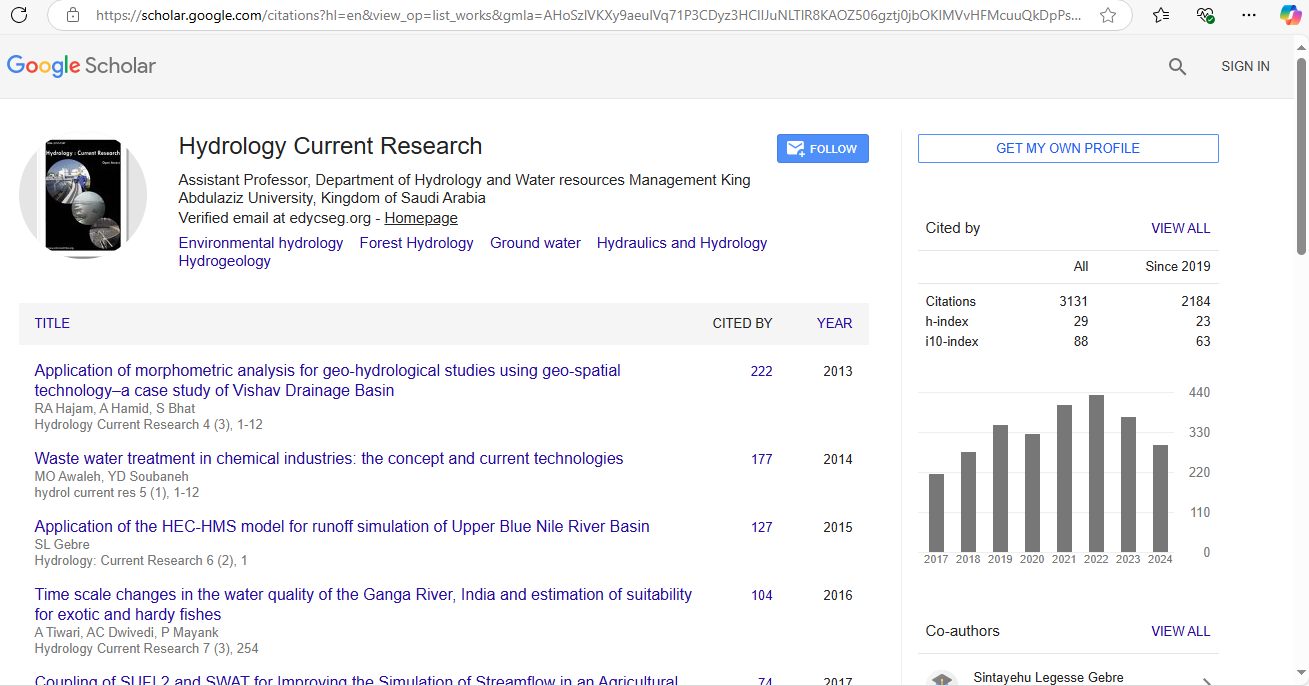
Hydrology: Current Research received 2843 citations as per Google Scholar report