Commentary - (2025) Volume 13, Issue 6
Received: 01-Dec-2025, Manuscript No. jcdd-25-177693;
Editor assigned: 03-Dec-2025, Pre QC No. P-177693;
Reviewed: 17-Dec-2025, QC No. Q-177693;
Revised: 22-Dec-2025, Manuscript No. R-177693;
Published:
29-Dec-2025
, DOI: 10.37421/2329-9517.2025.13.701
Citation: Reema Patel. ”Wearables: Transforming Cardiac
Monitoring with AI.” J Cardiovasc Dis Diagn 13 (2025):701.
Copyright: © 2025 P. Reema This is an open-access article distributed under the terms of the Creative Commons Attribution License, which permits unrestricted use,
distribution and reproduction in any medium, provided the original author and source are credited.
Wearable devices are transforming continuous cardiovascular monitoring, offering promising opportunities for early disease detection, personalized health management, and remote patient care. However, challenges related to data privacy, interoperability, and clinical validation need careful consideration for broader adoption [3].
Wearable continuous ECG monitoring patches show high clinical utility for detecting various arrhythmias, including atrial fibrillation, supraventricular tachycardia, and ventricular premature beats. This technology offers a practical, non-invasive approach for long-term cardiac rhythm assessment, improving diagnostic yield compared to traditional methods [1].
Long-term ECG monitoring using wearable sensors offers a practical solution for diagnosing intermittent arrhythmias that might be missed by short-term evaluations. From a clinical perspective, these devices improve diagnostic yield and facilitate chronic disease management by providing continuous, real-world data [6].
Single-lead wearable electrocardiograms are effective for detecting atrial fibrillation (AF), particularly in screening and diagnosing asymptomatic or paroxysmal AF. Systematic reviews and meta-analyses confirm their diagnostic accuracy and potential to reduce stroke risk by identifying AF earlier in at-risk populations [2].
The accuracy of wearable devices for arrhythmia detection varies, but many show good to excellent performance, particularly for identifying atrial fibrillation. These devices represent a valuable tool for extending cardiac monitoring outside the clinic, though the specific device and algorithm can impact detection reliability [4].
Wearable devices hold significant promise in detecting atrial fibrillation for stroke prevention. Early and widespread screening using these technologies could lead to timely intervention, particularly for individuals at high risk, thereby potentially reducing the incidence of AF-related strokes [5].
Wearable ECG monitors are showing increasing utility in pediatric cardiology for diagnosing and managing various heart conditions in children. These devices offer less invasive and more comfortable options for monitoring, which can be particularly beneficial in a pediatric population, enhancing adherence and data collection [7].
While primarily known for ECG, wearable devices are also advancing in continuous blood pressure monitoring, offering new avenues for hypertension management and cardiovascular risk assessment. This technology allows for real-time, ambulatory BP measurement, providing a more comprehensive picture than episodic readings [8].
Artificial Intelligence (AI) is dramatically enhancing the capabilities of wearable cardiac monitors, enabling more accurate and automated detection of arrhythmias and other cardiovascular conditions. AI algorithms process vast amounts of data, leading to faster diagnoses and personalized risk predictions, paving the way for proactive cardiac care [9].
Patient adherence to wearable cardiac monitoring devices is a critical factor influencing their effectiveness. Understanding factors that improve adherence, such as device comfort, ease of use, and perceived benefit, is essential for optimizing diagnostic outcomes and ensuring the successful integration of these technologies into clinical practice [10].
Wearable continuous Electrocardiogram (ECG) monitoring patches demonstrate high clinical utility for detecting various arrhythmias, including atrial fibrillation (AF), supraventricular tachycardia, and ventricular premature beats [1]. This technology offers a practical, non-invasive approach for long-term cardiac rhythm assessment, significantly improving diagnostic yield compared to traditional methods [1]. Single-lead wearable ECGs are particularly effective for identifying AF, especially in screening and diagnosing asymptomatic or paroxysmal cases [2]. Systematic reviews and meta-analyses confirm their diagnostic accuracy, highlighting their potential to reduce stroke risk by facilitating earlier AF detection in at-risk populations [2], [5]. The accuracy of these devices for arrhythmia detection varies by model and algorithm, but many consistently show good to excellent performance for AF specifically [4].
Beyond just arrhythmia detection, wearable devices are fundamentally transforming continuous cardiovascular monitoring. They present promising opportunities for early disease detection, personalized health management, and remote patient care [3]. Long-term ECG monitoring using these wearable sensors provides a practical solution for diagnosing intermittent arrhythmias that might be missed during short-term clinical evaluations [6]. From a clinical perspective, such devices enhance diagnostic yield and support chronic disease management by supplying continuous, real-world data [6]. Moreover, wearable ECG monitors are increasingly valuable in pediatric cardiology. They offer less invasive and more comfortable options for monitoring children with various heart conditions, which can be particularly beneficial for this population, improving adherence and data collection [7].
The capabilities of wearable devices are expanding beyond traditional ECG. For example, advances are being made in continuous blood pressure monitoring, which introduces new avenues for hypertension management and comprehensive cardiovascular risk assessment [8]. This technology provides real-time, ambulatory blood pressure measurements, offering a much more complete picture than isolated episodic readings [8]. Crucially, Artificial Intelligence (AI) is dramatically enhancing the power of wearable cardiac monitors. AI algorithms enable more accurate and automated detection of arrhythmias and other cardiovascular conditions by processing vast amounts of data [9]. This leads to faster diagnoses and personalized risk predictions, paving the way for more proactive cardiac care [9].
However, the broader adoption of wearable devices for cardiovascular monitoring is not without challenges. Issues related to data privacy, interoperability between different systems, and the need for rigorous clinical validation require careful consideration [3]. A significant factor influencing the effectiveness of these devices is patient adherence [10]. Understanding and addressing factors that improve adherence, such as device comfort, ease of use, and the patient's perceived benefit, is essential [10]. Optimizing these elements is key for maximizing diagnostic outcomes and ensuring these valuable technologies are successfully integrated into routine clinical practice [10].
Wearable devices are transforming cardiovascular monitoring, offering significant utility for detecting various arrhythmias like atrial fibrillation (AF), supraventricular tachycardia, and ventricular premature beats. These technologies provide a practical, non-invasive approach for long-term cardiac rhythm assessment, enhancing diagnostic yield compared to traditional methods. Single-lead wearable electrocardiograms (ECGs) are particularly effective for AF detection, especially for asymptomatic or paroxysmal cases, which can help reduce stroke risk through earlier identification in at-risk populations. While accuracy varies across devices, many demonstrate good to excellent performance for AF. Beyond ECG, wearable technology is advancing into continuous blood pressure monitoring, opening new possibilities for hypertension management. The integration of Artificial Intelligence (AI) is further enhancing these capabilities, enabling more accurate and automated detection of conditions and providing personalized risk predictions for proactive cardiac care. These devices are also finding utility in pediatric cardiology, offering less invasive and more comfortable monitoring options for children. However, broader adoption faces challenges, including data privacy, interoperability, and the need for clinical validation. Patient adherence, influenced by device comfort, ease of use, and perceived benefit, remains a critical factor for optimizing diagnostic outcomes and successful integration into clinical practice.
Indexed at, Google Scholar, Crossref
Indexed at, Google Scholar, Crossref
Indexed at, Google Scholar, Crossref
Indexed at, Google Scholar, Crossref
Indexed at, Google Scholar, Crossref
Indexed at, Google Scholar, Crossref
Indexed at, Google Scholar, Crossref
Indexed at, Google Scholar, Crossref
Indexed at, Google Scholar, Crossref
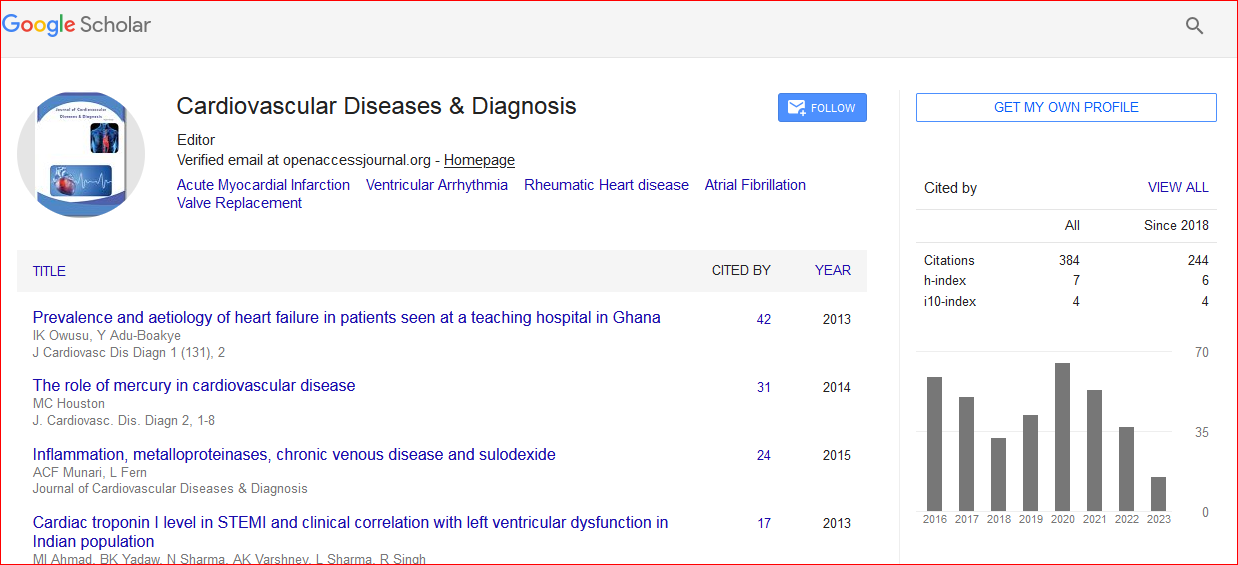
Cardiovascular Diseases & Diagnosis received 427 citations as per Google Scholar report