Perspective - (2025) Volume 16, Issue 6
Received: 01-Dec-2025, Manuscript No. jbsbe-26-183333;
Editor assigned: 03-Dec-2025, Pre QC No. P-183333;
Reviewed: 17-Dec-2025, QC No. Q-183333;
Revised: 22-Dec-2025, Manuscript No. R-183333;
Published:
29-Dec-2025
, DOI: 10.37421/2165-6210.2025.16.537
Citation: Andrade, Felipe. ”Wearable and Implantable Bioelectronics for Future Healthcare.” J Biosens Bioelectron 16 (2025):537.
Copyright: © 2025 Andrade F. This is an open-access article distributed under the terms of the Creative Commons Attribution License, which permits unrestricted use, distribution and reproduction in any medium, provided the original author and source are credited.
Recent years have witnessed a significant surge in the development of wearable and implantable bioelectronic devices, fundamentally reshaping the landscape of continuous health monitoring and personalized medicine. These advanced technologies are increasingly being integrated into daily life and medical practice, offering unprecedented capabilities for real-time physiological data acquisition and intervention. This transformative progress is driven by the convergence of flexible electronics, novel sensing materials, and sophisticated wireless communication technologies. The applications span a wide spectrum, from non-invasive glucose sensing to intricate neural interfacing, promising to revolutionize diagnostics, therapeutics, and preventative care. Crucially, the focus of much research and development in this field is on enhancing device biocompatibility, improving power efficiency, and optimizing data acquisition protocols to ensure reliable long-term in-vivo performance. These are critical considerations for the successful translation of bioelectronic devices from laboratory prototypes to clinical realities. Concurrently, the realm of flexible and stretchable biosensors has seen considerable exploration, particularly for wearable applications designed for continuous physiological monitoring. The fabrication of microelectrode arrays on compliant polymer substrates, coupled with their functionalization with specific biomolecules, allows for the detection of a diverse range of analytes present in bodily fluids like sweat and interstitial fluid. Such advancements underscore the importance of mechanical robustness and signal stability in these devices, which are paramount for ensuring the accuracy and reliability of real-time physiological measurements. The ability of these sensors to withstand mechanical deformation while maintaining consistent performance is a key area of innovation. In parallel, the development of implantable devices for continuous monitoring has made significant strides. One notable area is the creation of novel electrochemical biosensors for continuous glucose monitoring, which aim to provide more precise and stable readings than existing methods. These implantable sensors often involve microfabrication of biocompatible materials and sophisticated encapsulation techniques to ensure longevity and minimize adverse biological responses. Preclinical studies have demonstrated their accuracy and stability, suggesting a promising future for improved diabetes management. The field of implantable neural interfaces also presents both significant challenges and immense opportunities. Research continues to focus on improving electrode materials and fabrication techniques to achieve higher signal-to-noise ratios and enhanced long-term stability, essential for effective neural signal recording and stimulation. Furthermore, the integration of miniaturized sensors with advanced power solutions, such as wireless power transfer, is paving the way for truly self-powered subcutaneous bioelectronic devices. This eliminates the need for invasive battery replacements, significantly enhancing patient comfort and device longevity. Finally, the growing complexity and volume of data generated by these sophisticated bioelectronic devices necessitate the application of advanced analytical techniques. Artificial intelligence and machine learning algorithms are proving instrumental in processing this data for early disease detection, personalized treatment recommendations, and the identification of anomalies in continuous health monitoring streams.
The innovation landscape for wearable and implantable bioelectronic devices is characterized by a relentless pursuit of enhanced functionality and user-centric design. These devices are meticulously engineered to address the growing demand for continuous health monitoring and the precision required for personalized medicine. The synergy between flexible electronics, novel sensing materials, and advanced wireless communication technologies forms the bedrock of their development, enabling applications that range from non-invasive diagnostics to sophisticated neural interventions. Central to the successful implementation of these technologies is the stringent focus on improving device biocompatibility and power efficiency, alongside the refinement of data acquisition methods for sustained in-vivo use. These critical factors dictate the long-term viability and clinical utility of bioelectronic systems, ensuring they can reliably perform their intended functions without eliciting adverse biological reactions. Significant progress has been made in the design and fabrication of flexible and stretchable biosensors tailored for wearable health monitoring. The meticulous construction of microelectrode arrays on elastic polymer substrates, coupled with the precise functionalization of these electrodes with biomolecules, facilitates the sensitive detection of a wide array of analytes within bodily fluids such as sweat and interstitial fluid. The mechanical resilience and signal integrity of these flexible biosensors are paramount for their efficacy in real-time physiological measurements. Ensuring that these devices can withstand the dynamic mechanical stresses of wear while maintaining consistent and reliable signal output is a core objective in their advancement. In the domain of implantable devices, groundbreaking work continues in the development of novel electrochemical biosensors specifically designed for continuous glucose monitoring. These devices are crafted with the aim of delivering unparalleled accuracy and long-term stability, offering a significant improvement over conventional monitoring techniques and holding great promise for diabetes management. These implantable systems are typically the product of intricate microfabrication processes involving biocompatible materials and advanced encapsulation strategies. These measures are essential for ensuring the device's longevity within the body and minimizing any potential immune or foreign body responses, thereby facilitating seamless integration. The critical challenges and substantial opportunities inherent in the development of implantable neural interfaces are a major focus of current research. Efforts are concentrated on the selection and processing of electrode materials, alongside the refinement of fabrication techniques, to achieve superior signal-to-noise ratios and enduring stability. Complementing these efforts is the integration of miniaturized sensors with cutting-edge wireless power transfer capabilities, a development that is revolutionizing the design of subcutaneous bioelectronic devices. This innovative approach facilitates the creation of self-powered systems, effectively circumventing the need for periodic and invasive battery replacement procedures. Furthermore, the sophisticated analytical demands posed by the vast amounts of data generated by modern wearable bioelectronic devices are being met through the application of artificial intelligence and machine learning. These computational tools are proving invaluable for tasks such as early disease identification, the formulation of tailored treatment strategies, and the detection of subtle anomalies within continuous health monitoring data streams. Lastly, the investigation into the biocompatibility and long-term operational efficacy of implantable electronic devices remains a pivotal area of research. Understanding and mitigating the body's immune response to implanted materials, and actively promoting tissue integration while suppressing foreign body reactions, are crucial for the success of chronic implantable systems. This involves careful material selection and innovative surface modification techniques.
This compilation explores advancements in wearable and implantable bioelectronic devices for continuous health monitoring and personalized medicine. Key areas include flexible and stretchable biosensors for sweat analysis, implantable electrochemical sensors for glucose monitoring, and neural interfaces. Research also focuses on biocompatibility, power efficiency, and data analysis using AI. The development of self-powered devices and strategies to improve long-term in-vivo performance are highlighted as crucial for future applications in healthcare.
None
None
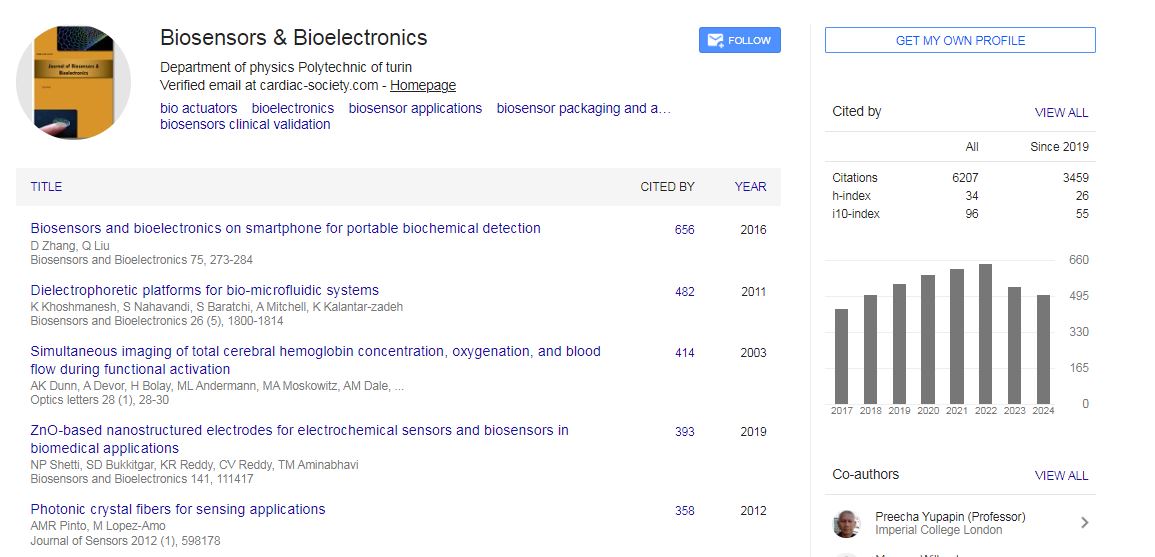
Biosensors & Bioelectronics received 6207 citations as per Google Scholar report