Short Communication - (2025) Volume 16, Issue 6
Received: 01-Nov-2025, Manuscript No. hycr-25-175052;
Editor assigned: 03-Nov-2025, Pre QC No. P-175052;
Reviewed: 17-Nov-2025, QC No. Q-175052;
Revised: 24-Nov-2025, Manuscript No. R-175052;
Published:
01-Dec-2025
, DOI: 10.37421/2157-7587.2025.16.633
Citation: Smithson, George K.. ”Watershed Health: Threats, Management, and Solutions.” Hydrol Current Res 16 (2025):633
Copyright: © 2025 Smithson K. George This is an open-access article distributed under the terms of the Creative Commons Attribution License, which permits unrestricted
use, distribution and reproduction in any medium, provided the original author and source are credited.
Watershed systems are fundamental to ecological balance and human well-being, influencing water quality, biodiversity, and ecosystem services globally. A core understanding emphasizes that robust watershed management is a direct determinant of water quality, which, in turn, critically impacts public health by mitigating waterborne diseases and enhancing overall community well-being [1].
The integrity of these vital systems faces significant pressures from diverse sources. Climate change, for instance, has profound effects on watershed health and the essential ecosystem services they provide [2].
Shifting precipitation patterns, escalating temperatures, and an increase in extreme weather events are shown to drastically alter hydrological regimes, diminish water quality, and reduce biodiversity, ultimately undermining human well-being and economic stability [2].
This intricate relationship between climate change and water resources is further explored in agricultural watersheds, where altered precipitation, temperature extremes, and intensified droughts or floods directly threaten food security and water availability, necessitating integrated watershed management and climate-smart agricultural practices for resilience building [8].
Beyond climatic shifts, land-use changes represent another major stressor. In regions like the Upper Blue Nile Basin, deforestation and agricultural expansion lead to significant alterations in runoff, evapotranspiration, and groundwater recharge, with clear implications for water availability and increasing flood risk [3].
Parallel to this, the relentless expansion of urban areas due to urbanization profoundly impacts watershed ecosystem services. Studies indicate that this expansion substantially degrades water quality, reduces biodiversity, and disrupts natural hydrological cycles, highlighting an urgent need for sustainable urban planning and the integration of green infrastructure to maintain critical watershed services [4].
Management practices within these areas also play a crucial role. Forest management, encompassing interventions like harvesting, afforestation, and prescribed burning, can significantly influence streamflow and water quality [5].
These practices alter hydrological processes, nutrient cycling, and sediment transport, underscoring the necessity for sustainable forest management strategies to safeguard water resources effectively [5].
Similarly, the management of agricultural watersheds is a key concern, with specific attention paid to mitigating agricultural pollution and sustaining water resources [6].
In response to these complex challenges, various tools and methodologies are being employed. Hydrological models are increasingly utilized for predicting streamflow and water quality in agricultural watersheds, offering insights into complex processes and informing critical management decisions [6].
Furthermore, remote sensing technologies are gaining prominence for monitoring and modeling hydrological processes within watersheds [7].
Satellite imagery and aerial platforms provide invaluable data for assessing land cover changes, soil moisture, and surface runoff, which are crucial for water resource management and flood prediction, especially in data-scarce regions [7].
A holistic approach to understanding and managing watersheds also involves comprehensive assessment. The evaluation of watershed ecosystem health requires the use of multiple indicators, integrating hydrological, ecological, and socio-economic data to provide a thorough understanding of their condition [9].
Such multi-indicator frameworks are essential for effective management and conservation efforts [9].
Ultimately, safeguarding raw water sources within watersheds from various contaminants is paramount for public health, demonstrating that effective protection measures are vital for preventing waterborne diseases and ensuring safe drinking water supplies for communities globally [10].
This interconnectedness of environmental factors, human activities, and technological solutions defines the contemporary landscape of watershed science and management.
Watershed systems are fundamental environmental components, playing a critical role in maintaining water quality and supporting diverse ecosystems. Effective watershed management directly influences these aspects, thereby impacting public health by mitigating waterborne diseases and fostering overall community well-being [1]. The interdisciplinary nature of watershed health necessitates an integrated approach, recognizing the complex interplay between environmental processes and human activities. This comprehensive perspective is vital for developing strategies that protect and enhance these essential natural resources for current and future generations.
However, watershed health is under considerable strain from various global changes. Climate change stands out as a significant threat, profoundly affecting watershed functions and the critical ecosystem services they provide [2]. Altered precipitation patterns, rising temperatures, and more frequent extreme weather events lead to substantial shifts in hydrological regimes, degraded water quality, and reduced biodiversity. These changes ultimately compromise human well-being and economic stability, demanding urgent attention and adaptive strategies [2]. Specifically, within agricultural watersheds, climate change impacts on water resources are severe, with increased vulnerability due to altered precipitation and temperature extremes. This leads to intensified droughts or floods, threatening food security and water availability, thus advocating for integrated watershed management and climate-smart agricultural practices to build resilience [8].
Land-use transformations also significantly alter watershed dynamics. Studies reveal that changes like deforestation and agricultural expansion, particularly in basins such as the Upper Blue Nile, induce considerable modifications in runoff, evapotranspiration, and groundwater recharge [3]. These alterations have direct implications for water availability and escalate the risk of flooding in affected regions, highlighting the need for careful land-use planning. Urbanization further compounds these problems by degrading water quality, reducing biodiversity, and disrupting hydrological cycles [4]. The expansion of urban areas necessitates a focus on sustainable urban planning and the implementation of green infrastructure solutions to sustain the critical services provided by watersheds [4].
Forest management practices are another influential factor. Interventions such as harvesting, afforestation, and prescribed burning within forested watersheds can significantly modify streamflow and water quality [5]. These practices impact hydrological processes, nutrient cycling, and sediment transport, underscoring the importance of sustainable forest management strategies to protect invaluable water resources [5]. Similarly, the management of agricultural watersheds is crucial, especially regarding mitigating agricultural pollution. Hydrological models are instrumental here, offering predictive capabilities for streamflow and water quality, which informs management decisions aimed at sustaining water resources and minimizing environmental impact [6].
Technological advancements are proving indispensable in monitoring and managing watersheds. Remote sensing technologies, for instance, are increasingly valuable for hydrological monitoring and modeling [7]. Satellite imagery and aerial platforms provide crucial data on land cover changes, soil moisture, and surface runoff, offering insights essential for water resource management and flood prediction, particularly in remote or data-sparse areas [7]. Furthermore, assessing the overall health of watersheds requires robust frameworks. Multi-indicator approaches, which integrate hydrological, ecological, and socio-economic data, provide a comprehensive understanding of watershed conditions, making them vital for effective management and conservation efforts [9]. Ultimately, effective source water protection within watersheds is paramount for public health, as safeguarding raw water sources from contaminants directly prevents waterborne diseases and ensures safe drinking water supplies for communities worldwide [10]. These interconnected studies collectively emphasize the complexity and critical importance of integrated watershed management.
Watershed health is a critical determinant of environmental quality and public well-being. Research consistently demonstrates that effective watershed management directly influences water quality and, subsequently, public health, mitigating waterborne diseases and improving community welfare [1, 10]. However, numerous anthropogenic and environmental factors pose significant threats. Climate change, characterized by shifting precipitation patterns, increased temperatures, and extreme weather, profoundly alters hydrological regimes, water quality, and biodiversity, compromising human well-being and economic stability [2, 8]. Land-use changes, such as deforestation and agricultural expansion, significantly impact hydrological processes like runoff and groundwater recharge, affecting water availability and flood risk [3]. Urbanization further degrades water quality, reduces biodiversity, and disrupts hydrological cycles, underscoring the need for sustainable urban planning [4]. Forest management practices, including harvesting and afforestation, also influence streamflow and water quality by altering hydrological processes and nutrient transport [5]. To address these challenges, hydrological models are vital for predicting streamflow and water quality in agricultural watersheds, informing management decisions to curb pollution [6]. Remote sensing technologies offer invaluable data for monitoring land cover, soil moisture, and surface runoff, aiding water resource management and flood prediction [7]. Assessing watershed ecosystem health requires multi-indicator frameworks integrating hydrological, ecological, and socio-economic data for comprehensive understanding and effective conservation [9]. Collectively, these studies highlight the complex interdependencies within watersheds and the urgent need for integrated, climate-smart, and data-driven management strategies to protect these vital resources for future generations.
None
None
Indexed at, Google Scholar, Crossref
Indexed at, Google Scholar, Crossref
Indexed at, Google Scholar, Crossref
Indexed at, Google Scholar, Crossref
Indexed at, Google Scholar, Crossref
Indexed at, Google Scholar, Crossref
Indexed at, Google Scholar, Crossref
Indexed at, Google Scholar, Crossref
Indexed at, Google Scholar, Crossref
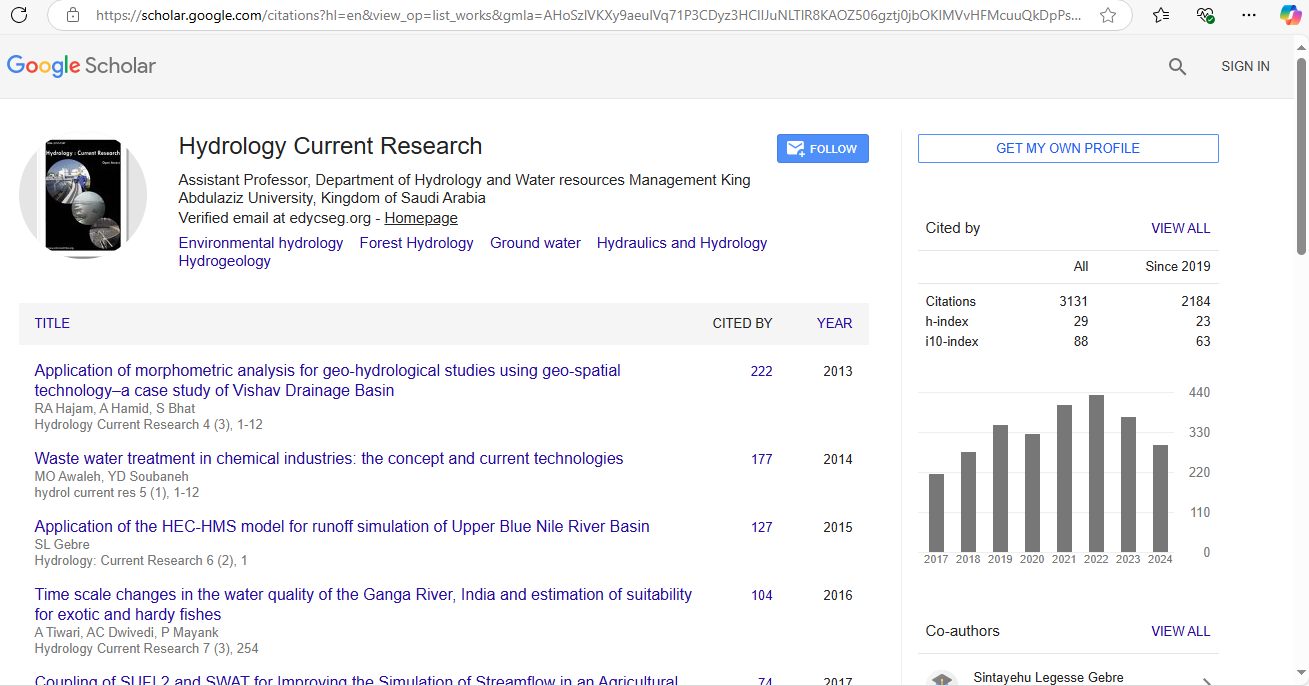
Hydrology: Current Research received 2843 citations as per Google Scholar report