Brief Report - (2025) Volume 16, Issue 5
Received: 01-Sep-2025, Manuscript No. hycr-25-175001;
Editor assigned: 03-Sep-2025, Pre QC No. P-175001;
Reviewed: 17-Sep-2025, QC No. Q-175001;
Revised: 22-Sep-2025, Manuscript No. R-175001;
Published:
29-Sep-2025
, DOI: 10.37421/2157-7587.2025.16.617
Citation: Al-Hashimi, Farah. ”Watershed Challenges, Solutions, and Technology for Resilience.” Hydrol Current Res 16 (2025):617.
Copyright: © 2025 Al-Hashimi F. This is an open-access article distributed under the terms of the Creative Commons Attribution License, which permits unrestricted use,
distribution and reproduction in any medium, provided the original author and source are credited.
Explorations reveal how future climate shifts and land use changes significantly affect key ecosystem services, such as water provisioning and soil retention, particularly within basins like the Upper Blue Nile. This work underscores the critical importance of integrated watershed management for sustaining these vital services amidst increasing environmental pressures, utilizing modeling to predict scenarios and inform robust adaptation strategies [1].
Further investigations evaluate the combined impacts of climate variability and land use transformations on water quantity and quality across diverse watersheds. Observations show that increasing urbanization and agricultural intensification, alongside altered rainfall patterns, contribute to elevated pollutant loads and reduced water availability, thereby emphasizing the urgent need for adaptive management approaches [2].
The emerging role of deep learning techniques in advancing hydrological modeling is a key area of comprehensive review. These advanced computational methods demonstrably enhance predictions of streamflow, water quality, and other complex watershed processes, offering substantial improvements over traditional models while also addressing existing challenges and outlining future research directions in this dynamic field [3].
Insights into socio-hydrological risks and community adaptation strategies within transboundary watersheds are gained through case studies, such as the Rio Grande basin. This analysis highlights the intricate interplay between water resource management, governance structures, and local community resilience when confronted with climate change and escalating water scarcity, providing valuable lessons applicable to similar global regions [4].
The effectiveness of nature-based solutions, including green infrastructure, in mitigating urban flooding within rapidly developing watersheds has been evaluated. It is evident that integrating these solutions markedly reduces peak flows and improves stormwater retention, presenting a cost-effective and environmentally friendly strategy for managing urban water challenges [5].
Synthesis of current knowledge addresses the ecological restoration of degraded river watersheds, outlining effective strategies, persistent challenges, and emerging opportunities. This synthesis emphasizes the profound importance of holistic approaches that carefully consider hydrological, geomorphological, and biological aspects to bolster ecosystem health and resilience against various environmental disturbances [6].
Global meta-analysis investigates how changes in forest cover influence water yield and other critical ecosystem services within watersheds under varying climatic conditions. These findings highlight the intricate and complex relationship between deforestation, afforestation, and hydrological processes, providing crucial insights for developing sustainable forest management strategies specifically aimed at optimizing water resources [7].
A hydrological assessment of crop production on a large watershed is conducted, with a particular focus on its impacts on water quality. This assessment reveals how agricultural practices, including the application of fertilizers and pesticides, directly influence nutrient and sediment loads in waterways, thereby emphasizing the necessity for improved land management and precision agriculture to mitigate widespread environmental degradation [8].
A comprehensive overview addresses socio-hydrological modeling, examining its conceptual foundations, methodologies, and diverse applications within watershed management. This highlights the crucial integration of human behavior and social dynamics with hydrological processes, which is essential for a better understanding and more effective management of water resources in complex, human-modified systems [9].
Review articles discuss the transformative impact of remote sensing and machine learning technologies on watershed monitoring and management. These tools illustrate how they enable efficient data acquisition, analysis, and prediction of hydrological variables, land cover changes, and water quality parameters, significantly enhancing decision-making for sustainable resource governance [10].
Watersheds are fundamental units for understanding and managing freshwater resources, yet they face increasing pressures from global climate change and evolving land use patterns. Explorations reveal how future climate shifts and land use changes significantly affect key ecosystem services, such as water provisioning and soil retention, especially in critical basins like the Upper Blue Nile, making integrated watershed management vital for sustainability [1]. Similarly, evaluations of mixed-use watersheds demonstrate that urbanization and agricultural intensification, coupled with altered rainfall, lead to elevated pollutant loads and reduced water availability, necessitating adaptive management strategies [2]. Beyond local impacts, a global meta-analysis indicates that changes in forest cover profoundly influence water yield and other critical ecosystem services under varying climatic conditions, emphasizing the complex relationship between forest management and hydrological processes for optimizing water resources [7]. These studies collectively underscore the pervasive influence of human activities and environmental shifts on watershed health.
To better address these challenges, significant advancements are happening in hydrological modeling and monitoring. Comprehensive reviews highlight the emerging role of deep learning techniques, which substantially enhance predictions of streamflow, water quality, and other watershed processes, offering marked improvements over traditional models, while also pointing out remaining challenges and future research avenues [3]. Complementing this, the transformative impact of remote sensing and machine learning technologies on watershed monitoring and management is also discussed. These tools enable efficient data acquisition, analysis, and prediction of hydrological variables, land cover changes, and water quality parameters, thereby significantly enhancing decision-making for sustainable resource governance [10]. Moreover, the field of socio-hydrological modeling provides a comprehensive overview of its conceptual frameworks, methodologies, and applications, emphasizing the crucial integration of human behavior and social dynamics with hydrological processes to better manage water resources in complex, human-modified systems [9].
Specific interventions and assessments offer pathways for mitigating negative impacts. Research evaluates the effectiveness of nature-based solutions, such as green infrastructure, in mitigating urban flooding within rapidly developing watersheds. These solutions demonstrably reduce peak flows and improve stormwater retention, providing cost-effective and environmentally friendly approaches to urban water management challenges [5]. On the agricultural front, a hydrological assessment of crop production within a large watershed focuses on its impacts on water quality. It reveals how agricultural practices, including fertilizer and pesticide application, directly influence nutrient and sediment loads in waterways, emphasizing the critical need for improved land management and precision agriculture to mitigate environmental degradation effectively [8].
Effective watershed management also involves addressing socio-hydrological risks and undertaking ecological restoration. A study delves into socio-hydrological risks and community adaptation strategies within transboundary watersheds, using the Rio Grande basin as a case study. It highlights the complex interplay between water resource management, governance structures, and local community resilience in the face of climate change and increasing water scarcity, offering lessons for similar regions globally [4]. Furthermore, a review synthesizes current knowledge on the ecological restoration of degraded river watersheds. This work outlines effective strategies, persistent challenges, and emerging opportunities, emphasizing the importance of holistic approaches that consider hydrological, geomorphological, and biological aspects to enhance ecosystem health and resilience against environmental disturbances [6]. These diverse studies collectively contribute to a deeper understanding and more effective stewardship of global water resources.
This collection of research explores the multifaceted challenges and innovative solutions in watershed management, primarily driven by climate change and land use alterations. Studies reveal significant impacts on ecosystem services, including water provisioning and soil retention, in various basins globally, from the Upper Blue Nile to mixed-use and transboundary watersheds [1, 2, 4, 7]. Increasing urbanization, agricultural intensification, and altered rainfall patterns lead to elevated pollutant loads and reduced water availability, necessitating adaptive management strategies [2, 8]. Technological advancements are transforming the field, with deep learning techniques enhancing hydrological modeling for streamflow and water quality predictions [3]. Remote sensing and machine learning further improve watershed monitoring, data acquisition, and decision-making for sustainable resource governance [10]. Socio-hydrological modeling integrates human behavior and social dynamics with hydrological processes to provide a more holistic understanding of water resource management in human-modified systems [9]. Practical solutions include nature-based interventions like green infrastructure, proven effective in mitigating urban flooding by reducing peak flows and improving stormwater retention [5]. The importance of ecological restoration for degraded river watersheds is also highlighted, advocating for holistic approaches that consider hydrological, geomorphological, and biological aspects to enhance ecosystem health [6]. Overall, these works stress the critical need for integrated, adaptive, and technologically informed strategies to sustain water resources and ecosystem resilience in the face of ongoing environmental pressures.
None
None
Indexed at, Google Scholar, Crossref
Indexed at, Google Scholar, Crossref
Indexed at, Google Scholar, Crossref
Indexed at, Google Scholar, Crossref
Indexed at, Google Scholar, Crossref
Indexed at, Google Scholar, Crossref
Indexed at, Google Scholar, Crossref
Indexed at, Google Scholar, Crossref
Indexed at, Google Scholar, Crossref
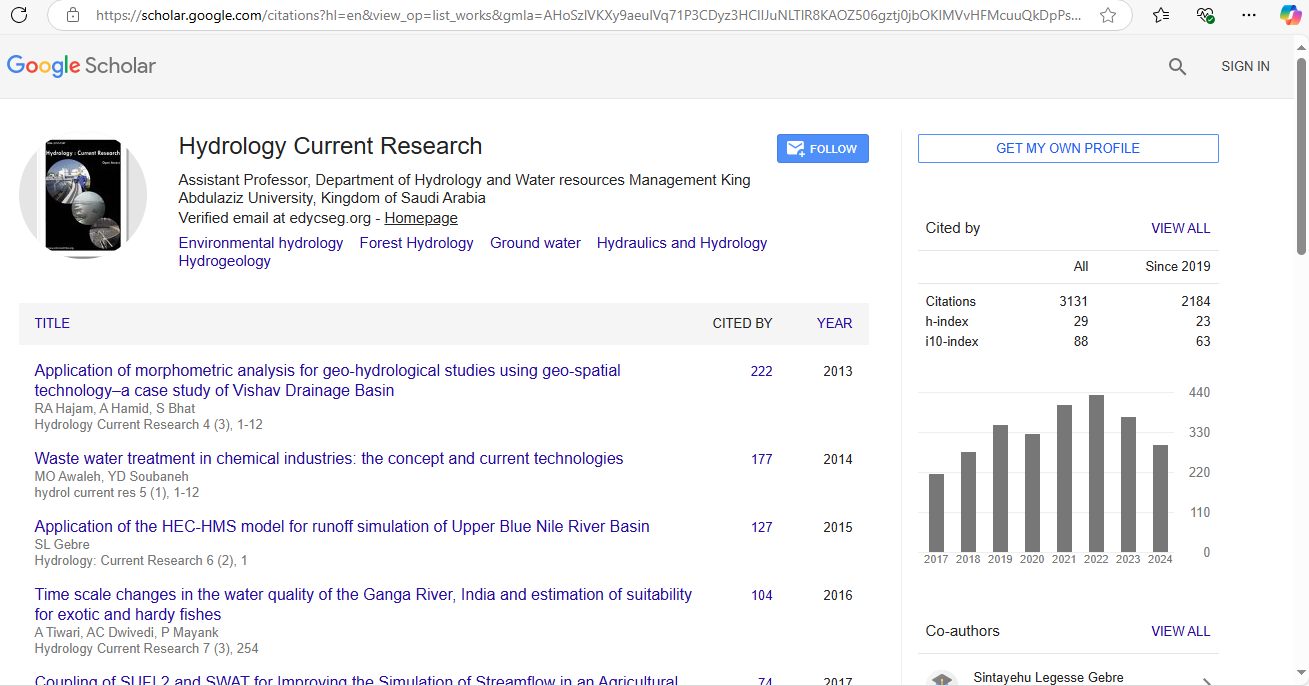
Hydrology: Current Research received 2843 citations as per Google Scholar report