Short Communication - (2025) Volume 16, Issue 5
Received: 01-Sep-2025, Manuscript No. hycr-25-175008;
Editor assigned: 03-Sep-2025, Pre QC No. P-175008;
Reviewed: 17-Sep-2025, QC No. Q-175008;
Revised: 22-Sep-2025, Manuscript No. R-175008;
Published:
29-Sep-2025
, DOI: 10.37421/2157-7587.2025.16.624
Citation: Abbas, Nour El-Din. ”Water Balance: Global Importance, Sustainable Management.” Hydrol Current Res 16 (2025):624
Copyright: © 2025 Abbas E. Nour This is an open-access article distributed under the terms of the Creative Commons Attribution License, which permits unrestricted use,
distribution and reproduction in any medium, provided the original author and source are credited.
Understanding how the body maintains water and sodium balance is crucial for overall health. This work explores the intricate interplay of dietary sodium intake and the hormone vasopressin in regulating fluid homeostasis in healthy adults, highlighting factors that can influence hydration status and electrolyte levels. Maintaining fluid homeostasis involves complex physiological processes, where even minor imbalances can lead to significant health issues. [1].
This article examines the complex issue of global freshwater resources, particularly under the stress of a changing climate. It delves into future projections for water scarcity and drought risks, providing a comprehensive assessment of how climate shifts will impact water availability worldwide and what that means for future resource management. The global distribution and availability of water are becoming increasingly precarious, necessitating urgent attention to future resource management. [2].
Agricultural water use is a huge part of the global water balance, and this research reviews strategies for enhancing irrigation efficiency. It highlights various methods and technologies aimed at optimizing water application in farming to reduce waste and ensure more sustainable crop production, addressing a critical need in food security. Improving how water is utilized in farming is essential not just for environmental conservation but also for ensuring long-term food security for a growing global population. [3].
Managing water effectively in urban environments is increasingly important, especially with growing populations and climate variability. This article explores advanced modeling techniques for understanding urban water balance, providing insights into how smart city initiatives can leverage these models for more resilient and sustainable water resource management. Effective urban planning requires sophisticated tools to predict and manage water demands, especially as cities expand and face new environmental challenges. [4].
Forest ecosystems play a vital role in regional and global water cycles. This review synthesizes current knowledge on how forest water balance is being altered by climate change, covering impacts on evapotranspiration, runoff, and groundwater recharge, and discussing the implications for forest health and water resources. Forests are critical regulators of regional climate and water cycles, making their response to climate change a key concern for hydrological stability. [5].
Assessing water balance accurately is fundamental to water resource management. This research offers a look into recent advancements in hydrological modeling, explaining how new models and techniques improve our ability to quantify water inputs, outputs, and storage across various scales, supporting better decision-making for water sustainability. Accurate hydrological models are indispensable for comprehending the dynamics of water systems and for developing informed strategies to mitigate water-related risks. [6].
Water quantity and quality are inherently linked, and this article explores their complex interactions. It highlights the global challenges posed by declining water quality and changing availability, and discusses integrated solutions that consider both aspects for comprehensive and effective water management strategies. A holistic approach to water management must inherently consider both the volume and purity of water, as these factors are inextricably linked to human and ecological health. [7].
Groundwater systems are crucial for water supply, yet they face significant pressures from human activities and climate change. This paper discusses the challenges in maintaining groundwater balance, exploring how environmental changes impact recharge and discharge, and outlining opportunities for sustainable groundwater management practices. Groundwater reserves are a vital component of the global water supply, and their sustainable use is paramount for future generations amidst changing climatic patterns. [8].
Proper hydration is a fundamental aspect of human health, directly influencing various physiological functions and health outcomes. This systematic review synthesizes evidence on the impact of hydration status across different health conditions, emphasizing its importance for disease prevention and overall well-being. The implications of hydration extend beyond immediate comfort, impacting metabolic processes, cognitive function, and resilience against various ailments. [9].
Remote sensing technologies offer powerful tools for monitoring and assessing water balance over large areas. This review discusses the diverse applications of remote sensing in regional water balance studies, including estimating precipitation, evapotranspiration, and changes in water storage, which are critical for effective water resource planning. These advanced technologies provide unprecedented capabilities to observe and analyze water dynamics across vast and remote regions, fostering better planning and adaptive management. [10].
The intricate subject of water balance is fundamental to human health and ecological stability alike. Understanding precisely how the human body maintains water and sodium balance is crucial for overall well-being. This involves the complex interplay of dietary sodium intake and the hormone vasopressin, which diligently regulates fluid homeostasis in healthy adults. Identifying these factors helps elucidate how hydration status and electrolyte levels are influenced, thereby providing insights into health maintenance [1].
Indeed, proper hydration is not merely about thirst quenching; it represents a fundamental aspect of human health, directly influencing a multitude of physiological functions and overall health outcomes. Systematic reviews comprehensively synthesize evidence on the profound impact of hydration status across various health conditions, unequivocally emphasizing its paramount importance for disease prevention and supporting overall well-being throughout life [9].
Beyond individual physiological needs, water's availability and quality are inextricably linked, creating complex global interactions. The world faces substantial challenges from both declining water quality and changing availability, problems that demand integrated solutions. Effective water management strategies must inherently consider both aspects for a truly comprehensive and impactful approach [7].
On a larger, environmental scale, the complex issue of global freshwater resources is experiencing unprecedented stress, largely attributable to a rapidly changing climate. Future projections for water scarcity and drought risks are critical, offering a comprehensive assessment of how these climate shifts will inevitably impact water availability worldwide. This understanding is vital for formulating robust future resource management strategies to avert crises [2].
Forest ecosystems, for example, occupy a central and vital role in both regional and global water cycles. Extensive reviews synthesize the current knowledge on how forest water balance is being significantly altered by ongoing climate change. This alteration covers crucial aspects like changes in evapotranspiration, surface runoff, and vital groundwater recharge, all of which carry profound implications for overall forest health and the broader water resources they regulate [5].
Similarly, subterranean groundwater systems are indispensable for providing a reliable water supply to numerous communities. However, these systems face significant pressures stemming from pervasive human activities and the pervasive effects of climate change. Sustaining groundwater balance involves meticulously exploring how these environmental changes impact both the natural recharge and discharge rates, simultaneously outlining promising opportunities for implementing sustainable groundwater management practices [8].
Specific economic and societal sectors are profoundly dependent on effective water balance management. Agricultural water use, for instance, constitutes a substantial and often dominant portion of the global water balance. Consequently, optimizing irrigation efficiency is paramount. Research meticulously reviews various strategies for enhancing this efficiency, highlighting diverse methods and innovative technologies specifically aimed at reducing water waste and ensuring more sustainable crop production. This focus addresses a critical, overarching need in global food security [3].
Concurrently, the task of managing water effectively within urban environments is growing in importance, especially given burgeoning global populations and increasing climate variability. The development and application of advanced modeling techniques are crucial for understanding the intricate urban water balance. These models provide invaluable insights into how smart city initiatives can intelligently leverage such tools for fostering more resilient and truly sustainable urban water resource management, adapting to future challenges [4].
Accurately assessing water balance is universally acknowledged as fundamental to comprehensive water resource management across all conceivable scales, from local catchments to entire regions. Recent advancements in hydrological modeling represent a significant leap forward, drastically improving our ability to quantitatively assess water inputs, outputs, and storage. These enhanced capabilities are pivotal for supporting better, evidence-based decision-making aimed at long-term water sustainability [6].
Moreover, the advent of remote sensing technologies has provided powerful, non-invasive tools for monitoring and assessing water balance across vast geographical areas. This review discusses the diverse and expansive applications of remote sensing in regional water balance studies. These include critical tasks like accurately estimating precipitation, quantifying evapotranspiration, and detecting changes in water storage, all of which are absolutely critical for effective water resource planning and ensuring the resilience of vital water systems for the future [10].
Understanding water balance is critical across diverse domains, from human physiology to global ecosystems and urban infrastructure. The human body's intricate regulation of water and sodium, influenced by dietary intake and hormones like vasopressin, is essential for overall health and preventing various conditions. Globally, freshwater resources face severe pressure from climate change, leading to increased water scarcity and drought risks, which demand proactive management strategies. Key sectors like agriculture are actively seeking to optimize irrigation efficiency through new technologies to ensure sustainable crop production and food security. Urban areas also leverage advanced modeling to manage water resources effectively amidst growing populations and environmental shifts, aiming for smart, resilient water systems. Natural systems such as forest ecosystems are profoundly impacted by climate change, affecting evapotranspiration, runoff, and groundwater recharge, necessitating a deeper understanding of their altered water balance. Groundwater systems themselves face significant challenges from human activities and climate change, highlighting the need for sustainable management practices. Accurate water balance assessment is fundamental to effective water resource management, supported by advances in hydrological modeling that quantify water dynamics across scales. Furthermore, remote sensing technologies provide powerful tools for monitoring regional water balance, offering insights into precipitation, evapotranspiration, and water storage crucial for planning. Ultimately, the intertwined issues of water quantity and quality require integrated solutions, emphasizing comprehensive approaches for sustainable water management worldwide. All these aspects underscore the pervasive importance of water balance in sustaining life and supporting societal functions in a changing world.
None
None
Indexed at, Google Scholar, Crossref
Indexed at, Google Scholar, Crossref
Indexed at, Google Scholar, Crossref
Indexed at, Google Scholar, Crossref
Indexed at, Google Scholar, Crossref
Indexed at, Google Scholar, Crossref
Indexed at, Google Scholar, Crossref
Indexed at, Google Scholar, Crossref
Indexed at, Google Scholar, Crossref
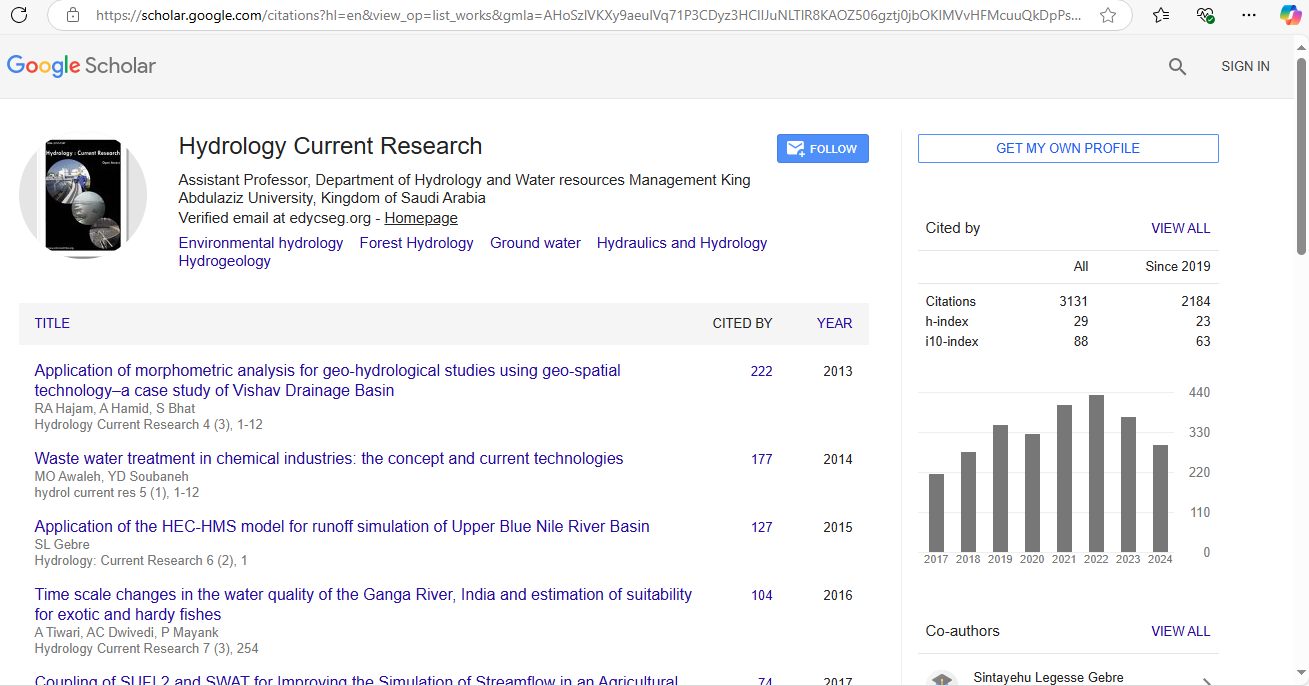
Hydrology: Current Research received 2843 citations as per Google Scholar report