Opinion - (2025) Volume 16, Issue 5
Received: 01-Sep-2025, Manuscript No. hycr-25-175005;
Editor assigned: 03-Sep-2025, Pre QC No. P-175005;
Reviewed: 17-Sep-2025, QC No. Q-175005;
Revised: 22-Sep-2025, Manuscript No. R-175005;
Published:
29-Sep-2025
, DOI: 10.37421/2157-7587.2025.16.621
Citation: Grant, Isabella. ”Water Balance: From Cells to Global Challenges.” Hydrol Current Res 16 (2025):621
Copyright: © 2025 Grant I. This is an open-access article distributed under the terms of the Creative Commons Attribution License, which permits unrestricted use, distribution
and reproduction in any medium, provided the original author and source are credited.
Maintaining optimal hydration is crucial for human health, influencing everything from cognitive function to physical performance. This indicates that a personalized approach to hydration, considering a person's specific context, is more effective than a one-size-fits-all recommendation[1].
Root system architecture plays a critical role in how plants manage water, especially under drought conditions. A crucial insight is that comprehending root development and its interaction with soil moisture can inform strategies for breeding drought-resilient crops. This exploration delves into the genetic and environmental factors influencing root systems, water uptake, and overall plant survival[2].
Forest ecosystems are vital regulators of the global water cycle, but climate change is altering their water balance dynamics. This highlights the need for integrated methods to predict how forests will respond to future climate scenarios and how that impacts regional water availability[3].
The global water cycle is undergoing significant shifts due to a warming climate, impacting precipitation patterns, evaporation, and water storage on land. These changes present substantial challenges for global water security, agricultural productivity, and ecosystem health worldwide, necessitating urgent adaptation strategies[4].
Fluid management in critically ill patients is a delicate balance, where both fluid overload and underload can lead to adverse outcomes. The paramount conclusion is that precise fluid resuscitation and de-resuscitation are essential for optimizing patient outcomes within intensive care settings[5].
Achieving sustainable crop production demands efficient water use, especially as water resources become scarcer. Key advancements, ranging from precision irrigation to drought-tolerant crop varieties, are critical for enhancing food security while simultaneously minimizing environmental impact[6].
Urban areas face mounting challenges to their water balance due to rapid urbanization and climate change, leading to increased flood risks and water scarcity. Essentially, integrated urban planning, which encompasses green infrastructure and smart water management, becomes indispensable for achieving future urban sustainability[7].
The neurohormonal regulation of water balance is a fundamental aspect of vertebrate physiology, allowing animals to adapt to diverse environments. Consequently, a deeper understanding of these intricate mechanisms could unlock new insights in both comparative physiology and human health[8].
Integrated hydrological models are becoming increasingly sophisticated tools for assessing water balance across various scales, from local catchments to entire river basins. Crucially, these models are vital for informing sound water resource management decisions, particularly given climate variability and escalating human demand[9].
Forests provide crucial ecosystem services, many of which are directly linked to their water balance, such as regulating water quality and mitigating floods. Fundamentally, preserving healthy forest ecosystems is paramount for securing vital water resources and ensuring environmental stability in a rapidly changing world[10].
Optimal hydration is fundamental for human health, impacting cognitive function and physical performance. Research highlights that daily activities, environmental factors, and individual variations significantly influence water balance, underscoring the effectiveness of personalized hydration strategies over generalized recommendations[1]. Similarly, fluid management in critically ill patients presents a delicate challenge, where both fluid overload and underload can lead to severe adverse outcomes. This calls for personalized approaches and dynamic assessment to maintain proper water balance, with precise fluid resuscitation and de-resuscitation being crucial for optimizing patient recovery in intensive care settings[5]. From a broader physiological perspective, the neurohormonal regulation of water balance is a fundamental aspect of vertebrate physiology, enabling adaptation across diverse environments. Understanding the complex interplay of hormones and neural pathways that control fluid and electrolyte homeostasis offers new insights into comparative physiology and human health[8].
In the botanical world, root system architecture plays a critical role in plant water management, particularly under drought conditions. A key insight is that comprehending root development and its interaction with soil moisture can inform strategies for breeding drought-resilient crops. This involves exploring genetic and environmental factors influencing root systems, water uptake, and overall plant survival[2]. Building on this, achieving sustainable crop production requires efficient water use, especially as global water resources diminish. Various strategies and technologies are focused on optimizing water balance in agricultural systems, ranging from precision irrigation to developing drought-tolerant crop varieties. These advancements are vital for enhancing food security while simultaneously minimizing environmental impact[6].
Forest ecosystems are recognized as vital regulators of the global water cycle, yet climate change is significantly altering their water balance dynamics. Current research synthesizes knowledge on the drivers, measurement techniques, and modeling approaches for forest water balance, indicating a need for integrated methods to predict forest responses to future climate scenarios and their impact on regional water availability[3]. The global water cycle as a whole is undergoing profound shifts due to a warming climate, affecting precipitation patterns, evaporation, and terrestrial water storage. These changes present substantial challenges for global water security, agricultural productivity, and ecosystem health worldwide, necessitating urgent adaptation strategies[4]. Forests also provide crucial ecosystem services directly linked to their water balance, such as regulating water quality and mitigating floods. Climate change impacts forest water balance, thereby affecting the delivery of these essential services. Fundamentally, preserving healthy forest ecosystems is paramount for securing vital water resources and ensuring environmental stability in a rapidly changing world[10].
Urban areas face escalating challenges to their water balance due to rapid urbanization and the impacts of climate change, leading to heightened flood risks and water scarcity. Addressing these issues involves discussing both the inherent challenges and potential solutions for establishing more resilient urban water systems. Essentially, integrated urban planning, which encompasses green infrastructure and smart water management, becomes indispensable for achieving future urban sustainability[7].
Integrated hydrological models are increasingly sophisticated tools for assessing water balance across diverse scales, from local catchments to entire river basins. Recent developments and applications of these models are being examined. Crucially, these models are vital for informing sound water resource management decisions, particularly given climate variability and escalating human demand[9].
The concept of water balance is fundamental across diverse scientific disciplines and practical applications, from biological systems to global environmental processes. For human health, maintaining optimal hydration is critical, demanding personalized approaches due to varying individual needs and environmental factors[1]. Similarly, in critical medical contexts, precise fluid management is paramount to prevent adverse outcomes and optimize patient care[5]. At a biological level, the neurohormonal regulation of water balance is a key mechanism enabling vertebrates to adapt to different environments, offering deep insights into physiology[8]. Beyond individual organisms, water balance is a central theme in ecological and environmental studies. Root system architecture dictates how plants, especially crops, manage water under stress, pointing towards breeding strategies for drought resilience and sustainable agricultural practices like precision irrigation[2, 6]. Forest ecosystems play a vital role in the global water cycle and provide essential services such as water quality regulation and flood mitigation. However, climate change is significantly altering forest water balance, impacting these services and necessitating integrated modeling approaches to predict future responses[3, 10]. The broader global water cycle is itself undergoing climate-driven shifts, creating serious challenges for water security, agriculture, and ecosystem health worldwide, requiring urgent adaptation[4]. Urban areas also face unique water balance challenges due to rapid urbanization and climate change, necessitating integrated planning with green infrastructure for resilience[7]. Finally, integrated hydrological models are becoming indispensable tools for assessing water balance at various scales, supporting informed water resource management decisions amidst climate variability and rising human demand[9].
None
None
Indexed at, Google Scholar, Crossref
Indexed at, Google Scholar, Crossref
Indexed at, Google Scholar, Crossref
Indexed at, Google Scholar, Crossref
Indexed at, Google Scholar, Crossref
Indexed at, Google Scholar, Crossref
Indexed at, Google Scholar, Crossref
Indexed at, Google Scholar, Crossref
Indexed at, Google Scholar, Crossref
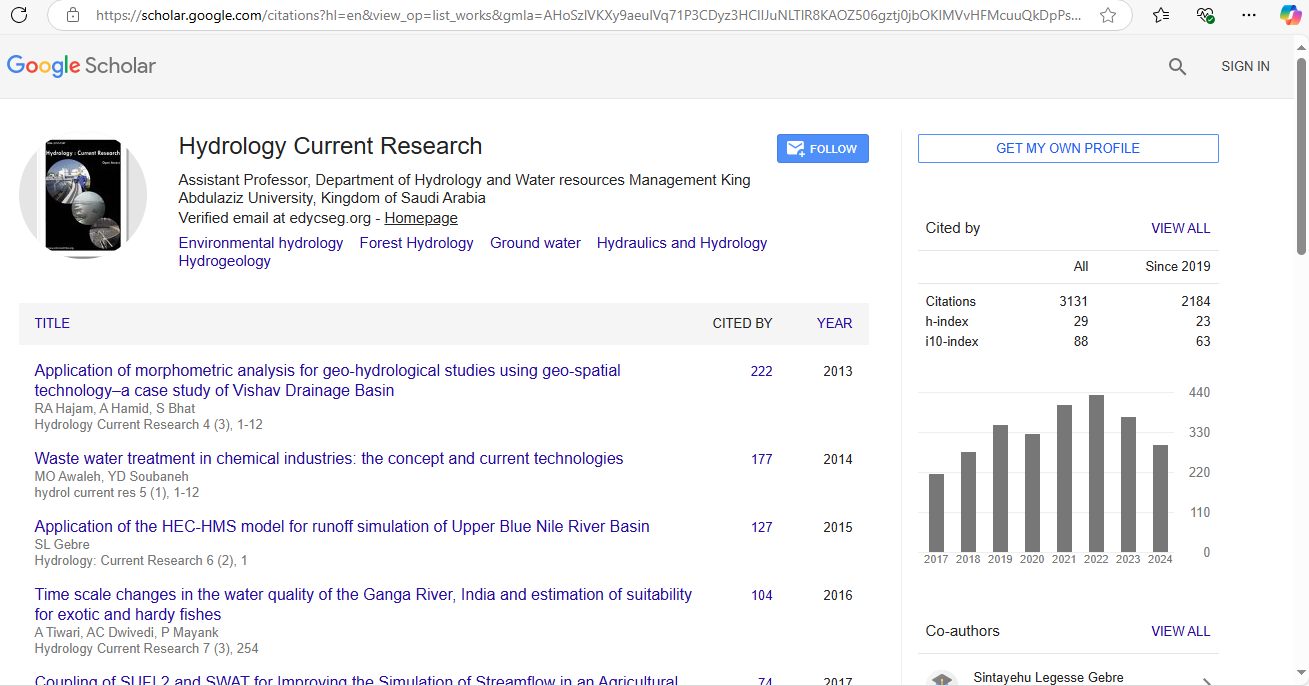
Hydrology: Current Research received 2843 citations as per Google Scholar report