Opinion - (2025) Volume 16, Issue 5
Received: 01-Sep-2025, Manuscript No. hycr-25-175004;
Editor assigned: 03-Sep-2025, Pre QC No. P-175004;
Reviewed: 17-Sep-2025, QC No. Q-175004;
Revised: 22-Sep-2025, Manuscript No. R-175004;
Published:
29-Sep-2025
, DOI: 10.37421/2157-7587.2025.16.620
Citation: Ishikawa, Haruto. ”Water Balance: A Multifaceted Health Imperative.” Hydrol Current Res 16 (2025):620.
Copyright: © 2025 Ishikawa H. This is an open-access article distributed under the terms of the Creative Commons Attribution License, which permits unrestricted use,
distribution and reproduction in any medium, provided the original author and source are credited.
This article offers a thorough review of different methods used to assess hydration status, highlighting the complexities and limitations of each. It emphasizes that no single method is perfect, and a combination of techniques, like body mass changes, urine osmolality, and plasma osmolality, often provides a more reliable picture, especially in diverse populations and environments. Understanding these methods is crucial for accurate water balance assessment in both clinical and athletic settings [1].
This systematic review and meta-analysis explores how fluid intake influences the body's ability to regulate temperature and maintain exercise performance, particularly in hot conditions. The findings suggest that appropriate fluid intake is vital for thermoregulation, preventing excessive core temperature rise, and preserving endurance capacity. It underpins the importance of personalized hydration strategies for athletes in challenging environments [2].
This article delves into the complex role of vasopressin, also known as antidiuretic hormone (ADH), in disorders affecting water balance. It clarifies how dysregulation of vasopressin secretion or action can lead to conditions like hyponatremia and hypernatremia, which are critical imbalances in body water. The review provides insights into the underlying mechanisms and potential therapeutic approaches for these challenging clinical scenarios [3].
This review offers a current overview of water and electrolyte homeostasis in athletes, emphasizing the unique challenges faced during intense physical activity. It discusses how sweat losses can significantly alter fluid and electrolyte balance, potentially impacting performance and health. The article underscores the importance of proper monitoring and tailored rehydration strategies to maintain optimal physiological function for athletic populations [4].
This comprehensive review examines the significant changes in body water homeostasis that occur with aging and their subsequent consequences for health. It highlights how factors like reduced thirst perception, altered renal function, and medication use contribute to a higher risk of dehydration and electrolyte imbalances in older adults. Understanding these age-related shifts is crucial for promoting healthy aging and preventing related complications [5].
This systematic review and meta-analysis investigates the impact of mild hypohydration on cognitive performance. The findings indicate that even small deficits in body water can negatively affect various cognitive functions, including attention, memory, and executive function. This underscores the importance of maintaining optimal hydration, not just for physical well-being, but also for mental acuity in daily life and demanding tasks [6].
This article explores the neurobiology of thirst, offering fresh perspectives on how the brain detects water deficits and drives fluid seeking behavior. It discusses the complex neural circuits and molecular mechanisms involved in sensing osmolality and blood volume changes, which ultimately regulate our desire to drink. Understanding these intricate processes helps unravel the mysteries of fluid intake control and its dysregulation in various conditions [7].
This narrative review focuses on the causes and management of hyponatremia, a common electrolyte disorder characterized by abnormally low sodium levels in the blood, often linked to water intoxication. It details the diverse etiologies, from excessive water intake to various medical conditions, and outlines current diagnostic and therapeutic strategies in hospitalized patients. This provides critical insights into addressing this potentially life-threatening water balance disturbance [8].
This article provides an insightful look into the physiological and clinical aspects of how kidneys handle water and electrolytes. It explains the intricate mechanisms by which the kidneys regulate fluid volume, osmolality, and electrolyte concentrations, playing a central role in maintaining overall water balance. Understanding these renal processes is fundamental for diagnosing and managing various fluid and electrolyte disorders [9].
This narrative review addresses water and beverage consumption patterns in children and adolescents, alongside current recommendations and their impact on health. It highlights the importance of adequate hydration for growth, development, and disease prevention, while discussing the challenges posed by the consumption of sugary drinks. The article emphasizes the need for public health strategies to promote healthy fluid intake habits from an early age [10].
Maintaining the body's delicate water and electrolyte balance is unequivocally vital for sustaining life and optimal physiological function. The process of accurately assessing an individual's hydration status, however, is far from simple. Current understanding emphasizes that relying on a single diagnostic method is insufficient; instead, a more robust and reliable picture emerges from combining various techniques. These often include monitoring subtle changes in body mass, evaluating urine osmolality, and analyzing plasma osmolality. This multifaceted approach is particularly crucial when dealing with diverse populations, such as athletes or the elderly, and when individuals are exposed to varying environmental conditions, ensuring that assessments are precise and contextually relevant in both clinical and high-performance settings [1]. A comprehensive grasp of these assessment complexities forms the bedrock for effective interventions and preventative strategies.
At the core of maintaining fluid equilibrium lie the intricate functions of the kidneys and the sophisticated hormonal systems they interact with. The kidneys, acting as master regulators, meticulously control fluid volume, osmolality, and the concentrations of essential electrolytes through a series of complex physiological mechanisms [9]. A pivotal hormone in this regulatory network is vasopressin, also known as antidiuretic hormone (ADH). Any dysregulation in the secretion or action of vasopressin can profoundly disrupt the body's water balance, leading to severe and potentially life-threatening clinical conditions. These include hyponatremia, characterized by abnormally low sodium levels, and hypernatremia, which represents an excess of sodium, both indicating critical imbalances in body water [3]. Furthermore, the fundamental neurobiological mechanisms that govern thirst provide deep insight into how the brain detects subtle water deficits and subsequently drives fluid-seeking behavior. Complex neural circuits and molecular pathways are involved in sensing changes in osmolality and blood volume, ultimately dictating our desire to drink. Understanding these intricate processes helps to unravel the mysteries of fluid intake control and its potential dysregulation in various medical conditions [7].
The profound impact of hydration status extends to specific populations and critical bodily functions. For athletes, intense physical activity, especially when undertaken in hot and challenging environments, presents unique and significant challenges to maintaining optimal water and electrolyte homeostasis. Substantial sweat losses during such activities can dramatically alter fluid balance, directly affecting the body's ability to regulate temperature (thermoregulation) and sustain endurance capacity [2, 4]. Consequently, personalized hydration strategies, along with vigilant monitoring of fluid and electrolyte levels, are not merely beneficial but essential to preserve athletic performance and prevent serious health complications in these populations [4]. Beyond physical prowess, the effects of hydration stretch into cognitive realms. Even mild degrees of hypohydration have been demonstrably shown to negatively impact cognitive performance. Research indicates that even small deficits in body water can impair various cognitive functions, including attention, memory, and executive function. This underscores the critical importance of maintaining optimal hydration, not only for physical well-being but also for mental acuity in daily life, academic pursuits, and demanding professional tasks [6].
Demographic shifts also highlight specific hydration vulnerabilities. With advancing age, individuals experience notable physiological changes that significantly alter body water homeostasis, rendering older adults particularly susceptible to dehydration and electrolyte imbalances. Factors contributing to this heightened risk include a reduced perception of thirst, age-related alterations in renal function, and the common use of multiple medications (polypharmacy) [5]. Recognizing and addressing these age-related shifts are paramount for promoting healthy aging and proactively preventing associated health complications. Conversely, at the other end of the age spectrum, early life stages demand specific attention to hydration. Water and beverage consumption patterns in children and adolescents are crucially linked to their healthy growth, proper development, and long-term disease prevention. Promoting adequate fluid intake, while effectively addressing the widespread consumption of sugary drinks, represents a vital public health objective aimed at fostering healthy hydration habits from an early age [10].
Finally, the clinical landscape is replete with disorders stemming from imbalances in water and electrolytes, with hyponatremia serving as a frequently encountered example. This common electrolyte disorder is characterized by abnormally low sodium levels in the blood and is often linked to scenarios of excessive water intake (water intoxication) or underlying medical conditions that impair water excretion. Effective management of hyponatremia necessitates a thorough understanding of its diverse etiologies, encompassing everything from medication side effects to organ dysfunction. Furthermore, clinicians must outline and implement current diagnostic protocols and therapeutic strategies tailored to hospitalized patients, given that hyponatremia can be a potentially life-threatening disturbance requiring precise intervention [8]. The ongoing insights derived from studying these complex fluid and electrolyte disorders are instrumental in refining clinical practice, improving patient outcomes, and advancing our understanding of systemic physiological balance.
Maintaining proper water and electrolyte balance is critical for overall health and physiological function across all life stages. Assessing hydration status presents complexities, with no single method proving universally perfect, thus necessitating a combination of techniques for reliability [1]. Fluid intake significantly influences thermoregulation and endurance, particularly for athletes in demanding environments, highlighting the need for personalized hydration strategies to counter sweat losses and maintain optimal function [2, 4]. The kidneys, in conjunction with hormones like vasopressin, play a pivotal role in regulating fluid volume, osmolality, and electrolyte concentrations. Dysregulation in these intricate mechanisms can lead to severe imbalances such as hyponatremia and hypernatremia, which are critical clinical challenges requiring careful management [3, 9, 8]. Beyond physical performance, hydration status profoundly impacts cognitive functions; even mild hypohydration can impair attention, memory, and executive function [6]. The fundamental neurobiology of thirst involves complex neural circuits that detect water deficits and drive fluid-seeking behaviors [7]. As individuals age, changes in thirst perception, renal function, and medication use increase the risk of dehydration and electrolyte disturbances, making age-related considerations crucial for healthy aging [5]. Furthermore, establishing healthy water and beverage consumption patterns from an early age is essential for children's growth, development, and disease prevention, underscoring the importance of public health initiatives [10]. This collective body of research emphasizes the multifaceted nature of water balance, from cellular mechanisms to its broad implications for health, performance, and disease across diverse populations.
None
None
Indexed at, Google Scholar, Crossref
Indexed at, Google Scholar, Crossref
Indexed at, Google Scholar, Crossref
Indexed at, Google Scholar, Crossref
Indexed at, Google Scholar, Crossref
Indexed at, Google Scholar, Crossref
Indexed at, Google Scholar, Crossref
Indexed at, Google Scholar, Crossref
Indexed at, Google Scholar, Crossref
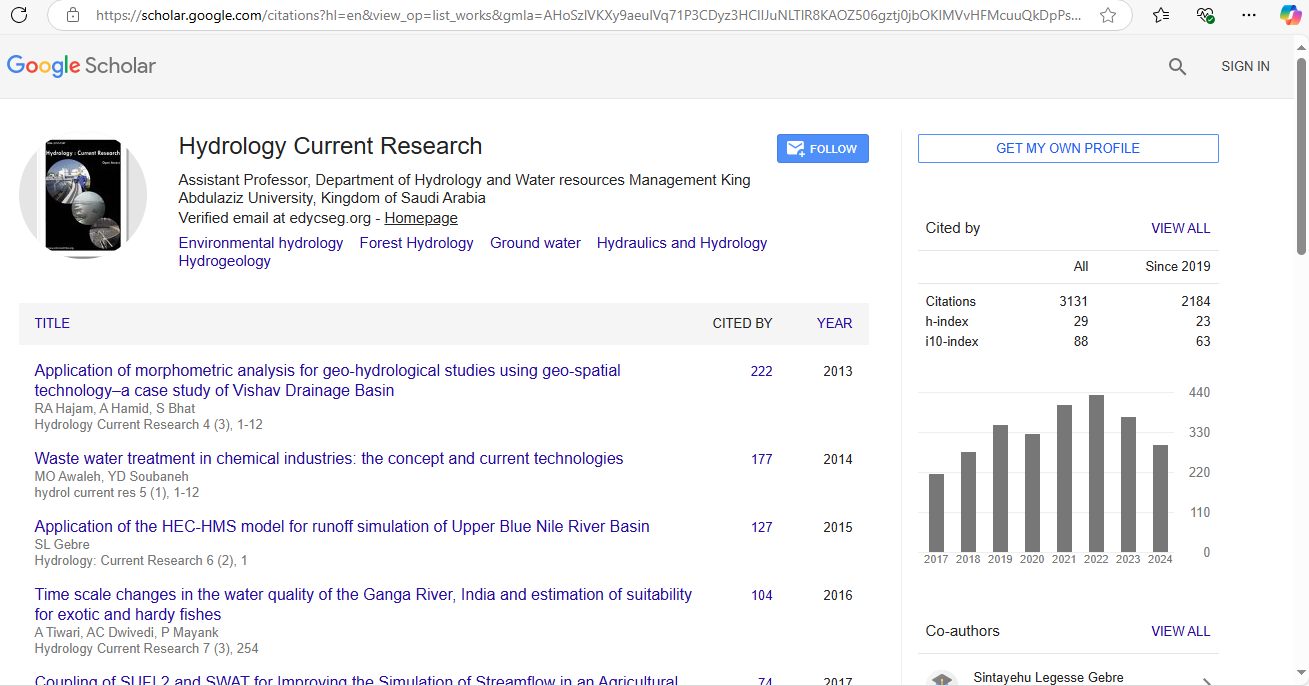
Hydrology: Current Research received 2843 citations as per Google Scholar report