Brief Report - (2025) Volume 9, Issue 2
Received: 01-Apr-2025, Manuscript No. ahbs-26-182401;
Editor assigned: 03-Apr-2025, Pre QC No. P-182401;
Reviewed: 17-Apr-2025, QC No. Q-182401;
Revised: 22-Apr-2025, Manuscript No. R-182401;
Published:
29-Apr-2025
, DOI: 10.37421/2952-8097.2025.9.305
Citation: Das, Priyanka. ”Veterinary Diagnostics: Revolutionizing
Animal Health Through Technology.” J Anim Health Behav Sci 09 (2025):305.
Copyright: © 2025 Das P. This is an open-access article distributed under the terms of the Creative Commons Attribution License, which permits unrestricted use, distribution
and reproduction in any medium, provided the original author and source are credited.
Recent advancements in veterinary diagnostics are profoundly revolutionizing animal health monitoring, ushering in an era of unprecedented precision and proactive care. These transformative technologies enable earlier detection, more precise diagnoses, and personalized treatment plans, significantly improving animal welfare and disease control across both companion and food-producing animal populations [1].
Specifically, next-generation sequencing has emerged as a powerful tool for the routine identification of infectious diseases in veterinary medicine, allowing for rapid and accurate pathogen detection. This capability is crucial for managing outbreaks and implementing targeted control measures in animal populations [1].
Furthermore, the accessibility and ease of use of portable ultrasound devices are significantly improving diagnostic capabilities in small animal practice, especially in resource-limited settings. These devices facilitate rapid, on-site assessments of abdominal and thoracic conditions, leading to faster clinical decision-making and improved patient outcomes [2].
The integration of biosensors and wearable technology represents a paradigm shift towards continuous animal health monitoring. Smart collars and implants are being developed to track vital parameters like heart rate, temperature, and activity levels, providing invaluable data streams for early disease detection and behavioral monitoring [3].
Artificial intelligence (AI) and machine learning (ML) are increasingly being applied to analyze complex veterinary datasets, from diagnostic images to genomic information. These algorithms can enhance the accuracy and efficiency of disease diagnosis and predict treatment responses, offering substantial assistance to veterinarians in making more informed clinical decisions [4].
The development of rapid and sensitive point-of-care diagnostic tests is crucial for timely intervention in animal infectious diseases. Novel assay designs, including lateral flow devices and microfluidic systems, enable on-farm or in-clinic detection of pathogens and biomarkers, improving accessibility and reducing critical diagnosis turnaround times [5].
Genomic surveillance, powered by next-generation sequencing, has become an indispensable tool for understanding the epidemiology of animal diseases. Whole-genome sequencing can rapidly identify and track outbreaks, characterize antimicrobial resistance genes, and monitor pathogen evolution, providing critical insights for public health and biosecurity [6].
The application of advanced imaging techniques, such as CT and MRI, is expanding beyond specialized referral centers. The increasing availability and utility of these modalities for diagnosing complex conditions in companion animals are highlighting improvements in resolution, speed, and accessibility for both diagnostic and surgical planning purposes [7].
Non-invasive diagnostic methods are gaining prominence for animal health monitoring, reducing stress on animals and facilitating frequent assessments. Novel biomarkers detectable in urine, saliva, or feces hold significant potential for early disease detection and monitoring of therapeutic responses in various animal species, emphasizing practical application and validation [8].
Finally, the integration of omics technologies such as genomics, proteomics, and metabolomics with advanced diagnostics is providing a more comprehensive understanding of animal health and disease. These multi-omics approaches can identify novel diagnostic targets, predict disease susceptibility, and inform personalized medicine strategies within veterinary practice [9].
Recent breakthroughs in veterinary diagnostics are fundamentally reshaping animal health monitoring, offering enhanced capabilities for disease detection and management. Techniques such as next-generation sequencing are revolutionizing pathogen identification, enabling swift and precise diagnostics crucial for controlling infectious diseases in animal populations [1].
The advent of advanced imaging modalities, including low-field MRI and portable ultrasound, is transforming diagnostic precision. Portable ultrasound, in particular, is proving invaluable in small animal practice for rapid, on-site assessments, thereby accelerating clinical decision-making and improving patient outcomes, especially in underserved regions [2].
Biosensors and wearable devices are ushering in a new era of real-time physiological data collection. These technologies, integrated into smart collars or implants, continuously monitor vital signs and physiological parameters, offering real-time insights into an animal's health status and facilitating early detection of anomalies [3].
The integration of artificial intelligence and machine learning to analyze vast veterinary datasets is further augmenting predictive capabilities. AI algorithms can significantly improve the accuracy and efficiency of disease diagnosis, predict treatment efficacy, and identify subtle indicators of behavioral changes or welfare concerns, thereby supporting informed clinical decision-making [4].
The development of point-of-care diagnostic tests is critical for immediate intervention in animal infectious diseases. Innovations in assay design, such as lateral flow devices and microfluidic systems, allow for rapid, on-site pathogen detection, reducing diagnostic turnaround times and enabling prompt treatment initiation [5].
Genomic surveillance using next-generation sequencing is becoming a cornerstone of animal disease epidemiology. Whole-genome sequencing provides rapid insights into outbreak dynamics, antimicrobial resistance patterns, and pathogen evolution, which are vital for effective disease control and public health initiatives [6].
Advanced imaging techniques like CT and MRI are becoming more accessible and versatile in companion animal diagnostics. Their enhanced resolution and speed are crucial for diagnosing complex conditions and play an important role in planning minimally invasive procedures and surgical interventions [7].
Non-invasive diagnostic methods are increasingly being explored and validated for their utility in routine animal health monitoring. The detection of biomarkers in biological samples such as urine, saliva, and feces offers a less stressful approach for frequent health assessments and therapeutic response monitoring [8].
Multi-omics approaches, combining genomics, proteomics, and metabolomics, are providing a holistic view of animal health and disease. This integrated analysis aids in identifying novel diagnostic targets and developing personalized medicine strategies tailored to individual animal needs [9].
Finally, digital technologies and big data analytics are significantly enhancing animal health surveillance systems. Cloud computing, mobile applications, and data integration platforms enable efficient collection, analysis, and dissemination of real-time health information, leading to improved disease outbreak prediction and response strategies [10].
Recent advancements in veterinary diagnostics are revolutionizing animal health monitoring through innovative technologies. Next-generation sequencing enables precise pathogen identification, while portable ultrasound devices offer accessible on-site diagnostics. Wearable biosensors provide continuous physiological data, and artificial intelligence enhances diagnostic accuracy and predictive capabilities. The development of point-of-care tests allows for rapid disease detection, and genomic surveillance aids in understanding disease epidemiology. Advanced imaging techniques like CT and MRI are becoming more accessible, and non-invasive biomarkers offer less stressful monitoring. Multi-omics approaches provide a comprehensive understanding of animal health, and digital technologies improve surveillance systems. These integrated advancements are significantly improving animal welfare and disease control.
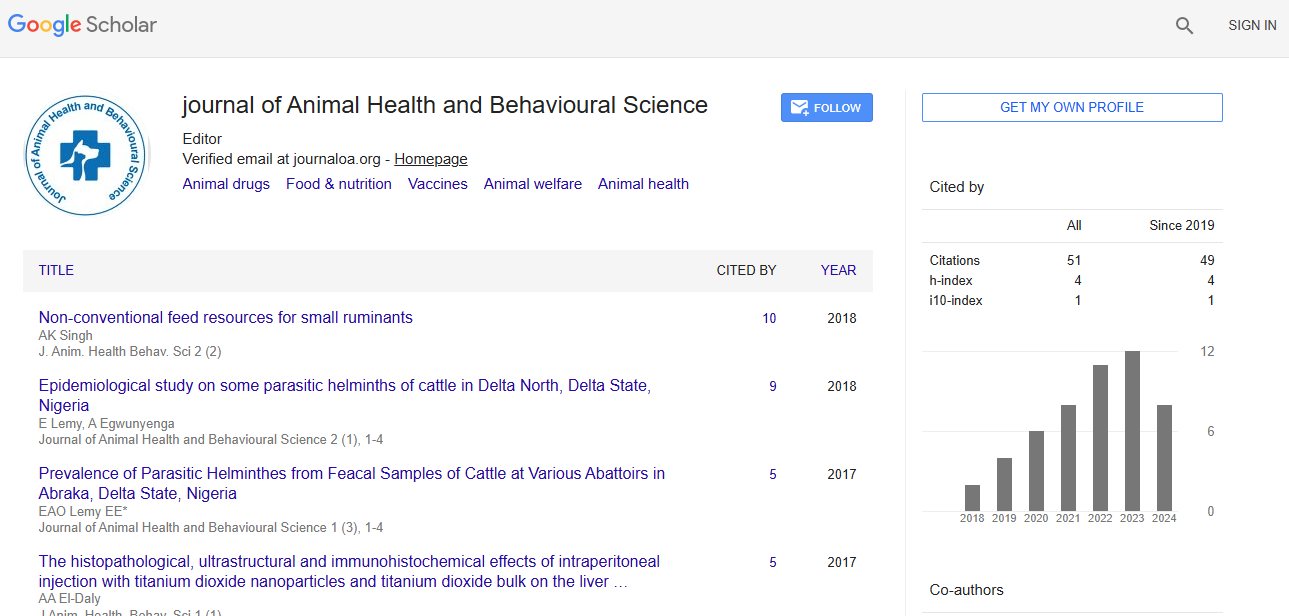
Journal of Animal Health and Behavioural Science received 38 citations as per Google Scholar report