Brief Report - (2025) Volume 15, Issue 6
Received: 01-Nov-2025, Manuscript No. jnt-26-178973;
Editor assigned: 03-Nov-2025, Pre QC No. P-178973;
Reviewed: 17-Nov-2025, QC No. Q-178973;
Revised: 24-Nov-2025, Manuscript No. R-178973;
Published:
29-Nov-2025
, DOI: 10.37421/2161-0959.2025.15.591
Citation: Zhiwen, Huang. ”Vascular Access Innovations: Better Outcomes, Fewer Complications.” J Nephrol Ther 15 (2025):591.
Copyright: © 2025 Zhiwen H. This is an open-access article distributed under the terms of the Creative Commons Attribution License, which permits unrestricted use, distribution and reproduction in any medium, provided the original author and source are credited.
Innovations in vascular access for dialysis patients are crucial for improving patient outcomes and reducing complications. Recent advancements focus on minimally invasive techniques, enhanced materials for grafts and catheters, and sophisticated imaging for precise placement. These developments aim to prolong the lifespan of vascular access, decrease infection rates, and improve the overall quality of life for individuals undergoing hemodialysis. Smart technologies are also emerging, offering real-time monitoring and early detection of potential issues [1].
The development of bioengineered grafts and advanced antimicrobial coatings represents a significant leap forward in reducing infection rates associated with hemodialysis vascular access. These materials are designed to resist bacterial colonization and promote better healing, thereby minimizing the need for interventions and hospitalizations. The focus is on creating more durable and biocompatible options [2].
Minimally invasive percutaneous techniques are revolutionizing the placement and management of arteriovenous fistulas and grafts. These methods offer faster recovery times, reduced patient discomfort, and a lower risk of bleeding and infection compared to traditional surgical approaches. The precision afforded by imaging guidance is key to their success [3].
The integration of ultrasound and other imaging modalities is paramount for the accurate and safe placement of central venous catheters. Real-time visualization allows for precise navigation through venous structures, avoiding critical organs and minimizing complications like pneumothorax. This technology significantly enhances the safety profile of tunneled catheters [4].
Wearable sensors and remote monitoring systems are emerging as powerful tools for proactive vascular access surveillance. These technologies can detect subtle changes in blood flow, pressure, or temperature, alerting healthcare providers to potential problems like stenosis or thrombosis before they become clinically apparent. This shift towards predictive care is a game-changer [5].
The use of expanded polytetrafluoroethylene (ePTFE) grafts with improved patency rates and reduced complication profiles continues to evolve. Modifications in graft design and material composition are aimed at enhancing biocompatibility and minimizing intimal hyperplasia, a key factor in graft failure [6].
Novel anti-thrombotic strategies are being investigated to improve the longevity of both fistulas and grafts. This includes the development of anticoagulant-coated devices and targeted pharmacological interventions to prevent clot formation [7].
Patient education and self-management are being empowered by technological innovations. Digital platforms and mobile applications can provide patients with personalized information, appointment reminders, and tools for monitoring their vascular access, fostering greater engagement in their care [8].
The development of biodegradable materials for temporary vascular access devices offers a promising avenue to reduce the long-term complications associated with permanent implants, particularly in patients with limited dialysis life expectancy [9].
Advanced imaging techniques, including computed tomography angiography (CTA) and magnetic resonance angiography (MRA), are increasingly used for detailed pre-procedural planning and post-procedural assessment of vascular access, allowing for early detection of anatomical variations and potential complications [10].
Innovations in vascular access for dialysis patients are crucial for improving patient outcomes and reducing complications. Recent advancements focus on minimally invasive techniques, enhanced materials for grafts and catheters, and sophisticated imaging for precise placement. These developments aim to prolong the lifespan of vascular access, decrease infection rates, and improve the overall quality of life for individuals undergoing hemodialysis. Smart technologies are also emerging, offering real-time monitoring and early detection of potential issues [1].
The development of bioengineered grafts and advanced antimicrobial coatings represents a significant leap forward in reducing infection rates associated with hemodialysis vascular access. These materials are designed to resist bacterial colonization and promote better healing, thereby minimizing the need for interventions and hospitalizations. The focus is on creating more durable and biocompatible options [2].
Minimally invasive percutaneous techniques are revolutionizing the placement and management of arteriovenous fistulas and grafts. These methods offer faster recovery times, reduced patient discomfort, and a lower risk of bleeding and infection compared to traditional surgical approaches. The precision afforded by imaging guidance is key to their success [3].
The integration of ultrasound and other imaging modalities is paramount for the accurate and safe placement of central venous catheters. Real-time visualization allows for precise navigation through venous structures, avoiding critical organs and minimizing complications like pneumothorax. This technology significantly enhances the safety profile of tunneled catheters [4].
Wearable sensors and remote monitoring systems are emerging as powerful tools for proactive vascular access surveillance. These technologies can detect subtle changes in blood flow, pressure, or temperature, alerting healthcare providers to potential problems like stenosis or thrombosis before they become clinically apparent. This shift towards predictive care is a game-changer [5].
The use of expanded polytetrafluoroethylene (ePTFE) grafts with improved patency rates and reduced complication profiles continues to evolve. Modifications in graft design and material composition are aimed at enhancing biocompatibility and minimizing intimal hyperplasia, a key factor in graft failure [6].
Novel anti-thrombotic strategies are being investigated to improve the longevity of both fistulas and grafts. This includes the development of anticoagulant-coated devices and targeted pharmacological interventions to prevent clot formation [7].
Patient education and self-management are being empowered by technological innovations. Digital platforms and mobile applications can provide patients with personalized information, appointment reminders, and tools for monitoring their vascular access, fostering greater engagement in their care [8].
The development of biodegradable materials for temporary vascular access devices offers a promising avenue to reduce the long-term complications associated with permanent implants, particularly in patients with limited dialysis life expectancy [9].
Advanced imaging techniques, including computed tomography angiography (CTA) and magnetic resonance angiography (MRA), are increasingly used for detailed pre-procedural planning and post-procedural assessment of vascular access, allowing for early detection of anatomical variations and potential complications [10].
Recent advancements in vascular access for hemodialysis patients focus on improving outcomes and reducing complications. Innovations include minimally invasive techniques, advanced materials for grafts and catheters with antimicrobial properties, and sophisticated imaging for precise placement. Smart technologies like wearable sensors and remote monitoring offer proactive surveillance and early detection of issues. Bioengineered grafts and biodegradable materials aim to enhance durability and reduce infection rates. Novel anti-thrombotic strategies and improved ePTFE graft designs contribute to increased longevity. Patient education is being augmented through digital platforms, empowering self-management. Advanced imaging modalities like CTA and MRA are crucial for pre- and post-procedural assessment, ultimately enhancing the safety and effectiveness of vascular access.
None
None
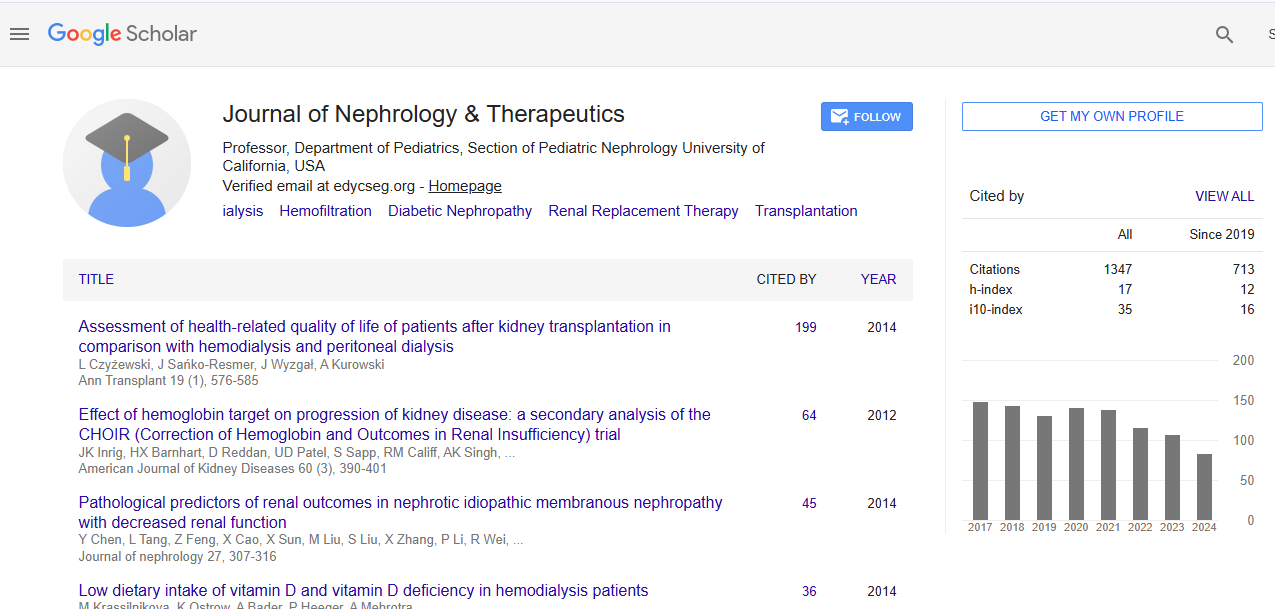
Journal of Nephrology & Therapeutics received 784 citations as per Google Scholar report