Commentary - (2025) Volume 16, Issue 2
Received: 02-Mar-2025, Manuscript No. jpm-26-179350;
Editor assigned: 04-Mar-2025, Pre QC No. P-179350;
Reviewed: 18-Mar-2025, QC No. Q-179350;
Revised: 24-Mar-2025, Manuscript No. R-179350;
Published:
31-Mar-2025
, DOI: 10.37421/2090-0902.2025.16.525
Citation: Whitaker, Noah. ”Variational Principles: Unifying Physics, Symmetries, and Computation.” J Phys Math 16 (2025):525.
Copyright: © 2025 Whitaker N. This is an open-access article distributed under the terms of the Creative Commons Attribution License, which permits unrestricted use, distribution and reproduction in any medium, provided the original author and source are credited.
Variational principles represent a cornerstone of theoretical physics, offering a sophisticated and powerful methodology for reformulating physical laws and deriving equations of motion. The fundamental concept involves the extremization, either minimization or maximization, of a quantity known as the action, from which the system's dynamics can be precisely extracted [1].
This approach has proven to be a unifying framework, spanning diverse and fundamental areas of physics, including classical mechanics, electromagnetism, quantum mechanics, and field theory, thereby enabling deeper insights into the nature of symmetries and conservation laws. The principle of least action, a direct manifestation of variational methods, asserts that the trajectory a physical system follows between two specified points in time is invariably the one that minimizes or, more generally, extremizes the action. This profound perspective elegantly unifies disparate concepts, such as the conservation of energy and momentum, through the powerful lens of Noether's theorem, which establishes a direct link between continuous symmetries and conserved quantities. It signifies a conceptual paradigm shift, moving from a force-centric description to one based on energies and potentials, thereby paving the way for more generalized and robust theoretical formulations [2].
In the realm of quantum mechanics, the path integral formulation, a landmark contribution by Feynman, stands as a prime illustration of a variational principle in action. Instead of focusing solely on a single classical trajectory, this formulation meticulously sums over all conceivable paths a particle might traverse, with each path weighted by a factor intrinsically related to the action. This summation process fundamentally leads to a probabilistic interpretation of quantum phenomena and serves as an exceptionally potent tool for the precise calculation of transition amplitudes between quantum states [3].
Field theory, encompassing the advanced domain of quantum field theory, is profoundly dependent on variational principles. The Lagrangian density, a natural extension of the classical Lagrangian, is meticulously employed to construct the action pertinent to fields. The subsequent derivation of the Euler-Lagrange equations from this action provides the foundational equations that rigorously govern the behavior of these fields, exemplifying this in Maxwell's equations for electromagnetism and the Dirac equation for relativistic electrons [4].
General relativity, Einstein's theory of gravity, is deeply and intrinsically rooted in the framework of variational principles. The celebrated Einstein-Hilbert action, when subjected to the process of extremization, precisely yields Einstein's field equations. These equations are paramount in describing the curvature of spacetime and its intricate relationship with the distribution of mass and energy, thereby encapsulating the inherently geometric nature of gravity within a variational formulation [5].
The utility of variational principles extends significantly into the domain of condensed matter physics, particularly in complex areas such as quantum many-body theory. Techniques like the variational Monte Carlo method are adeptly employed to approximate the ground state properties of intricate quantum systems. This is achieved by systematically minimizing an energy functional, offering a viable strategy to tackle systems that prove intractable through exact analytical methods [6].
In statistical mechanics, variational principles are instrumental in deriving approximate partition functions and subsequently calculating thermodynamic properties. A notable example is the Gibbs variational principle, which furnishes an essential upper bound for the free energy. This principle proves exceptionally useful as a computational tool for the detailed study of phase transitions and critical phenomena in complex and often challenging systems [7].
Variational methods play a critical role in the development and implementation of numerical techniques within the field of physics. The process of discretizing continuous variables and subsequently applying variational principles enables the systematic development of sophisticated algorithms that are indispensable in computational physics. This allows for the accurate simulation of complex systems that would otherwise be impossible to solve using purely analytical approaches [8].
The concept of an action is unequivocally central to the entirety of modern theoretical physics. The principle of stationary action dictates, with remarkable precision, how physical systems evolve over time. Furthermore, its application directly leads to the identification of conserved quantities through the exploitation of symmetries, as articulated by Noether's theorem. This fundamental principle serves as the bedrock for comprehending a vast spectrum of phenomena, ranging from the mechanics of classical systems to the intricacies of quantum field theory and even extending beyond [9].
Variational principles offer an exceptionally potent conceptual lens through which to rigorously explore the fundamental symmetries and conservation laws that govern the physical universe. By meticulously formulating physical problems in terms of an action and carefully considering how this action responds to continuous transformations, one can rigorously derive conserved quantities. This abstract yet powerful framework provides a unified and remarkably elegant approach to understanding the most fundamental physical principles across a wide array of scientific domains [10].
Variational principles are fundamental to theoretical physics, providing elegant and powerful means to reformulate physical laws and derive equations of motion. At their core, they involve minimizing or maximizing a quantity known as an action, from which the dynamics of a system can be extracted. This approach offers a unified framework for diverse areas of physics, including classical mechanics, electromagnetism, quantum mechanics, and field theory, enabling deeper insights into symmetries and conservation laws [1].
The principle of least action, a cornerstone of variational methods, posits that the path taken by a physical system between two points in time is the one that minimizes or extremizes the action. This perspective elegantly unifies concepts like the conservation of energy and momentum through Noether's theorem, linking continuous symmetries to conserved quantities. It represents a profound shift from describing forces to describing energies and potentials, leading to more generalized and powerful formulations [2].
In quantum mechanics, the path integral formulation, pioneered by Feynman, serves as a prime example of a variational principle. Rather than considering only a single classical trajectory, it involves summing over all possible paths a particle can take, each weighted by a factor related to the action. This leads to a probabilistic interpretation of quantum phenomena and provides a powerful tool for calculating transition amplitudes [3].
Field theory, including quantum field theory, relies heavily on variational principles. The Lagrangian density, an extension of the classical Lagrangian, is used to construct the action for fields. The Euler-Lagrange equations derived from this action provide the fundamental equations governing the behavior of fields, such as Maxwell's equations for electromagnetism and the Dirac equation for relativistic electrons [4].
General relativity is deeply rooted in variational principles. The Einstein-Hilbert action, when extremized, yields Einstein's field equations, which describe the curvature of spacetime and its relationship to mass and energy. This variational formulation elegantly encapsulates the geometric nature of gravity [5].
The application of variational principles extends to condensed matter physics, particularly in areas like quantum many-body theory. Methods such as the variational Monte Carlo technique are used to approximate the ground state properties of complex quantum systems by minimizing an energy functional, offering a way to tackle systems intractable by exact analytical methods [6].
In statistical mechanics, variational principles are employed to derive approximate partition functions and thermodynamic properties. The Gibbs variational principle, for instance, provides an upper bound on the free energy, offering a useful tool for studying phase transitions and critical phenomena in complex systems [7].
Variational methods are crucial for developing numerical techniques in physics. Discretizing continuous variables and applying variational principles allows for the development of algorithms used in computational physics, enabling the simulation of systems that are otherwise impossible to solve analytically [8].
The concept of an action is central to modern theoretical physics. The principle of stationary action dictates how physical systems evolve, and its application leads to conserved quantities through symmetries via Noether's theorem. This principle forms the bedrock for understanding phenomena from classical mechanics to quantum field theory and beyond [9].
Variational principles provide a powerful lens for exploring symmetries and conservation laws in physics. By formulating problems in terms of an action, and considering how this action changes under continuous transformations, one can rigorously derive conserved quantities. This abstract framework offers a unified and elegant approach to understanding fundamental physical principles across different domains [10].
Variational principles are fundamental tools in theoretical physics, enabling the derivation of equations of motion by extremizing an action. This approach unifies classical mechanics, electromagnetism, quantum mechanics, and field theory. The principle of least action links symmetries to conserved quantities via Noether's theorem. In quantum mechanics, Feynman's path integral formulation exemplifies this principle. Field theories utilize Lagrangian densities to define actions, while general relativity's Einstein-Hilbert action yields field equations. Variational methods are also applied in condensed matter physics for many-body systems and in statistical mechanics for thermodynamic properties. They are crucial for numerical techniques in computational physics and provide a unified framework for understanding symmetries and conservation laws across physics.
None
None
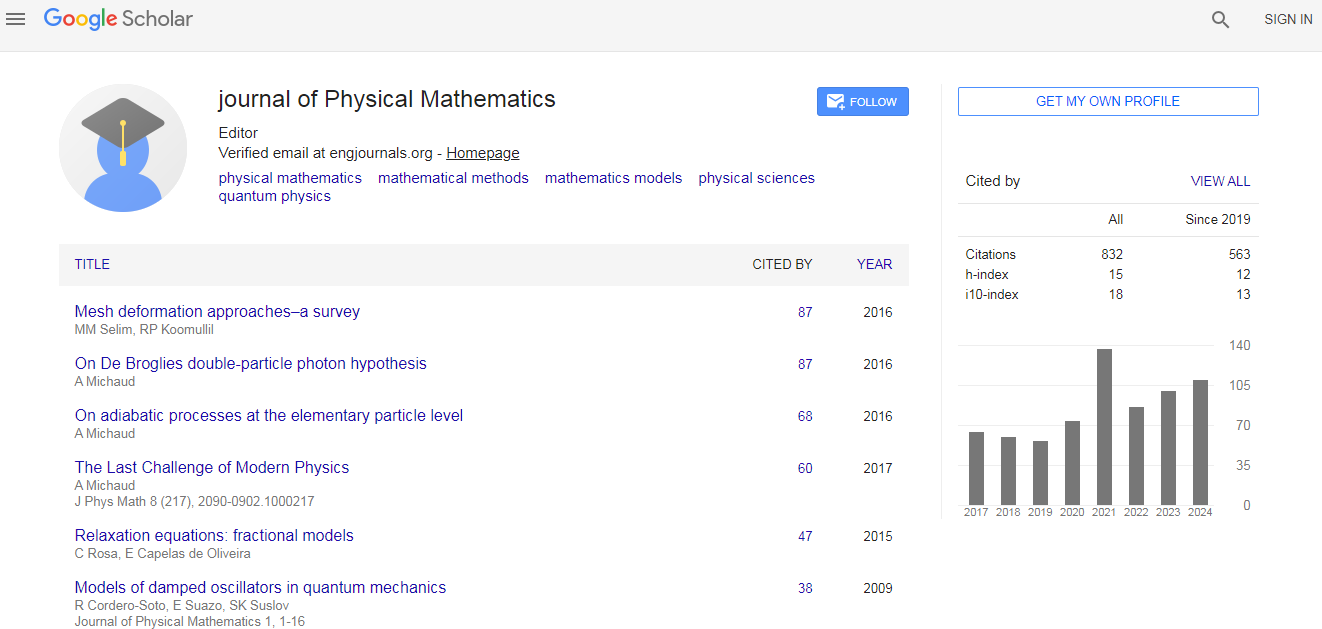
Physical Mathematics received 686 citations as per Google Scholar report