Perspective - (2025) Volume 12, Issue 4
Received: 01-Aug-2025, Manuscript No. jreac-26-185843;
Editor assigned: 04-Aug-2025, Pre QC No. P-185843;
Reviewed: 18-Aug-2025, QC No. Q-185843;
Revised: 22-Aug-2025, Manuscript No. R-185843;
Published:
29-Aug-2025
, DOI: 10.37421/2380-2391.2025.12.444
Citation: Demir, Ibrahim. ”Urban Wastewater Antibiotic Residues: Detection, Treatment, and Impact.” J Environ Anal Chem 12 (2025):444.
Copyright: © 2025 Demir I. This is an open-access article distributed under the terms of the Creative Commons Attribution License, which permits unrestricted use, distribution and reproduction in any medium, provided the original author and source are credited.
The pervasive presence of antibiotic residues in urban wastewater represents a significant environmental and public health concern, necessitating rigorous investigation into their occurrence, distribution, and removal. Early research has established the utility of advanced analytical techniques, such as liquid chromatography coupled with tandem mass spectrometry (LC-MS/MS), for the sensitive and selective detection of these contaminants in complex environmental matrices like urban wastewater [1].
This technological advancement has paved the way for comprehensive studies characterizing the types and concentrations of antibiotics found in these systems. Exploring the efficacy of various wastewater treatment processes is crucial for mitigating the environmental impact of antibiotic pollution. Advanced oxidation processes (AOPs) have emerged as promising technologies capable of degrading a wide range of organic pollutants, including antibiotic compounds, thereby reducing their ecotoxicological potential [2].
Understanding the mechanisms and effectiveness of these AOPs is vital for designing efficient treatment strategies. The development of robust and sensitive analytical methodologies remains a cornerstone of antibiotic residue monitoring in wastewater. Recent efforts have focused on creating methods for the simultaneous determination of a broad spectrum of veterinary antibiotics, addressing a critical gap in current environmental surveillance and enabling more holistic assessments of contamination [3].
Such methods are indispensable for accurate quantification and risk evaluation. Beyond the detection of antibiotic residues themselves, research is increasingly focusing on their co-occurrence with antibiotic resistance genes (ARGs) in urban wastewater. The discharge of treated or untreated wastewater can contribute to the dissemination of ARGs into receiving surface waters, posing a substantial threat to microbial ecosystems and potentially facilitating the spread of antibiotic resistance among bacterial populations [4].
This highlights a dual concern: the presence of the antibiotics and the promotion of resistance. Different wastewater treatment technologies exhibit varying efficiencies in removing specific classes of antibiotics. Comparative studies investigating the removal rates of prevalent antibiotic classes, such as macrolides, by technologies like activated sludge and membrane bioreactors are essential. These studies provide critical data for optimizing treatment plant designs and operations to maximize antibiotic removal [5].
The focus on particular antibiotic classes, such as fluoroquinolones, in urban wastewater is driven by their widespread use and potential for environmental persistence. Investigations into the occurrence, behavior, and development of specialized detection methods for these specific compounds are crucial for understanding their environmental fate and managing their associated risks [6].
Urbanization levels significantly influence the concentration and diversity of antibiotic residues found in wastewater. Comparative studies across different urban settings can elucidate how factors like population density and industrial activity shape contamination patterns, offering insights into the drivers of antibiotic pollution in diverse environments [7].
A critical aspect of addressing antibiotic pollution involves understanding their environmental fate and ecotoxicological effects. Comprehensive reviews synthesizing existing knowledge on the persistence, transformation, and potential impacts of antibiotics on aquatic ecosystems are vital for informing environmental risk assessments and guiding regulatory efforts [8].
Tertiary treatment steps, such as ozonation, offer additional capabilities for removing recalcitrant pollutants like antibiotic residues from wastewater effluents. Research into optimizing these advanced treatment processes, including parameters like ozone dosage and contact time, is essential for achieving high removal efficiencies and improving overall water quality [9].
Specific antibiotic classes, like tetracyclines, warrant dedicated investigation due to their widespread use and potential ecological risks. Comprehensive analyses of their occurrence, transformation pathways in the environment, and associated risks are critical for developing targeted management strategies and ensuring effective environmental protection [10].
The presence and levels of various antibiotic residues in urban wastewater are being meticulously investigated using advanced analytical techniques, specifically liquid chromatography coupled with tandem mass spectrometry (LC-MS/MS). This approach allows for the identification of key antibiotics, their spatial distribution within wastewater systems, and potential sources of contamination, underscoring the importance of monitoring for environmental risk assessment and wastewater treatment strategy development [1].
The efficacy of advanced oxidation processes (AOPs) in removing common antibiotic classes from treated wastewater is a subject of significant research. These studies detail the degradation pathways and identify residual transformation products, offering crucial insights into the limitations and potential of AOPs for comprehensive antibiotic removal from municipal wastewater [2].
Development and validation of sensitive LC-MS/MS methods for the simultaneous determination of a wide range of veterinary antibiotics in both raw and treated urban wastewater are critical for accurate environmental monitoring. This includes detailed method optimization, assessment of matrix effects, and determination of limits of quantification [3].
Research is also exploring the impact of urban wastewater discharge on receiving surface waters, with a specific focus on antibiotic resistance genes (ARGs) that co-occur with antibiotic residues. This work discusses the environmental implications and the potential for ARG dissemination from wastewater sources into natural aquatic environments [4].
Comparative studies are evaluating the efficiency of different wastewater treatment technologies, such as activated sludge and membrane bioreactors, in removing prevalent classes of antibiotics like macrolides from municipal wastewater. These studies provide comparative data on removal rates and identify factors influencing treatment efficacy [5].
The emerging threat posed by fluoroquinolone antibiotics in urban wastewater is under investigation, with novel findings on their persistence and potential for bioaccumulation. Concurrently, the development of highly selective LC-MS/MS methods for their detection is being advanced to better understand their environmental behavior [6].
The influence of different urbanization levels on the concentration and diversity of antibiotic residues in wastewater is being examined. These studies offer a comparative analysis across various urban settings, highlighting how factors such as population density and industrial activity affect contamination patterns [7].
A critical review of the environmental fate and ecotoxicological effects of common pharmaceutical compounds, including antibiotics, found in urban wastewater is synthesizing existing knowledge. This review covers their persistence, transformation, and potential impacts on aquatic ecosystems [8].
The effectiveness of ozonation as a tertiary treatment step for removing a broad spectrum of antibiotics from urban wastewater effluents is being explored. Research details the optimization of ozone dosage and contact time to achieve maximum removal efficiency and improve the quality of treated wastewater [9].
A comprehensive analysis of tetracycline antibiotics in urban wastewater is being conducted, focusing on their sources, transformation products, and potential ecological risks. This research aims to establish sensitive analytical methods for their accurate quantification and risk assessment [10].
This collection of research focuses on the critical issue of antibiotic residues in urban wastewater. Studies employ advanced analytical techniques like LC-MS/MS to detect and quantify various antibiotics, exploring their distribution and sources. The effectiveness of treatment technologies, including advanced oxidation processes, ozonation, activated sludge, and membrane bioreactors, in removing these residues is rigorously evaluated. Research also delves into the impact of urbanization on contamination levels, the environmental fate and ecotoxicological effects of antibiotics, and the co-occurrence and dissemination of antibiotic resistance genes. Specific antibiotic classes like fluoroquinolones and tetracyclines receive dedicated attention due to their persistence and potential risks. Overall, these studies highlight the need for robust monitoring, effective treatment strategies, and a comprehensive understanding of antibiotic pollution to protect environmental and public health.
None
None
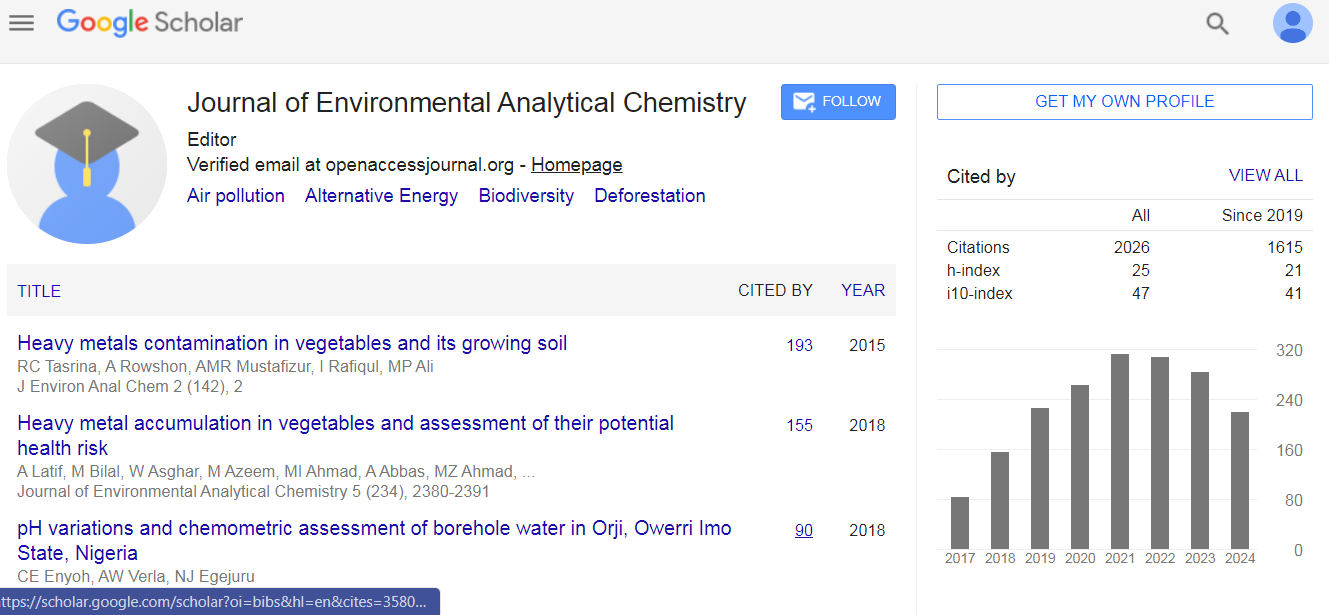
Journal of Environmental Analytical Chemistry received 1781 citations as per Google Scholar report