Opinion - (2025) Volume 16, Issue 6
Received: 01-Nov-2025, Manuscript No. hycr-25-175047;
Editor assigned: 03-Nov-2025, Pre QC No. P-175047;
Reviewed: 17-Nov-2025, QC No. Q-175047;
Revised: 24-Nov-2025, Manuscript No. R-175047;
Published:
01-Dec-2025
, DOI: 10.37421/2157-7587.2025.16.629
Citation: Othmani, Fatima Zahra. ”Urban Stormwater: Challenges, Solutions, and Policy.” Hydrol Current Res 16 (2025):629.
Copyright: © 2025 Othmani Z. Fatima This is an open-access article distributed under the terms of the Creative Commons Attribution License, which permits unrestricted use,
distribution and reproduction in any medium, provided the original author and source are credited.
The effective management of urban stormwater is a complex and multifaceted challenge, increasingly critical due to urbanization and climate change impacts. This compilation of reviews addresses various dimensions of this global issue, from the efficacy of specific infrastructure types to overarching policy frameworks. One significant area of focus is green infrastructure (GI), particularly its performance in challenging environments. A comprehensive review highlights the effectiveness of GI in managing stormwater in cold climates, noting how freeze-thaw cycles, snowmelt, and frozen soils profoundly impact its performance [1].
Further discussions involve specific treatment technologies designed to enhance stormwater quality. For instance, a review synthesizes current knowledge on using biochar-amended bioretention systems for treating urban stormwater runoff. It explores mechanisms by which biochar improves pollutant removal, such as heavy metals, nutrients, and organic pollutants, providing insights into optimizing these systems for better stormwater quality management [2].
Accurate assessment of stormwater pollution is foundational to effective management. A paper reviews the state of urban stormwater quality monitoring, identifying current challenges like sampling representativeness, sensor limitations, and data interpretation complexities. It also discusses recent advancements, including integrating smart technologies and advanced analytical methods, which promise more accurate and comprehensive assessments [3].
The broader environmental context, particularly climate change, significantly influences stormwater dynamics. One review examines the pervasive impacts of climate change on urban stormwater runoff and associated flood risks globally. It synthesizes findings from studies on altered precipitation patterns and increased flood frequency, offering critical insights into future perspectives for urban planning and adaptation strategies to mitigate these growing threats [4].
Sustainable Drainage Systems (SuDS) represent a crucial approach to urban water management. Research assesses the effectiveness of SuDS in enhancing urban water quality, drawing on global studies. It evaluates how various SuDS components, like rain gardens and permeable pavements, contribute to reducing pollutant loads and improving the ecological health of receiving waters, emphasizing design considerations for optimal pollutant removal [5].
Beyond managing runoff, the potential for stormwater as a resource is also explored. A global review comprehensively surveys technologies and applications for stormwater harvesting and reuse. It details various collection, treatment, and storage methods, assessing their suitability for different end-uses, such as irrigation and non-potable urban demands. This highlights stormwaterâ??s value as an alternative water source and identifies challenges for wider implementation [6].
Emerging pollutants in urban stormwater demand urgent attention. One paper investigates microplastic pollution in urban stormwater runoff, outlining their diverse sources, such as tire wear and road markings, and their pathways into aquatic environments. It also explores various mitigation strategies, from source reduction to advanced treatment technologies, stressing the urgency of addressing this environmental contaminant [7].
Effective implementation of stormwater solutions requires robust governance. A systematic review delves into the governance and policy frameworks for stormwater management and green infrastructure implementation. It examines varying approaches taken by different jurisdictions, identifies common barriers to effective adoption, and offers recommendations for developing more coherent and integrated policy instruments to promote sustainable urban water management [8].
Practical strategies for pollution control are also a vital component. The literature summarizes best management practices (BMPs) for controlling pollution in urban stormwater runoff. It evaluates the performance of various structural and non-structural BMPs, such as infiltration trenches and public education campaigns, in reducing contaminants like sediment, nutrients, and heavy metals, offering practical guidance for urban stormwater engineers and planners [9].
Finally, the economic viability of sustainable solutions is often a determinant for adoption. A paper reviews economic tools and methodologies used to assess the benefits and costs of urban green infrastructure (GI) for stormwater management. It examines various valuation techniques, including cost-benefit analysis and contingent valuation, providing insights into how the multiple co-benefits of GI can be quantified to support investment decisions and policy development [10].
Collectively, these reviews underscore the dynamic nature of stormwater challenges and the multidisciplinary approaches required for effective, sustainable urban water management worldwide.
Urban stormwater management presents a complex array of challenges and opportunities, spanning technological advancements, environmental protection, and policy development. A key area of focus involves Green Infrastructure (GI), which is extensively reviewed for its effectiveness in managing stormwater. Notably, its performance in cold climates is thoroughly examined, highlighting how environmental factors such as freeze-thaw cycles, snowmelt, and frozen soils significantly impact GI functionality [1]. Optimizing GI in these challenging regions requires specific design and maintenance adjustments. Furthermore, the broader implementation of GI necessitates robust governance and policy frameworks. A systematic review investigates varying approaches across jurisdictions, identifying common barriers to effective adoption and proposing recommendations for more coherent, integrated policy instruments to advance sustainable urban water management [8]. The economic dimension is also critical; methodologies and tools for assessing the benefits and costs of urban GI for stormwater management are explored. This includes various valuation techniques, like cost-benefit analysis, to quantify GI's multiple co-benefits and inform investment and policy decisions [10].
Advancements in treatment technologies and management practices are central to improving urban stormwater quality. Biochar-amended bioretention systems, for instance, are reviewed for their efficacy in treating urban stormwater runoff. This synthesis delves into the mechanisms by which biochar enhances the removal of pollutants, including heavy metals, nutrients, and organic contaminants, offering strategies for system optimization [2]. Similarly, Sustainable Drainage Systems (SuDS) are globally recognized for their role in enhancing urban water quality. Studies assess how different SuDS components, such as rain gardens and permeable pavements, contribute to reducing pollutant loads and fostering better ecological health in receiving waters, underscoring important design considerations for pollutant removal [5]. Complementing these engineered solutions, a comprehensive review of best management practices (BMPs) for controlling urban stormwater runoff pollution evaluates both structural and non-structural approaches. This provides practical guidance for engineers and planners on reducing contaminants like sediment, nutrients, and heavy metals [9].
Monitoring stormwater quality is fundamental to understanding pollution dynamics and assessing the effectiveness of management strategies. The current state of urban stormwater quality monitoring is reviewed, exposing significant challenges related to sampling representativeness, sensor capabilities, and the complexities of data interpretation [3]. However, the paper also highlights promising advancements, including the integration of smart technologies and sophisticated analytical methods, which are set to improve the accuracy and comprehensiveness of stormwater pollution assessments. An urgent environmental concern is microplastic pollution in urban stormwater runoff, with a detailed investigation into their diverse originsâ??such as tire wear and road markingsâ??and their pathways into aquatic ecosystems. This review also addresses various mitigation strategies, ranging from source reduction to advanced treatment technologies, emphasizing the critical need to tackle this emerging contaminant [7].
The pervasive influence of global climate change on urban stormwater runoff and associated flood risks is a major consideration for future urban planning. A review synthesizes global findings on altered precipitation patterns and increased flood frequency, offering crucial insights for developing adaptation strategies to mitigate these growing threats [4]. Understanding and preparing for these climatic shifts are paramount for resilient urban environments.
Finally, stormwater is increasingly viewed not merely as a waste product but as a valuable resource. A global review of stormwater harvesting and reuse technologies and applications outlines various methods for collection, treatment, and storage. It assesses their suitability for different end-uses, such as irrigation and non-potable demands, thereby emphasizing stormwaterâ??s potential as a vital alternative water source and identifying key challenges for broader implementation [6]. These diverse approaches collectively underline the evolving and interconnected nature of urban stormwater management.
This collection of reviews explores various facets of urban stormwater management, highlighting both existing challenges and innovative solutions. A significant focus is placed on Green Infrastructure (GI), with studies examining its performance in challenging cold climates, emphasizing the need for specific design and maintenance adjustments to handle freeze-thaw cycles and snowmelt. Economic tools are also discussed for assessing the benefits and costs of GI, providing insights into quantifying its multiple co-benefits to inform investment decisions. Beyond GI, research delves into specific treatment technologies, such as biochar-amended bioretention systems, which show promise in enhancing pollutant removal for urban stormwater runoff. The broader issue of urban water quality is addressed through a review of Sustainable Drainage Systems (SuDS) and their effectiveness in reducing pollutant loads. Moreover, the critical environmental concern of microplastic pollution in stormwater is investigated, detailing its sources, pathways, and mitigation strategies. The impact of global climate change on urban stormwater runoff and associated flood risks is a key theme, necessitating a deeper understanding of altered precipitation patterns and the development of robust adaptation strategies. Effective stormwater management also relies on advanced monitoring, with discussions covering current challenges in sampling and sensor limitations, alongside advancements like smart technologies. Furthermore, best management practices (BMPs) for pollution control are evaluated, offering practical guidance for urban planners. Lastly, the governance and policy frameworks crucial for implementing these sustainable solutions are systematically reviewed, identifying barriers and proposing integrated policy instruments for urban water management.
None
None
Indexed at, Google Scholar, Crossref
Indexed at, Google Scholar, Crossref
Indexed at, Google Scholar, Crossref
Indexed at, Google Scholar, Crossref
Indexed at, Google Scholar, Crossref
Indexed at, Google Scholar, Crossref
Indexed at, Google Scholar, Crossref
Indexed at, Google Scholar, Crossref
Indexed at, Google Scholar, Crossref
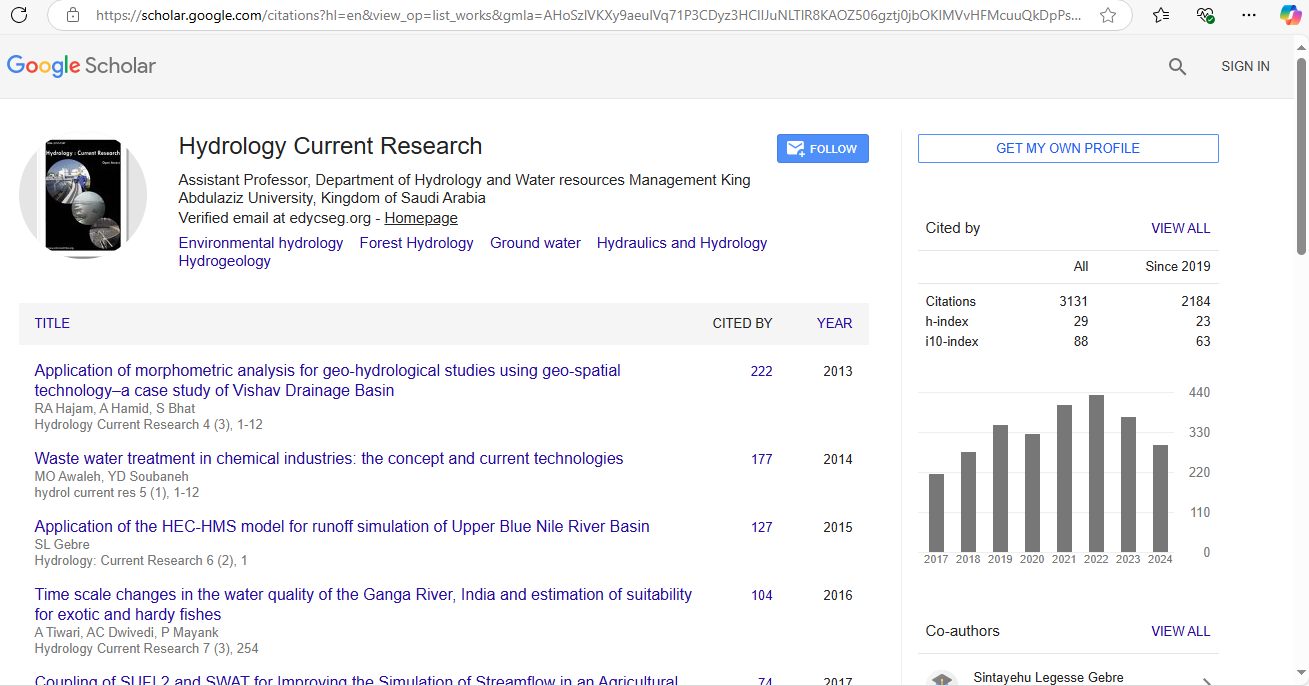
Hydrology: Current Research received 2843 citations as per Google Scholar report