Short Communication - (2025) Volume 13, Issue 4
Received: 02-Aug-2025, Manuscript No. JGPR-26-190221;
Editor assigned: 04-Aug-2025, Pre QC No. P-190221;
Reviewed: 18-Aug-2025, QC No. Q-190221;
Revised: 25-Aug-2025, Manuscript No. R-190221;
Published:
30-Aug-2025
, DOI: 10.37421/2329-9126.2025.13.631
Citation: Papadopoulos, George. ”Urban Primary Care Access: Barriers and Solutions.” J Gen Pract 13 (2025):631.
Copyright: © 2025 Papadopoulos G. This is an open-access article distributed under the terms of the Creative Commons Attribution License, which permits unrestricted use, distribution and reproduction in any medium, provided the original author and source are credited.
Access to primary healthcare services in urban environments is a multifaceted challenge, significantly influenced by a complex interplay of socioeconomic disparities, geographical obstacles within cities, and the varied availability of healthcare providers. Research consistently demonstrates that transportation difficulties and the pervasive digital divide pose substantial impediments to accessing care for vulnerable urban populations, highlighting the need for targeted interventions [1].
The effectiveness of primary care models in urban settings is intrinsically tied to their capacity to adapt and respond to the diverse and often complex needs of the patient population. Studies have identified patient-centered medical homes and team-based care approaches as promising strategies for enhancing health outcomes and patient satisfaction, though equitable distribution remains a significant hurdle [2].
Digital health technologies, while presenting opportunities to improve primary healthcare access in urban areas, concurrently introduce new challenges. The digital divide, defined by unequal access to technology and varying levels of digital literacy, can inadvertently exclude substantial segments of the urban population from potential benefits, necessitating inclusive digital strategies [3].
Socioeconomic factors are recognized as fundamental determinants that profoundly shape the accessibility of primary healthcare within urban locales. Lower income levels, periods of unemployment, and unstable housing situations are consistently correlated with diminished access to essential health services, underscoring the critical importance of addressing these underlying social determinants of health [4].
Urban primary care facilities frequently contend with issues of overcrowding and limited appointment availability, particularly in neighborhoods that are already underserved by healthcare resources. Innovative solutions such as revised scheduling systems and the expansion of walk-in clinic models are being actively explored to alleviate these pressing access bottlenecks [5].
The spatial distribution of primary healthcare providers across urban centers plays a crucial role in determining overall accessibility. Numerous studies indicate a tendency for services to cluster in more affluent areas, consequently leaving lower-income neighborhoods with significantly fewer options and reduced access to care [6].
Culturally competent care represents a vital component for ensuring equitable access to primary healthcare for diverse urban populations. Language barriers and a lack of understanding regarding distinct cultural health beliefs can foster mistrust and lead to the underutilization of available services, emphasizing the need for cultural humility training [7].
Transportation continues to be a significant barrier to primary healthcare access for a considerable number of urban residents, especially for the elderly, individuals with disabilities, and those residing in the peripheral or outer areas of the city. The cost and reliability of public transport, coupled with the absence of personal vehicles, create substantial challenges for consistent access [8].
The integration of mental health services into primary healthcare settings within urban areas is a growing trend, aiming to enhance access to timely and comprehensive care for individuals experiencing mental health concerns. This approach seeks to reduce stigma and improve overall well-being, although challenges in workforce training and resource allocation persist [9].
Policy interventions are instrumental in shaping the landscape of primary healthcare accessibility within urban environments. Governmental initiatives designed to foster equitable resource distribution, support innovative care delivery models, and proactively address the social determinants of health are fundamental to achieving broad access and improved health outcomes [10].
The complex issue of urban primary healthcare accessibility is significantly shaped by socioeconomic disparities, geographical barriers within cities, and the availability of diverse service providers. Research indicates that transportation challenges and the digital divide can hinder access for vulnerable urban populations, emphasizing the need for integrated solutions. Furthermore, the incorporation of specialized services within general practice settings is vital for addressing the comprehensive health requirements of city dwellers [1].
The effectiveness of primary care models in urban areas is directly correlated with their ability to cater to the varied needs of patients. Patient-centered medical homes and team-based care approaches have demonstrated potential in improving outcomes and patient satisfaction. However, ensuring an equitable distribution of these services across different urban neighborhoods remains a persistent challenge, often magnifying existing health inequalities [2].
Digital health technologies offer promising avenues for enhancing primary healthcare access in cities, but they also introduce new obstacles. The digital divide, characterized by unequal access to technology and digital literacy, can exclude large segments of the urban population. Successful implementation necessitates careful attention to equity and the development of inclusive digital strategies [3].
Socioeconomic factors serve as fundamental determinants of primary healthcare access in urban settings. Lower income levels, unemployment, and precarious housing are consistently linked to reduced access to essential services. Addressing these underlying social determinants of health is as critical as improving the healthcare infrastructure itself [4].
Urban primary care facilities often struggle with overcrowding and limited appointment availability, particularly in underserved areas. Innovative scheduling systems and the expansion of walk-in clinics are being explored as potential remedies to these issues. Robust patient feedback mechanisms are also essential for identifying and addressing specific access bottlenecks [5].
The geographical distribution of primary healthcare providers within urban centers has a significant impact on accessibility. Studies reveal a concentration of services in affluent neighborhoods, leaving lower-income areas with fewer choices. Policies aimed at incentivizing providers to practice in underserved urban areas are crucial for achieving equitable access [6].
Culturally competent care is a critical element in ensuring primary healthcare accessibility for diverse urban populations. Language barriers and a lack of understanding of cultural health beliefs can lead to mistrust and the underutilization of services. Training healthcare professionals in cultural humility and increasing staff diversity are key strategies for improvement [7].
Transportation continues to be a substantial barrier to primary healthcare access for many urban residents, particularly the elderly, disabled, and those in peripheral areas. The cost and availability of public transport, or the lack of personal vehicles, create significant challenges. Exploring partnerships with transportation services or community-based transport solutions is essential [8].
The integration of mental health services into urban primary care settings is an emerging trend aimed at improving access to timely and comprehensive care for individuals with mental health challenges. This approach seeks to reduce stigma and enhance overall well-being, though workforce training and resource allocation remain important considerations [9].
Policy interventions play a vital role in shaping primary healthcare accessibility in urban environments. Government initiatives that promote equitable resource distribution, support innovative care models, and address social determinants of health are fundamental. Evaluating the impact of these policies is crucial for ongoing improvement and evidence-based decision-making [10].
Urban primary healthcare accessibility is a complex issue influenced by socioeconomic disparities, geographical barriers, and service provider availability. Transportation and the digital divide disproportionately affect vulnerable populations. Patient-centered models show promise but face challenges in equitable distribution. Digital health offers potential but requires inclusive strategies to avoid exacerbating the digital divide. Socioeconomic factors are fundamental determinants of access. Overcrowding and limited appointments plague urban clinics, necessitating innovative solutions. Uneven geographical distribution of providers leads to service deserts in underserved areas. Culturally competent care, addressing language barriers and cultural beliefs, is essential. Transportation remains a significant barrier for many, especially the elderly and disabled. Integrating mental health services into primary care is a growing trend. Effective policy interventions are crucial for equitable access and addressing social determinants of health.
None
None
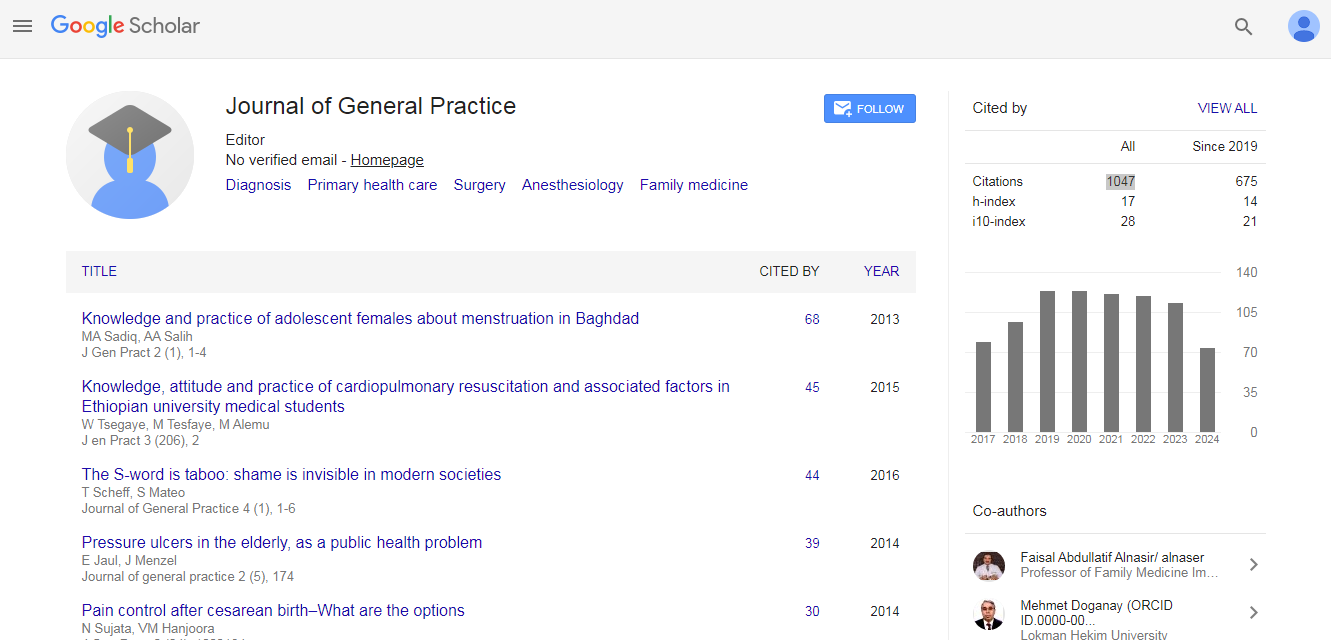
Journal of General Practice received 1047 citations as per Google Scholar report