Short Communication - (2025) Volume 15, Issue 6
Received: 02-Dec-2025, Manuscript No. jeat-26-188657;
Editor assigned: 04-Dec-2025, Pre QC No. P-188657;
Reviewed: 18-Dec-2025, QC No. Q-188657;
Revised: 23-Dec-2025, Manuscript No. R-188657;
Published:
30-Dec-2025
, DOI: 10.37421/2161-0525.2025.15.877
Citation: Siddiqui, Ayesha. ”Urban Ecosystems: Toxic Pollutant
Contamination and Control.” J Environ Anal Toxicol 15 (2025):877.
Copyright: © 2025 Siddiqui A. This is an open-access article distributed under the terms of the Creative Commons Attribution License, which permits unrestricted use,
distribution and reproduction in any medium, provided the original author and source are credited.
This article investigates the critical role of environmental monitoring in understanding the distribution and impact of toxic pollutants within urban ecosystems. It highlights advancements in analytical techniques for detecting a wide range of contaminants, including heavy metals, persistent organic pollutants (POPs), and emerging contaminants like microplastics and pharmaceuticals. The research emphasizes the interconnectedness of urban environments with surrounding natural systems and the subsequent risks to both ecological health and human well-being. It also discusses the importance of developing integrated monitoring strategies that combine field measurements, laboratory analysis, and modeling to inform policy and mitigation efforts [1].
This study focuses on the accumulation of heavy metals, such as lead, cadmium, and mercury, in various urban compartments, including soil, air, and biota. It presents a comprehensive assessment of pollution sources, transport pathways, and the potential for biomagnification within urban food webs. The research underscores the long-term ecological consequences and human health risks associated with chronic exposure to these persistent pollutants, advocating for stricter regulatory frameworks and effective remediation strategies [2].
The increasing presence of pharmaceuticals and personal care products (PPCPs) in urban environments is examined, focusing on their transformation products and ecological effects. This research details advanced analytical techniques used to detect and quantify these trace contaminants in wastewater, surface water, and drinking water. It discusses the challenges in assessing the ecotoxicological impact of complex mixtures of PPCPs and the need for innovative treatment technologies to remove them from water sources [3].
This paper addresses the pervasive issue of microplastic pollution in urban ecosystems, detailing their sources, distribution patterns, and interaction with other pollutants. The research outlines methodologies for sampling and analyzing microplastics in various environmental matrices, including air, water, and soil. It highlights the potential risks to urban biodiversity and the implications for ecosystem services, calling for comprehensive strategies to reduce microplastic generation and facilitate their removal from the environment [4].
This research explores the atmospheric transport and deposition of toxic pollutants, such as polycyclic aromatic hydrocarbons (PAHs) and volatile organic compounds (VOCs), in urban air. It presents findings on the spatial and temporal variations of these pollutants and their contribution to urban air quality issues. The study emphasizes the importance of continuous air quality monitoring and the development of emission control strategies to protect public health and mitigate the formation of secondary pollutants [5].
The article examines the impact of urban green spaces on mitigating the effects of toxic pollutants. It investigates how plants and soil in urban parks and gardens can absorb, degrade, or immobilize certain contaminants. The research highlights the dual role of green infrastructure in improving air and water quality while also serving as indicators of pollution levels, advocating for their strategic integration into urban planning for enhanced environmental resilience [6].
This study evaluates the efficacy of different remediation technologies for cleaning up contaminated urban soils. It provides an in-depth comparison of physical, chemical, and biological methods, assessing their effectiveness, cost-efficiency, and potential for secondary environmental impacts. The research emphasizes the need for site-specific approaches and the integration of multiple technologies to address complex contamination scenarios in urban areas [7].
This paper examines the bioaccumulation and biomagnification of persistent organic pollutants (POPs) in urban aquatic ecosystems. It presents data on the concentrations of POPs in various trophic levels of urban rivers and lakes, identifying potential risks to aquatic life and human consumers. The study highlights the persistence of these compounds and the need for effective strategies to reduce their input into aquatic environments [8].
This research introduces novel sensor technologies for real-time environmental monitoring of toxic pollutants in urban settings. It discusses the development and application of portable and low-cost sensors for detecting contaminants like heavy metals and organic compounds in air and water. The study emphasizes the potential of these technologies to provide continuous data streams, enabling rapid response to pollution events and more effective management of urban environmental quality [9].
This study investigates the human health risks associated with exposure to toxic pollutants in urban ecosystems, focusing on children's vulnerability. It links pollutant levels in air, water, and soil to adverse health outcomes, including respiratory illnesses, developmental disorders, and increased susceptibility to chronic diseases. The research stresses the urgent need for integrated urban planning and robust pollution control measures to safeguard public health, particularly for vulnerable populations [10].
Environmental monitoring is crucial for understanding the distribution and impact of toxic pollutants within urban ecosystems. Advancements in analytical techniques have enabled the detection of a wide array of contaminants, from heavy metals and POPs to emerging pollutants like microplastics and pharmaceuticals. The interconnectedness of urban environments with their surroundings poses risks to ecological health and human well-being, necessitating integrated monitoring strategies that combine field measurements, laboratory analysis, and modeling to inform policy [1].
Heavy metal contamination, including lead, cadmium, and mercury, is a significant concern in urban areas, affecting soil, air, and biota. Studies have assessed pollution sources, transport pathways, and biomagnification potential within urban food webs, highlighting long-term ecological consequences and human health risks. This underscores the need for stricter regulatory frameworks and effective remediation strategies [2].
The presence of pharmaceuticals and personal care products (PPCPs) in urban environments, along with their transformation products, is a growing issue. Advanced analytical techniques are employed to detect these trace contaminants in various water sources. Challenges remain in assessing the ecotoxicological impact of complex PPCP mixtures and developing effective treatment technologies for their removal [3].
Microplastic pollution is pervasive in urban ecosystems, with research detailing its sources, distribution, and interactions with other pollutants. Methodologies for sampling and analyzing microplastics in diverse environmental matrices are being developed. The potential risks to urban biodiversity and ecosystem services necessitate comprehensive strategies to reduce microplastic generation and facilitate their removal [4].
Atmospheric transport and deposition of pollutants like PAHs and VOCs significantly impact urban air quality. Studies are investigating spatial and temporal variations and their contribution to air quality issues, emphasizing the importance of continuous monitoring and emission control strategies to protect public health and mitigate secondary pollutant formation [5].
Urban green spaces play a vital role in mitigating the effects of toxic pollutants. Plants and soil in these areas can absorb, degrade, or immobilize contaminants, improving air and water quality. Green infrastructure also serves as an indicator of pollution levels, highlighting its strategic integration into urban planning for enhanced environmental resilience [6].
Evaluating remediation technologies for contaminated urban soils is essential. Comparative assessments of physical, chemical, and biological methods highlight their effectiveness, cost-efficiency, and potential environmental impacts. Site-specific approaches and the integration of multiple technologies are crucial for addressing complex contamination scenarios [7].
Bioaccumulation and biomagnification of POPs in urban aquatic ecosystems are significant concerns. Research on POP concentrations in various trophic levels of urban water bodies identifies risks to aquatic life and human consumers, emphasizing the need for strategies to reduce pollutant input into these environments [8].
Novel sensor technologies are being developed for real-time monitoring of urban environmental pollutants. Portable and low-cost sensors for detecting heavy metals and organic compounds in air and water offer continuous data streams, enabling rapid response to pollution events and improved environmental quality management [9].
Human health risks associated with urban pollutant exposure, particularly for vulnerable populations like children, are a critical focus. Links between pollutant levels and adverse health outcomes, such as respiratory illnesses and developmental disorders, highlight the urgent need for integrated urban planning and robust pollution control measures to safeguard public health [10].
This compilation of research highlights the multifaceted issue of toxic pollutant contamination in urban ecosystems. It details advancements in analytical techniques for detecting a wide range of contaminants, including heavy metals, persistent organic pollutants, pharmaceuticals, microplastics, and atmospheric pollutants like PAHs and VOCs. The studies explore the sources, distribution, transport, and ecological risks associated with these pollutants, as well as their impact on human health, with a particular focus on vulnerable populations. The research also examines the role of urban green spaces in mitigation, evaluates various remediation technologies for contaminated soils, and introduces novel sensor technologies for real-time monitoring. The overarching theme is the critical need for integrated monitoring strategies, robust pollution control measures, and effective urban planning to safeguard environmental health and public well-being.
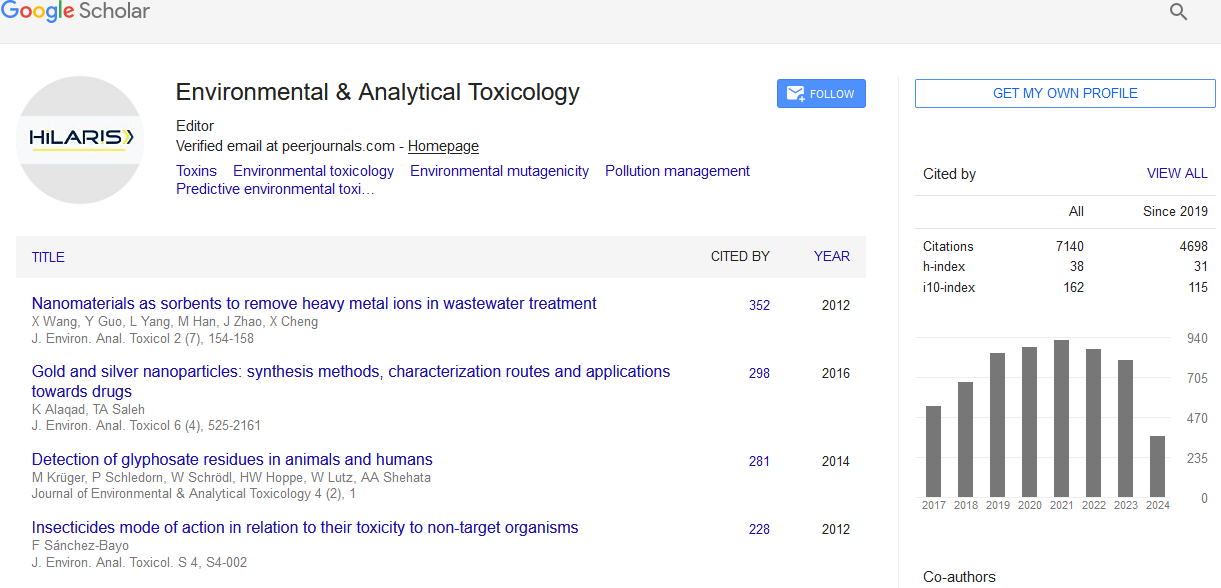
Environmental & Analytical Toxicology received 6818 citations as per Google Scholar report