Short Communication - (2025) Volume 12, Issue 3
Received: 01-Jun-2025, Manuscript No. jreac-26-185790;
Editor assigned: 03-Jun-2025, Pre QC No. P-185790;
Reviewed: 17-Jun-2025, QC No. Q-185790;
Revised: 23-Jun-2025, Manuscript No. R-185790;
Published:
30-Jun-2025
, DOI: 10.37421/2380-2391.2025.12.428
Citation: Santos, Miguel. ”Urban Air PAHs: Sources, Impacts, and Solutions.” J Environ Anal Chem 12 (2025):428.
Copyright: © 2025 Santos M. This is an open-access article distributed under the terms of the Creative Commons Attribution License, which permits unrestricted use, distribution and reproduction in any medium, provided the original author and source are credited.
The investigation into Polycyclic Aromatic Hydrocarbons (PAHs) in urban air particulates has become a critical area of environmental science due to their pervasive nature and significant health implications. These compounds, primarily formed from incomplete combustion of organic materials, are consistently detected in atmospheric aerosols, posing a threat to public health and ecosystems. Understanding their sources, concentrations, and distribution patterns is paramount for effective air quality management and the development of targeted mitigation strategies. In Porto, Portugal, a detailed study was conducted to determine the concentration and sources of PAHs in urban air particulates. Utilizing advanced analytical chemistry techniques, the research revealed substantial PAH levels, pointing to significant contributions from both vehicular traffic and industrial emissions. These findings are crucial for gaining a comprehensive understanding of urban air quality and assessing associated public health risks [1].
To address the challenges in identifying and quantifying these ubiquitous pollutants, a comprehensive review of analytical methods for detecting PAHs in airborne particulate matter has been presented. This review highlights recent advancements in chromatography and mass spectrometry, emphasizing their pivotal role in the identification and quantification of a wide array of PAH compounds. Such advancements are indispensable for informing and refining environmental monitoring strategies [2].
Furthermore, research into the spatial and temporal variations of PAHs within urban aerosols of major European cities has provided valuable insights. This research identifies key emission sources and critically assesses the influence of meteorological conditions on PAH distribution. The data generated is essential for robust risk assessment and informed urban planning decisions [3].
The direct health implications of exposure to PAHs adsorbed on fine particulate matter are of significant concern. Studies have rigorously examined the carcinogenic potential of detected PAH mixtures, underscoring the urgent need for stricter air quality regulations to mitigate public health risks, particularly in densely populated urban environments [4].
In pursuit of more precise environmental monitoring, a novel and highly sensitive method has been introduced for the simultaneous determination of a broad spectrum of PAHs in airborne particulate matter. This method employs high-resolution gas chromatography-tandem mass spectrometry, offering significantly improved detection limits crucial for accurate environmental assessments [5].
Another crucial aspect of PAH research involves evaluating the impact of different urban land use types on PAH concentrations in airborne particles. Studies have consistently found that areas characterized by high traffic density and substantial industrial activity exhibit markedly higher PAH levels, emphasizing the critical role of urban planning in effective air quality management [6].
The seasonal dynamics of PAHs in urban air particulates and their correlation with specific emission sources are also vital for a holistic understanding. Findings often indicate higher concentrations during colder months, attributable to increased residential heating and greater atmospheric stability, thereby providing crucial insights into temporal exposure patterns [7].
Methodological advancements in sampling techniques are equally important for accurate PAH analysis. A comparative study of different sampling methods for collecting airborne particulate matter for PAH analysis has been conducted. This research discusses the efficiency and suitability of various methods, including filter-based sampling and active/passive samplers, for comprehensive PAH characterization [8].
Finally, research focusing on the identification and quantification of specific high-molecular-weight PAHs in urban air, often linked to incomplete combustion processes, contributes to a deeper understanding of emission source contributions. These include sources such as traffic and biomass burning, providing granular data for source apportionment [9].
The concentration and sources of Polycyclic Aromatic Hydrocarbons (PAHs) in urban air particulates collected in Porto, Portugal, were thoroughly investigated using advanced analytical chemistry techniques. The findings clearly indicated significant PAH levels, suggesting substantial contributions from both vehicular traffic and industrial emissions. This understanding is fundamental for assessing urban air quality and the associated public health risks [1].
A comprehensive review has been conducted to detail the analytical methods employed for the detection of PAHs in airborne particulate matter. This review highlights significant advancements in chromatographic and mass spectrometric techniques, emphasizing their vital role in the precise identification and quantification of diverse PAH compounds, which directly informs the development of effective environmental monitoring strategies [2].
The spatio-temporal variations of PAHs within the urban aerosols of a major European city have been explored in detail. This research successfully identified key emission sources and meticulously assessed the impact of prevailing meteorological conditions on PAH distribution. The data procured is indispensable for conducting accurate risk assessments and for guiding strategic urban planning initiatives [3].
Significant focus has been placed on the health implications arising from exposure to PAHs that are adsorbed onto fine particulate matter. The carcinogenic potential of various PAH mixtures detected has been rigorously examined, thereby reinforcing the critical necessity for the implementation of more stringent air quality regulations to effectively mitigate public health risks within urban settings [4].
Introducing a novel and highly sensitive analytical approach, this work presents a method for the simultaneous determination of a wide array of PAHs present in airborne particulate matter. Employing high-resolution gas chromatography-tandem mass spectrometry, this technique offers superior detection limits, which are critically important for achieving accurate and reliable environmental monitoring outcomes [5].
The influence exerted by different urban land use patterns on the concentration of PAHs found in airborne particles has been systematically evaluated. The study revealed that areas exhibiting high traffic density and significant industrial activity are associated with substantially elevated PAH levels, underscoring the profound importance of thoughtful urban planning in the effective management of air quality [6].
Investigating the seasonal dynamics of PAHs in urban air particulates, this article examines their correlation with various emission sources. The results consistently show higher PAH concentrations during the colder months, largely attributed to increased residential heating activities and periods of greater atmospheric stability, thus offering critical insights into temporal exposure patterns [7].
A comparative analysis of various sampling techniques designed for the collection of airborne particulate matter for subsequent PAH analysis has been undertaken. The research deliberates on the efficiency and appropriateness of diverse methods, including filter-based sampling and both active and passive samplers, for achieving a comprehensive characterization of PAHs [8].
This research centers on the precise identification and quantification of specific high-molecular-weight PAHs commonly found in urban air, which are predominantly linked to incomplete combustion processes. The outcomes of this study significantly enhance the understanding of the contributions made by specific emission sources, such as vehicular traffic and biomass burning, to overall air pollution [9].
An evaluation of the efficacy of distinct extraction techniques for isolating PAHs from airborne particulate matter has been conducted. This study compares various methodologies, including sonication, Soxhlet extraction, and accelerated solvent extraction, providing valuable guidance on selecting optimal sample preparation procedures to ensure the accuracy of subsequent analyses [10].
This collection of research highlights the critical issue of Polycyclic Aromatic Hydrocarbons (PAHs) in urban air. Studies detail their concentrations, sources such as vehicular traffic and industrial emissions, and the impact of urban land use on their prevalence. Advanced analytical techniques like chromatography and mass spectrometry are crucial for accurate detection, with ongoing development of more sensitive methods. The research also addresses the spatio-temporal distribution of PAHs, seasonal variations, and the health risks associated with exposure, emphasizing the need for stricter regulations and effective urban planning to improve air quality.
None
None
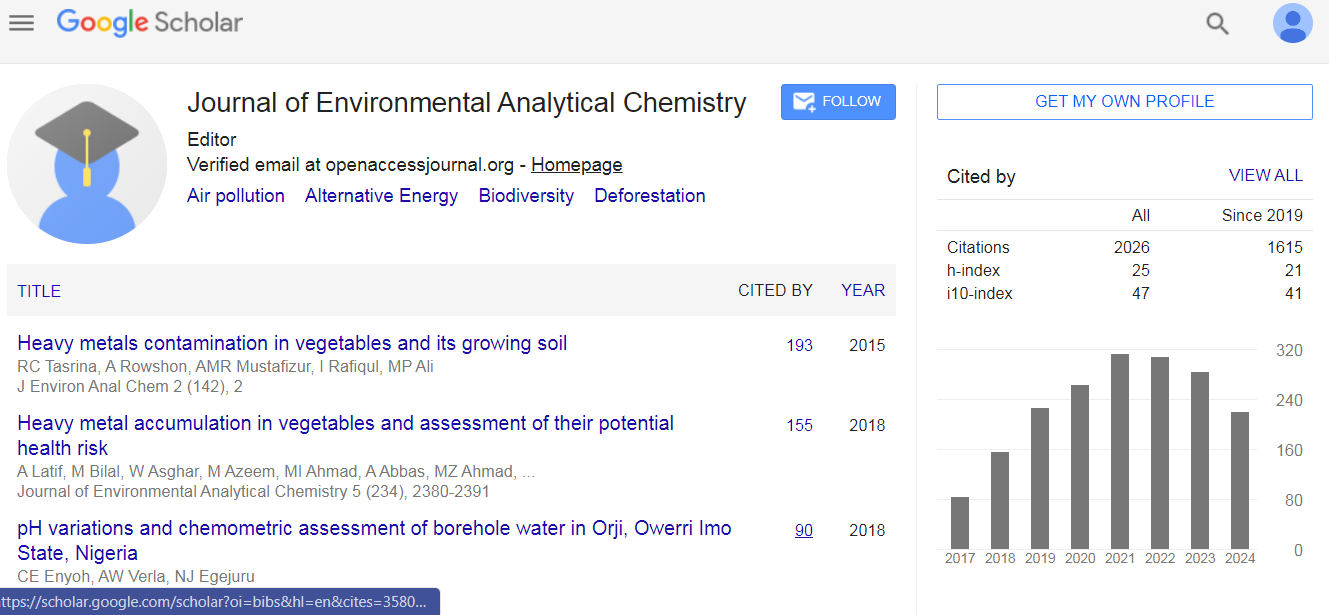
Journal of Environmental Analytical Chemistry received 1781 citations as per Google Scholar report