Commentary - (127) Volume 9, Issue 6
Received: 01-Nov-2025, Manuscript No. jgdr-26-179218;
Editor assigned: 03-Nov-2025, Pre QC No. P-179218;
Reviewed: 17-Nov-2025, QC No. Q-179218;
Revised: 24-Nov-2025, Manuscript No. R-179218;
Published:
29-Nov-2025
, DOI: 10.37421/2684-6039.2025.09.298
Citation: White, Narelle. ”Unraveling the Genome: Health, Disease and Future Applications.” J Genet DNA Res 09 (2025):298.
Copyright: © 2025 White N. This is an open-access article distributed under the terms of the Creative Commons Attribution License, which permits unrestricted use, distribution and reproduction in any medium, provided the original author and source are credited.
The human genome, a vast and intricate blueprint, continues to be a central area of scientific inquiry for understanding health and disease [1].
Functional annotation efforts are paramount for deciphering the roles of non-coding regions and genetic variants, which are increasingly recognized as significant contributors to various health conditions [1].
Significant advancements in sequencing technologies and computational biology are accelerating our capacity to assign functional roles to genomic elements, thereby paving the way for the development of personalized medicine and the identification of novel therapeutic targets [1].
Understanding the functional consequences of genetic variants is particularly crucial, especially for those located within regulatory regions such as enhancers and promoters [2].
Foundational datasets from projects like ENCODE and Roadmap Epigenomics have been instrumental, but integrating these with population-scale genomic data is essential for accurately pinpointing disease-associated variants and elucidating their underlying mechanisms [2].
This annotation process provides a much clearer understanding of how genetic variations influence cellular functions and susceptibility to diseases [2].
Non-coding RNAs are recognized for their substantial influence on gene regulation and fundamental cellular processes [3].
The functional annotation of these non-coding elements represents an active and evolving area of research, with ongoing progress in transcriptomics and bioinformatics enabling the identification and detailed characterization of novel long non-coding RNAs (lncRNAs) and microRNAs (miRNAs) [3].
These RNA molecules are implicated in a broad spectrum of biological functions and diseases, making their thorough annotation critical for a comprehensive grasp of the genome's complexity [3].
The epigenome offers a dynamic regulatory layer that governs the static genomic sequence [4].
Functional annotation of epigenetic modifications, such as DNA methylation and histone modifications, is indispensable for comprehending cellular differentiation, developmental processes, and disease states like cancer [4].
The integration of epigenomic data with genomic and transcriptomic information provides a multi-layered perspective on gene regulation and cellular function [4].
Intergenic regions, previously relegated to the category of 'junk DNA', are now known to harbor critical regulatory elements and other functional components [5].
Sophisticated computational tools and experimental techniques are being extensively employed to annotate these extensive stretches of the genome, revealing their diverse roles in gene expression, genome organization, and their association with disease [5].
This ongoing research underscores the profound complexity and interconnectedness inherent in the human genome [5].
The development of advanced algorithms and comprehensive databases is indispensable for the effective functional annotation of the human genome [6].
Machine learning approaches are increasingly being leveraged to predict the functions of genomic elements, interpret variants of uncertain significance, and identify disease-associated pathways [6].
These computational tools are vital for managing the immense volumes of data generated by modern genomic research [6].
Single-cell genomics provides an unprecedented level of resolution for understanding cellular heterogeneity and the functional implications of genomic alterations within specific cell populations [7].
Functional annotation at the single-cell level facilitates the identification of distinct cellular states, their associated regulatory mechanisms, and their roles in both development and disease [7].
This approach is fundamentally transforming our understanding of complex biological tissues [7].
The integration of multi-omics data, encompassing genomics, transcriptomics, epigenomics, and proteomics, is crucial for achieving a holistic functional annotation of the human genome [8].
This integrative strategy enables the deciphering of complex molecular interactions and pathways that govern cellular function and disease pathogenesis [8].
Progress in bioinformatics is central to effectively combining and analyzing these diverse datasets [8].
The functional annotation of the human genome is a continuous and evolving endeavor, with a particular emphasis on identifying regulatory elements that orchestrate gene expression [9].
Techniques such as ChIP-seq and ATAC-seq, in conjunction with computational predictions, are essential for mapping key regulatory elements like enhancers, promoters, and insulators [9].
Understanding the function of these elements is vital for deciphering the molecular mechanisms of disease and for developing precise, targeted therapeutic interventions [9].
Variant interpretation presents a significant ongoing challenge in the functional annotation of the human genome, particularly concerning variants of uncertain significance (VUS) encountered in clinical diagnostic settings [10].
Novel computational methodologies and experimental validation strategies are under development to accurately classify VUS and elucidate their functional impact on protein function or gene regulation [10].
This is critically important for achieving accurate genetic diagnoses and effective patient management [10].
The human genome, a complex blueprint, remains a focal point for understanding health and disease. Functional annotation efforts are vital for deciphering the roles of non-coding regions and variants, which are increasingly linked to various conditions [1].
Advances in sequencing and computational biology accelerate the assignment of function to genomic elements, driving personalized medicine and novel therapeutic targets [1].
Understanding the functional impact of genetic variants is paramount, especially for those in regulatory regions like enhancers and promoters [2].
The ENCODE and Roadmap Epigenomics projects have provided foundational datasets, and integrating them with population-scale genomic data is essential for pinpointing disease-associated variants and their mechanisms [2].
This annotation clarifies how genetic variations influence cellular function and disease susceptibility [2].
Non-coding RNAs play a significant role in gene regulation and cellular processes. Functional annotation of these elements is an active research area, with advancements in transcriptomics and bioinformatics enabling the identification and characterization of novel long non-coding RNAs (lncRNAs) and microRNAs (miRNAs) [3].
These molecules are implicated in a wide range of biological functions and diseases, making their annotation critical for a comprehensive understanding of the genome [3].
The epigenome provides a dynamic layer of regulation over the static genome sequence. Functional annotation of epigenetic marks, such as DNA methylation and histone modifications, is essential for understanding cellular differentiation, development, and disease states like cancer [4].
Integrating epigenomic data with genomic and transcriptomic information offers a multi-layered view of gene regulation and function [4].
Intergenic regions, once considered 'junk DNA', are now known to harbor critical regulatory elements and functional components. Advanced computational tools and experimental techniques are employed to annotate these vast stretches of the genome, revealing their roles in gene expression, genome organization, and disease [5].
This ongoing work highlights the complexity and interconnectedness of the human genome [5].
The development of sophisticated algorithms and databases is crucial for the effective functional annotation of the human genome. Machine learning approaches are increasingly used to predict the function of genomic elements, interpret variants of uncertain significance, and identify disease-associated pathways [6].
These computational tools are indispensable for handling the massive amounts of data generated by modern genomics [6].
Single-cell genomics offers unprecedented resolution for understanding cellular heterogeneity and the functional consequences of genomic alterations within specific cell populations. Functional annotation at the single-cell level allows for the identification of distinct cell states, their regulatory mechanisms, and their roles in development and disease [7].
This approach is revolutionizing our understanding of complex tissues [7].
The integration of multi-omics data, including genomics, transcriptomics, epigenomics, and proteomics, is crucial for a holistic functional annotation of the human genome. This integrative approach allows for the deciphering of complex molecular interactions and pathways that govern cellular function and disease. Advances in bioinformatics are key to effectively combining and analyzing these diverse datasets [8].
The human genome's functional annotation is an ongoing endeavor, with a significant focus on identifying regulatory elements that control gene expression. Techniques like ChIP-seq and ATAC-seq, coupled with computational predictions, are instrumental in mapping enhancers, promoters, and insulators [9].
Understanding these elements is vital for deciphering disease mechanisms and developing targeted therapies [9].
Variant interpretation remains a significant challenge in human genome functional annotation, particularly for variants of uncertain significance (VUS) found in clinical diagnostics. Novel computational methods and experimental validation strategies are being developed to classify VUS and understand their functional impact on protein function or gene regulation [10].
This is critical for accurate genetic diagnosis and patient management [10].
The human genome's functional annotation is a critical and evolving field focused on understanding health and disease. This involves deciphering the roles of non-coding regions, genetic variants, and regulatory elements like enhancers and promoters. Advancements in sequencing, computational biology, and machine learning are accelerating these efforts, enabling the integration of diverse data types including genomics, transcriptomics, and epigenomics. Projects like ENCODE and Roadmap Epigenomics have provided foundational datasets. Non-coding RNAs and epigenetic modifications are recognized for their significant regulatory roles. Single-cell genomics offers high-resolution insights into cellular heterogeneity. Key challenges remain in variant interpretation, particularly for variants of uncertain significance, driving the development of new computational and experimental approaches for accurate diagnosis and personalized medicine.
None
None
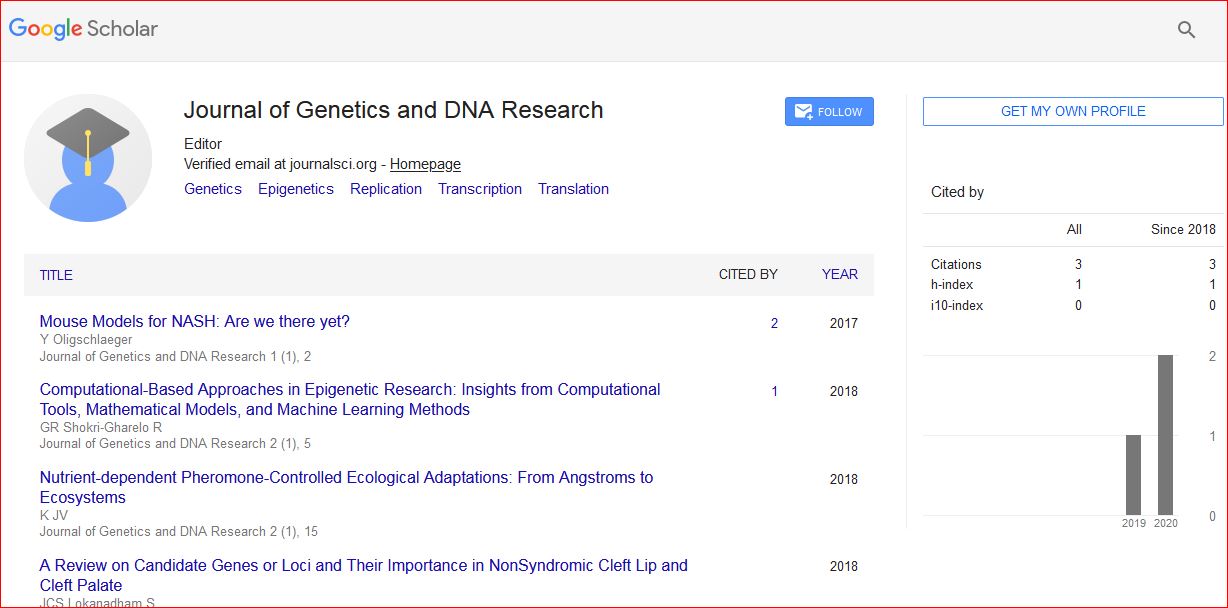
Journal of Genetics and DNA Research received 3 citations as per Google Scholar report