Brief Report - (2025) Volume 13, Issue 2
Received: 01-Apr-2025, Manuscript No. jaat-26-183145;
Editor assigned: 03-Apr-2025, Pre QC No. P-183145;
Reviewed: 17-Apr-2025, QC No. Q-183145;
Revised: 22-Apr-2025, Manuscript No. R-183145;
Published:
29-Apr-2025
, DOI: 10.37421/2329-6542.2025.13.344
Citation: Al‑Zuhair, Amina. ”Unraveling Dark Energy and Dark Matter’s Mysteries.” J Astrophys Aerospace Technol 13 (2025):344.
Copyright: © 2025 Al‑Zuhair A. This is an open-access article distributed under the terms of the Creative Commons Attribution License, which permits unrestricted use, distribution and reproduction in any medium, provided the original author and source are credited.
The universe's accelerating expansion, a phenomenon attributed to dark energy, alongside the gravitational dominance of dark matter, constitutes two of the most significant enigmas in modern cosmology. The confluence of observational data derived from the cosmic microwave background radiation, the large-scale structure of the cosmos, and observations of distant supernovae consistently underscores a universe predominantly shaped by these mysterious constituents. Theoretical endeavors are actively investigating potential candidates for dark matter, including weakly interacting massive particles (WIMPs) and axions, while the models for dark energy encompass a spectrum from a simple cosmological constant to more complex dynamic scalar fields. A comprehensive understanding of these phenomena is indispensable for formulating a complete picture of cosmic evolution and its ultimate fate [1].
Recent breakthroughs in observational cosmology, particularly those facilitated by the James Webb Space Telescope and extensive ground-based surveys, are instrumental in refining our comprehension of dark matter distribution and the intrinsic properties of dark energy. These advanced observations are rigorously testing fundamental cosmological models and are progressively imposing more stringent constraints on alternative theoretical frameworks. The synergistic interplay between theoretical particle physics and empirical astrophysical observations is paramount to unraveling the fundamental nature of these elusive dark components [2].
The prevailing standard cosmological model, known as Î?CDM, operates under the fundamental assumptions that dark energy is characterized by a cosmological constant (Î?) and that dark matter is cold and non-interacting. However, persistent discrepancies within this model, such as the observed tension in the Hubble constant measurements, serve as a powerful impetus for exploring alternative cosmological scenarios. These investigations include the examination of modified gravity theories and dynamic dark energy models, both of which are undergoing intense scrutiny through the analysis of new observational datasets [3].
Direct detection experiments meticulously designed to identify dark matter particles are progressively pushing the boundaries of experimental sensitivity. These efforts are focused on searching for faint interactions between WIMPs or other proposed dark matter candidates and ordinary matter. Complementary approaches, such as indirect detection, which involves observing the annihilation or decay products of dark matter in astrophysical environments, and collider searches, offer further avenues for discovery and characterization [4].
The statistical analysis of data obtained from cosmic shear measurements and galaxy clustering phenomena provides exceptionally powerful constraints on the properties of dark matter and the equation of state governing dark energy. Upcoming cosmological surveys are poised to significantly enhance the precision of these critical measurements, thereby enabling more stringent tests of established cosmological models and facilitating a more robust search for deviations from the predictions of standard physics [5].
Axion-like particles have emerged as a leading theoretical candidate for the composition of dark matter, originating from theoretical extensions to the Standard Model of particle physics. Current theoretical frameworks are actively exploring the mechanisms by which these particles could have been produced in the early universe and their potential interactions with photons and ordinary matter, the signatures of which could be detectable through various astrophysical and laboratory-based experiments [6].
The potential interaction between dark matter and dark energy, if such an interaction exists, represents a vibrant and active area of theoretical investigation. Cosmological models that propose such interactions offer a compelling possibility for alleviating some of the observed tensions within the standard Î?CDM framework, thereby opening up new avenues for understanding the universe's expansion history and its large-scale structure formation processes [7].
Gravitational lensing, encompassing both strong and weak lensing phenomena, stands as an exceptionally powerful observational tool for meticulously mapping the distribution of dark matter throughout the cosmos. Detailed studies of galaxy clusters and the cosmic web, employing sophisticated lensing techniques, yield intricate insights into the structure and intrinsic properties of dark matter halos, providing robust and independent constraints on theoretical dark matter models [8].
The fundamental nature of dark energy continues to pose one of the most profound and pressing questions in contemporary cosmology. While the cosmological constant remains the most parsimonious explanation consistent with current data, observational evidence also accommodates more intricate models. These include theories such as quintessence or phantom energy, which posit evolving dark energy fields characterized by distinct equations of state [9].
The concerted development of precision cosmological probes, exemplified by instruments such as the Dark Energy Spectroscopic Instrument (DESI) and the Vera C. Rubin Observatory, is heralding a transformative era in our ability to study the intricate large-scale structure of the universe. These advanced instruments are expected to deliver unprecedented datasets, crucial for constraining the properties of dark matter and dark energy with significantly improved accuracy and for rigorously testing fundamental physics [10].
The universe's accelerating expansion, driven by dark energy, and the gravitational influence of dark matter are two of the most profound mysteries in cosmology. Observational evidence from cosmic microwave background radiation, large-scale structure, and supernovae consistently points to a universe dominated by these enigmatic components. Theoretically, ongoing research explores potential candidates for dark matter, such as weakly interacting massive particles (WIMPs) and axions, while dark energy models range from a cosmological constant to dynamic scalar fields. Understanding these phenomena is crucial for a complete picture of cosmic evolution and fate [1].
Recent advancements in observational cosmology, particularly from the James Webb Space Telescope and ground-based surveys, are refining our understanding of dark matter distribution and the properties of dark energy. These observations are testing fundamental cosmological models and placing tighter constraints on alternative theories. The interplay between theoretical particle physics and astrophysical observations is key to deciphering the nature of these dark components [2].
The standard cosmological model (Î?CDM) assumes dark energy is a cosmological constant (Î?) and dark matter is cold and collisionless. However, tensions in the model, such as the Hubble constant discrepancy, motivate exploration of alternative scenarios. This includes modified gravity theories and dynamic dark energy models, which are being scrutinized by new datasets [3].
Direct detection experiments for dark matter particles are pushing the sensitivity limits, searching for faint interactions of WIMPs or other proposed candidates with ordinary matter. Indirect detection, through the observation of annihilation or decay products of dark matter in astrophysical environments, and collider searches also provide complementary avenues for discovery [4].
The statistical analysis of cosmic shear and galaxy clustering data provides powerful constraints on dark matter properties and the equation of state of dark energy. Upcoming surveys aim to significantly improve the precision of these measurements, enabling stringent tests of cosmological models and the search for deviations from standard physics [5].
Axion-like particles are a leading candidate for dark matter, arising from extensions to the Standard Model. Theoretical frameworks explore their production mechanisms in the early universe and their potential interactions with photons and matter, which could be probed by various astrophysical and laboratory experiments [6].
The interaction between dark matter and dark energy, if any, is an active area of theoretical investigation. Models proposing such interactions could potentially alleviate some of the cosmological tensions observed in the Î?CDM framework, offering new avenues for understanding the universe's expansion history and structure formation [7].
Gravitational lensing, both strong and weak, serves as a powerful tool to map the distribution of dark matter in the universe. Studies of galaxy clusters and the cosmic web using lensing techniques provide detailed insights into the structure and properties of dark matter halos, offering robust constraints on dark matter models [8].
The nature of dark energy remains one of the most pressing questions in modern cosmology. While the cosmological constant is the simplest explanation, observational data also allow for more complex models, such as quintessence or phantom energy, which describe evolving dark energy fields with different equations of state [9].
The development of precision cosmological probes, such as the Dark Energy Spectroscopic Instrument (DESI) and the Vera C. Rubin Observatory, is revolutionizing our ability to study the large-scale structure of the universe. These instruments will provide unprecedented data to constrain dark matter and dark energy properties and test fundamental physics with greater accuracy [10].
Cosmology is grappling with two major mysteries: the accelerating expansion driven by dark energy and the gravitational dominance of dark matter. Observational evidence from cosmic microwave background radiation, large-scale structure, and supernovae consistently supports a universe dominated by these unknown components. Theoretical research is exploring candidates like WIMPs and axions for dark matter, and models for dark energy range from the cosmological constant to dynamic fields. Recent astronomical observations are refining our understanding of these dark components and testing cosmological models. Tensions in the standard Î?CDM model are prompting exploration of alternative theories, including modified gravity and dynamic dark energy. Various experimental approaches, from direct and indirect dark matter detection to gravitational lensing and future surveys like DESI and the Vera C. Rubin Observatory, are being employed to probe their nature and properties.
None
None
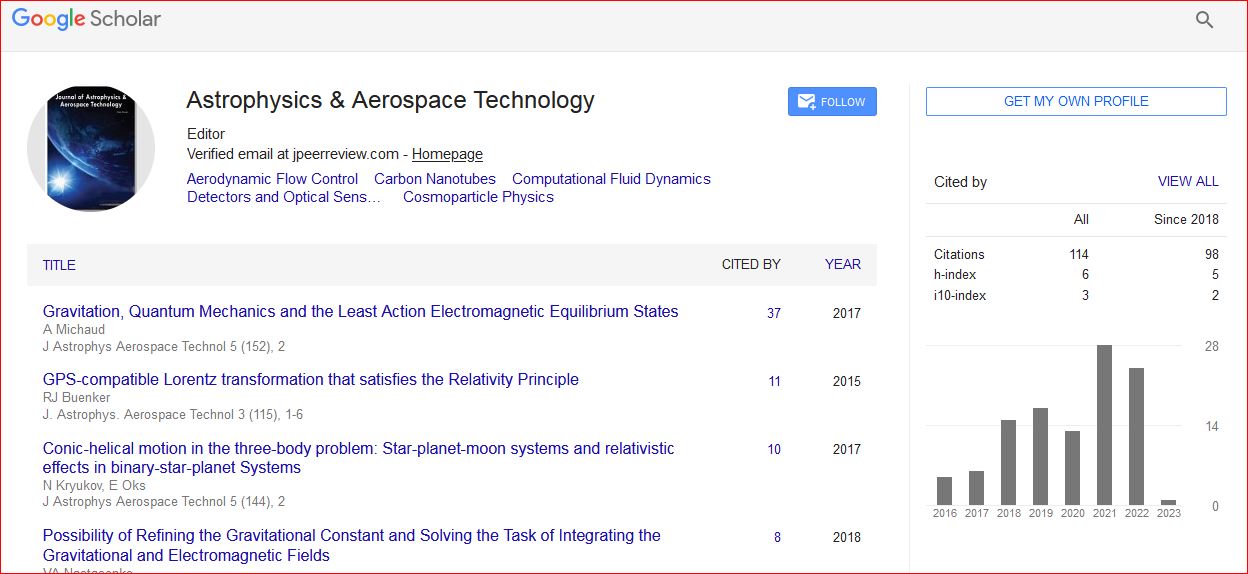
Astrophysics & Aerospace Technology received 114 citations as per Google Scholar report